



 Chat with AI
Exam 40: Nuclear Physics

Exam 1: Overview64 Questions
Exam 2: Motion in a Straight Line81 Questions
Exam 3: Motion in Two and Three Dimensions73 Questions
Exam 4: Force86 Questions
Exam 5: Kinetic Energy, work, and Power70 Questions
Exam 6: Potential Energy and Energy Conservation79 Questions
Exam 7: Momentum and Collisions82 Questions
Exam 8: Systems of Particles and Extended Objects62 Questions
Exam 9: Circular Motion78 Questions
Exam 10: Rotation78 Questions
Exam 11: Static Equilibrium60 Questions
Exam 12: Gravitation73 Questions
Exam 13: Solids and Fluids81 Questions
Exam 14: Oscillations66 Questions
Exam 15: Waves61 Questions
Exam 16: Sound60 Questions
Exam 17: Temperature61 Questions
Exam 18: Heat and the First Law of Thermodynamics67 Questions
Exam 19: Ideal Gases82 Questions
Exam 20: The Second Law of Thermodynamics64 Questions
Exam 21: Electrostatics70 Questions
Exam 22: Electric Fields and Gausss Law74 Questions
Exam 23: Electric Potential75 Questions
Exam 24: Capacitors78 Questions
Exam 25: Current and Resistance80 Questions
Exam 26: Direct Current Circuits63 Questions
Exam 27: Magnetism72 Questions
Exam 28: Magnetic Fields of Moving Charges58 Questions
Exam 29: Electromagnetic Induction85 Questions
Exam 30: Alternating Current Circuits78 Questions
Exam 31: Electromagnetic Waves74 Questions
Exam 32: Geometric Optics63 Questions
Exam 33: Lenses and Optical Instruments77 Questions
Exam 34: Wave Optics76 Questions
Exam 35: Relativity61 Questions
Exam 36: Quantum Physics68 Questions
Exam 37: Quantum Mechanics67 Questions
Exam 38: Atomic Physics72 Questions
Exam 39: Elementary Particle Physics59 Questions
Exam 40: Nuclear Physics77 Questions
Select questions type


How large is the electrostatic repulsion between two protons a distance d = 6.7 fm apart in a nucleus?
(Multiple Choice)
4.8/5  (92)
(92) If protons decay with a half-life of 1030 years,how long will it take for 1% of the protons in the universe to decay?
(Multiple Choice)
4.9/5 (78)
(78) What is the binding energy of 56Fe? The atomic mass of 56Fe is 55.9349 u,the mass of a proton = 1.0078 u,the mass of a neutron = 1.0087 u,the atomic number Z = 26 and the atomic mass A = 56.
(Multiple Choice)
4.8/5 (81)
(81) 
An archeologist discovers the bones of a person who appeared to have been dead a very long time.Using carbon dating,they determine that the rate of change of the  is 0.259 Bq per gram of carbon for the bones.The rate of change of
 is 0.270 Bq per gram of carbon for the bones of a person who had just died.How old are the bones? The half life of
 is 5.73 x 10³ y.
is 0.259 Bq per gram of carbon for the bones.The rate of change of is 0.270 Bq per gram of carbon for the bones of a person who had just died.How old are the bones? The half life of is 5.73 x 10³ y. (Multiple Choice)
4.8/5 (73)
(73) Calculate the binding energy for  ,which consists of 92 protons,92 electrons,and 146 neutrons with a total mass of 238.0507826 u.
 (Multiple Choice)
4.8/5 (67)
(67) A nuclear fission power plant consumes 7.11 kg of 235U each day to produce electrical power.Assume that the plant has an overall efficiency of 40.0% and that each fission produces 200.0 MeV of energy.Calculate the power output of the nuclear fission power plant.
(Multiple Choice)
4.8/5 (90)
(90) A drug containing  ( t 1/2 = 6.05 h)with an activity of 2.00 Ci is to be injected into a patient at 11:00 am.A sample is prepared 4.00 hours before the injection (at 7:00 am).What activity should the drug have at the preparation time (7:00 am)?
 (Multiple Choice)
4.8/5 (86)
(86) The rate of change of  is 0.270 Bq per gram of carbon for the bones of a person who had just died.What is the decay constant? The half life of
 is 5.73 *103 y-1.
is 0.270 Bq per gram of carbon for the bones of a person who had just died.What is the decay constant? The half life of is 5.73 *103 y-1. (Multiple Choice)
4.8/5 (90)
(90) If the Fermi energy of a neutron inside a nucleus is 38 MeV,estimate the maximum speed with which it moves around inside the nucleus.
(Multiple Choice)
4.9/5 (85)
(85) If 1030 atoms of a radioactive sample remain after 10 half-lives,how many atoms remain after 20 half-lives?
(Multiple Choice)
4.8/5 (80)
(80) A certain radioactive isotope decays to one sixteenth of its original amount in 4.0 hours.What is its mean lifetime?
(Multiple Choice)
4.9/5 (81)
(81) Calculate the binding energy per nucleon for  ,which consists of 92 protons,92 electrons,and 146 neutrons with a total mass of 238.0507826 u.
 (Multiple Choice)
4.8/5 (79)
(79) Which elements have the most stable nuclei because they have the greatest binding energy per nucleon?
(Multiple Choice)
4.8/5 (73)
(73) Consider a hypothetical fission process where a  nucleus splits into two identical
 nuclei without producing any other particles or radiation.The mass of
 is 119.904040 u,and the mass of
 is 59.934078 u.At the moment when the two Fe nuclei form,but before they start moving away due to Coulomb repulsion,how far apart are the two Fe nuclei?
nucleus splits into two identical nuclei without producing any other particles or radiation.The mass of is 119.904040 u,and the mass of is 59.934078 u.At the moment when the two Fe nuclei form,but before they start moving away due to Coulomb repulsion,how far apart are the two Fe nuclei? (Multiple Choice)
4.7/5 (96)
(96) A radioactive isotope has a lifetime of 6.30 min.If you begin with a sample of 2.50 moles of this isotope,how many atoms have you left after one hour?
(Multiple Choice)
4.9/5 (84)
(84) A radioactive isotope has a lifetime of 6.30 min.If you begin with a sample of this isotope and there are 2.05 * 1021 atoms left after one hour,how many moles were in your initial sample?
(Multiple Choice)
4.8/5 (82)
(82) The fusion reaction: 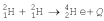 releases 23.85 MeV of energy.World power consumption is about 1013 W and 0.0300% of ocean water contains deuterium,
 .If the deuterium in the ocean water were fused by controlled fusion with 100% efficiency,how much water would be needed every second to cover world's power consumption?
releases 23.85 MeV of energy.World power consumption is about 1013 W and 0.0300% of ocean water contains deuterium, .If the deuterium in the ocean water were fused by controlled fusion with 100% efficiency,how much water would be needed every second to cover world's power consumption? (Multiple Choice)
4.8/5 (72)
(72) What is the decay constant for 14C? Carbon 14 has a half-life of 5730 years?
(Multiple Choice)
4.8/5 (74)
(74) 
Filters
- Essay(0)
- Multiple Choice(0)
- Short Answer(0)
- True False(0)
- Matching(0)