



 Chat with AI
Exam 10: Capital Budgeting Techniques

Exam 1: The Role of Managerial Finance134 Questions
Exam 2: The Financial Market Environment91 Questions
Exam 3: Financial Statements and Ratio Analysis208 Questions
Exam 4: Cash Flow and Financial Planning185 Questions
Exam 5: Time Value of Money173 Questions
Exam 6: Interest Rates and Bond Valuation224 Questions
Exam 7: Stock Valuation188 Questions
Exam 8: Risk and Return188 Questions
Exam 9: The Cost of Capital137 Questions
Exam 10: Capital Budgeting Techniques167 Questions
Exam 11: Capital Budgeting Cash Flows117 Questions
Exam 12: Risk and Refinements in Capital Budgeting106 Questions
Exam 13: Leverage and Capital Structure217 Questions
Exam 14: Payout Policy130 Questions
Exam 15: Working Capital and Current Assets Management336 Questions
Exam 16: Current Liabilities Management171 Questions
Exam 17: Hybrid and Derivative Securities185 Questions
Exam 18: Mergers, Lbos, Divestitures, and Business Failure191 Questions
Exam 19: International Managerial Finance108 Questions
Select questions type


What is the NPV for a project if its cost of capital is 0 percent and its initial after-tax cost is $5,000,000 and it is expected to provide after-tax operating cash inflows of $1,800,000 in year 1, $1,900,000 in year 2, $1,700,000 in year 3, and $1,300,000 in year 4?
(Multiple Choice)
4.7/5  (85)
(85) A firm with a cost of capital of 13 percent is evaluating three capital projects. The internal rates of return are as follows: 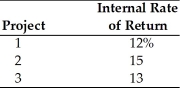 The firm should ________.
 (Multiple Choice)
4.9/5 (71)
(71) Mutually exclusive projects are those whose cash flows compete with one another; the acceptance of one eliminates the others from further consideration.
(True/False)
4.8/5 (68)
(68) The payback period of a project that costs $1,000 initially and promises after-tax cash inflows of $300 each year for the next three years is 0.333 years.
(True/False)
4.8/5 (83)
(83) The ranking approach involves the ranking of capital expenditure projects on the basis of some predetermined measure such as the rate of return.
(True/False)
4.8/5 (76)
(76) Some firms use the payback period as a decision criterion or as a supplement to sophisticated decision techniques, because ________.
(Multiple Choice)
4.9/5 (88)
(88) The NPV of a project with an initial investment of $1,000 that provides after-tax operating cash flows of $300 per year for four years where the firm's cost of capital is 15 percent is $856.49.
(True/False)
4.9/5 (82)
(82) 
Filters
- Essay(0)
- Multiple Choice(0)
- Short Answer(0)
- True False(0)
- Matching(0)