



 Chat with AI
Exam 10: Capital Budgeting Techniques

Exam 1: The Role of Managerial Finance134 Questions
Exam 2: The Financial Market Environment91 Questions
Exam 3: Financial Statements and Ratio Analysis208 Questions
Exam 4: Cash Flow and Financial Planning185 Questions
Exam 5: Time Value of Money173 Questions
Exam 6: Interest Rates and Bond Valuation224 Questions
Exam 7: Stock Valuation188 Questions
Exam 8: Risk and Return188 Questions
Exam 9: The Cost of Capital137 Questions
Exam 10: Capital Budgeting Techniques167 Questions
Exam 11: Capital Budgeting Cash Flows117 Questions
Exam 12: Risk and Refinements in Capital Budgeting106 Questions
Exam 13: Leverage and Capital Structure217 Questions
Exam 14: Payout Policy130 Questions
Exam 15: Working Capital and Current Assets Management336 Questions
Exam 16: Current Liabilities Management171 Questions
Exam 17: Hybrid and Derivative Securities185 Questions
Exam 18: Mergers, Lbos, Divestitures, and Business Failure191 Questions
Exam 19: International Managerial Finance108 Questions
Select questions type


The payback period of a project that costs $1,000 initially and promises after-tax cash inflows of $3,000 each year for the next three years is 0.333 years.
(True/False)
4.8/5  (78)
(78) Table 10.1  -The cash flow pattern depicted is associated with a capital investment and may be characterized as ________. (See Table 10.1)
 (Multiple Choice)
4.7/5 (84)
(84) Projects having higher cash inflows in the early years tend to be less sensitive to changes in the cost of capital and are therefore often acceptable at higher discount rates compared to projects with higher cash inflows that occur in the later years.
(True/False)
4.9/5 (80)
(80) Consider the following projects, X and Y where the firm can only choose one. Project X costs $600 and has cash flows of $400 in each of the next 2 years. Project Y also costs $600, and generates cash flows of $500 and $275 for the next 2 years, respectively. Which investment should the firm choose if the cost of capital is 25 percent?
(Multiple Choice)
4.8/5 (88)
(88) If a project's IRR is greater than zero, the project should be accepted.
(True/False)
4.8/5 (81)
(81) If a project's payback period is greater than the maximum acceptable payback period, we would accept it.
(True/False)
4.9/5 (91)
(91) In capital budgeting, the preferred approaches in assessing whether a project is acceptable are those that integrate time value of money, risk and return considerations, and valuation concepts to select capital expenditures that are consistent with the firm's goal of maximizing owners' wealth.
(True/False)
4.9/5 (79)
(79) What is the NPV for a project whose cost of capital is 15 percent and initial after-tax cost is $5,000,000 and is expected to provide after-tax operating cash inflows of $1,800,000 in year 1, $1,900,000 in year 2, $1,700,000 in year 3, and $1,300,000 in year 4?
(Multiple Choice)
4.7/5 (79)
(79) For calculating payback period for an annuity, all cash flows must be adjusted for time value of money.
(True/False)
5.0/5 (79)
(79) A nonconventional cash flow pattern associated with capital investment projects consists of an initial outflow followed by a series of inflows.
(True/False)
4.8/5 (98)
(98) If a firm has unlimited funds to invest in capital assets, all independent projects that meet its minimum investment criteria should be implemented.
(True/False)
5.0/5 (69)
(69) If a project's payback period is greater than the maximum acceptable payback period, we would reject it.
(True/False)
4.9/5 (70)
(70) On a purely theoretical basis, NPV is a better approach when selecting among two mutually exclusive projects.
(True/False)
4.9/5 (80)
(80) If net present value of a project is greater than zero, the firm will earn a return greater than its cost of capital. The acceptance of such a project would enhance the wealth of the firm's owners.
(True/False)
4.9/5 (73)
(73) Table 10.5
Galaxy Satellite Co. is attempting to select the best group of independent projects competing for the firm's fixed capital budget of $10,000,000. Any unused portion of this budget will earn less than its 20 percent cost of capital. A summary of key data about the proposed projects follows. 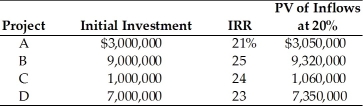 -Use the IRR approach to select the best group of projects, if the required rate of return is 23.5%. (See Table 10.5)
 (Essay)
4.9/5 (77)
(77) For conventional projects, both NPV and IRR techniques will always generate the same accept-reject decision.
(True/False)
4.8/5 (74)
(74) One of the primary motives for adding fixed assets to a firm is ________.
(Multiple Choice)
4.8/5 (79)
(79) A firm is evaluating two independent projects utilizing the internal rate of return technique. Project X has an initial investment of $80,000 and cash inflows at the end of each of the next five years of $25,000. Project Z has an initial investment of $120,000 and cash inflows at the end of each of the next four years of $40,000. The firm should ________.
(Multiple Choice)
4.9/5 (77)
(77) A firm is evaluating an investment proposal which has an initial investment of $5,000 and cash flows presently valued at $4,000. The net present value of the investment is ________.
(Multiple Choice)
4.7/5 (80)
(80) 
Filters
- Essay(0)
- Multiple Choice(0)
- Short Answer(0)
- True False(0)
- Matching(0)