



 Chat with AI
Exam 10: Capital Budgeting Techniques

Exam 1: The Role of Managerial Finance134 Questions
Exam 2: The Financial Market Environment91 Questions
Exam 3: Financial Statements and Ratio Analysis208 Questions
Exam 4: Cash Flow and Financial Planning185 Questions
Exam 5: Time Value of Money173 Questions
Exam 6: Interest Rates and Bond Valuation224 Questions
Exam 7: Stock Valuation188 Questions
Exam 8: Risk and Return188 Questions
Exam 9: The Cost of Capital137 Questions
Exam 10: Capital Budgeting Techniques167 Questions
Exam 11: Capital Budgeting Cash Flows117 Questions
Exam 12: Risk and Refinements in Capital Budgeting106 Questions
Exam 13: Leverage and Capital Structure217 Questions
Exam 14: Payout Policy130 Questions
Exam 15: Working Capital and Current Assets Management336 Questions
Exam 16: Current Liabilities Management171 Questions
Exam 17: Hybrid and Derivative Securities185 Questions
Exam 18: Mergers, Lbos, Divestitures, and Business Failure191 Questions
Exam 19: International Managerial Finance108 Questions
Select questions type


A project's net present value profile is a graph that plots a project's IRR for various discount rates.
(True/False)
4.8/5  (96)
(96) Table 10.2 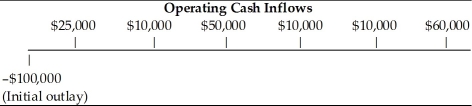 -Given the information in Table 10.2 and 15 percent cost of capital,
(a) compute the net present value.
(b) should the project be accepted?
-Given the information in Table 10.2 and 15 percent cost of capital,
(a) compute the net present value.
(b) should the project be accepted? (Essay)
4.9/5 (85)
(85) If a firm is subject to capital rationing, it has only a fixed number of dollars available for capital expenditures and numerous projects compete for these dollars.
(True/False)
4.9/5 (74)
(74) Table 10.4
A firm must choose from six capital budgeting proposals outlined below. The firm is subject to capital rationing and has a capital budget of $1,000,000; the firm's cost of capital is 15 percent. 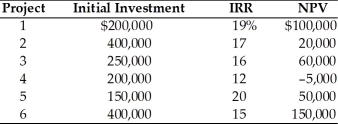 -Using the net present value approach to ranking projects, which projects should the firm accept? (See Table 10.4)
 (Multiple Choice)
4.9/5 (72)
(72) What is the NPV for a project if its cost of capital is 12 percent and its initial after-tax cost is $5,000,000 and it is expected to provide after-tax operating cash flows of $1,800,000 in year 1, $1,900,000 in year 2, $1,700,000 in year 3, and ($1,300,000) in year 4?
(Multiple Choice)
5.0/5 (78)
(78) An internal rate of return greater than the cost of capital guarantees that the firm will earn at least its required return.
(True/False)
4.9/5 (81)
(81) A sophisticated capital budgeting technique that can be computed by solving for the discount rate that equates the present value of a project's inflows to the present value of its outflows is called internal rate of return.
(True/False)
4.7/5 (81)
(81) Should Tangshan Mining company accept a new project if its maximum payback is 3.25 years and its initial after-tax cost is $5,000,000 and it is expected to provide after-tax operating cash inflows of $1,800,000 in year 1, $1,900,000 in year 2, $700,000 in year 3, and $1,800,000 in year 4?
(Multiple Choice)
4.9/5 (81)
(81) The financial decision makers find NPV more intuitive because it measures benefits relative to the amount invested.
(True/False)
4.7/5 (92)
(92) One weakness of payback period approach is its failure to recognize cash flows that occur after the payback period.
(True/False)
4.7/5 (84)
(84) If a project's IRR is greater than 0 percent, the project should be accepted.
(True/False)
4.7/5 (73)
(73) Independent projects are those whose cash flows compete with one another and therefore more than one project needs to be accepted in order to implement the capital budgeting decision.
(True/False)
4.9/5 (79)
(79) The capital budgeting process consists of five distinct but interrelated steps: proposal generation, review and analysis, decision making, implementation, and follow-up.
(True/False)
4.9/5 (78)
(78) Table 10.4
A firm must choose from six capital budgeting proposals outlined below. The firm is subject to capital rationing and has a capital budget of $1,000,000; the firm's cost of capital is 15 percent.
-Using the internal rate of return approach to ranking projects, which project(s) should the firm accept? (See Table 10.4)
-Using the internal rate of return approach to ranking projects, which project(s) should the firm accept? (See Table 10.4) (Multiple Choice)
4.8/5 (93)
(93) Which of the following statements is true of payback period?
(Multiple Choice)
5.0/5 (73)
(73) Comparing net present value and internal rate of return ________.
(Multiple Choice)
4.8/5 (75)
(75) If the NPV is less than the initial investment, a project should be rejected.
(True/False)
4.8/5 (68)
(68) Table 10.5
Galaxy Satellite Co. is attempting to select the best group of independent projects competing for the firm's fixed capital budget of $10,000,000. Any unused portion of this budget will earn less than its 20 percent cost of capital. A summary of key data about the proposed projects follows. 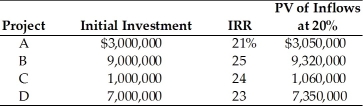 -Which projects should the firm implement? (See Table 10.5)
 (Short Answer)
4.9/5 (77)
(77) Economic value added is the difference between an investment's net operating profit after taxes and the accounting profit.
(True/False)
4.9/5 (85)
(85) A firm can accept a project with a net present value of zero because ________.
(Multiple Choice)
4.9/5 (86)
(86) 
Filters
- Essay(0)
- Multiple Choice(0)
- Short Answer(0)
- True False(0)
- Matching(0)