



 Chat with AI
Exam 10: Capital Budgeting Techniques

Exam 1: The Role of Managerial Finance134 Questions
Exam 2: The Financial Market Environment91 Questions
Exam 3: Financial Statements and Ratio Analysis208 Questions
Exam 4: Cash Flow and Financial Planning185 Questions
Exam 5: Time Value of Money173 Questions
Exam 6: Interest Rates and Bond Valuation224 Questions
Exam 7: Stock Valuation188 Questions
Exam 8: Risk and Return188 Questions
Exam 9: The Cost of Capital137 Questions
Exam 10: Capital Budgeting Techniques167 Questions
Exam 11: Capital Budgeting Cash Flows117 Questions
Exam 12: Risk and Refinements in Capital Budgeting106 Questions
Exam 13: Leverage and Capital Structure217 Questions
Exam 14: Payout Policy130 Questions
Exam 15: Working Capital and Current Assets Management336 Questions
Exam 16: Current Liabilities Management171 Questions
Exam 17: Hybrid and Derivative Securities185 Questions
Exam 18: Mergers, Lbos, Divestitures, and Business Failure191 Questions
Exam 19: International Managerial Finance108 Questions
Select questions type


A firm is evaluating a proposal which has an initial investment of $35,000 and has cash flows of $10,000 in year 1, $20,000 in year 2, and $10,000 in year 3. The payback period of the project is ________.
(Multiple Choice)
4.8/5  (74)
(74) The purchase of additional physical facilities, such as additional property or a new factory, is an example of a capital expenditure.
(True/False)
4.8/5 (79)
(79) The final step in the capital budgeting process is ________.
(Multiple Choice)
4.9/5 (85)
(85) A sophisticated capital budgeting technique that can be computed by subtracting a project's initial investment from the present value of its cash inflows discounted at a rate equal to a firm's cost of capital is called net present value.
(True/False)
4.8/5 (95)
(95) The IRR is the discount rate that equates the NPV of an investment opportunity with $0.
(True/False)
4.9/5 (71)
(71) If a project's IRR is greater than the cost of capital, the project should be rejected.
(True/False)
4.7/5 (82)
(82) The accept-reject approach involves the ranking of capital expenditure projects on the basis of some predetermined measure, such as the rate of return.
(True/False)
4.9/5 (77)
(77) The capital budgeting process consists of four distinct but interrelated steps: proposal generation, review and analysis, decision making, and termination.
(True/False)
4.7/5 (71)
(71) Capital expenditure proposals are reviewed to assess their appropriateness in light of a firm's overall objectives and plans, and to evaluate their economic validity.
(True/False)
5.0/5 (96)
(96) The ________ is the compound annual rate of return that a firm will earn if it invests in the project and receives the given cash inflows.
(Multiple Choice)
4.8/5 (78)
(78) The internal rate of return assumes that a project's intermediate cash inflows are reinvested at a rate equal to the firm's cost of capital.
(True/False)
4.9/5 (76)
(76) If a project's payback period is less than the maximum acceptable payback period, we would accept it.
(True/False)
4.7/5 (77)
(77) The appeal of the IRR technique is due to the general disposition of business people to think in terms of rates of return rather than actual dollar returns.
(True/False)
4.8/5 (68)
(68) Table 10.3
A firm is evaluating two projects that are mutually exclusive with initial investments and cash flows as follows: 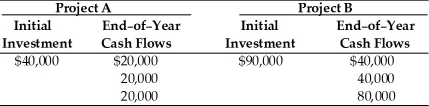 -If the firm in Table 10.3 has a required payback of two years, it should ________.
 (Multiple Choice)
4.8/5 (69)
(69) The payback period of a project that costs $1,000 initially and promises after-tax cash inflows of $2,000 each year for the next three years is 0.5 years.
(True/False)
4.8/5 (72)
(72) Table 10.2  -The cash flow pattern depicted is associated with a capital investment and may be characterized as ________. (See Table 10.2)
 (Multiple Choice)
4.9/5 (65)
(65) The primary motive for capital expenditures is to refurbish fixed assets.
(True/False)
4.9/5 (78)
(78) 
Filters
- Essay(0)
- Multiple Choice(0)
- Short Answer(0)
- True False(0)
- Matching(0)