



 Chat with AI
Exam 10: Capital Budgeting Techniques

Exam 1: The Role of Managerial Finance134 Questions
Exam 2: The Financial Market Environment91 Questions
Exam 3: Financial Statements and Ratio Analysis208 Questions
Exam 4: Cash Flow and Financial Planning185 Questions
Exam 5: Time Value of Money173 Questions
Exam 6: Interest Rates and Bond Valuation224 Questions
Exam 7: Stock Valuation188 Questions
Exam 8: Risk and Return188 Questions
Exam 9: The Cost of Capital137 Questions
Exam 10: Capital Budgeting Techniques167 Questions
Exam 11: Capital Budgeting Cash Flows117 Questions
Exam 12: Risk and Refinements in Capital Budgeting106 Questions
Exam 13: Leverage and Capital Structure217 Questions
Exam 14: Payout Policy130 Questions
Exam 15: Working Capital and Current Assets Management336 Questions
Exam 16: Current Liabilities Management171 Questions
Exam 17: Hybrid and Derivative Securities185 Questions
Exam 18: Mergers, Lbos, Divestitures, and Business Failure191 Questions
Exam 19: International Managerial Finance108 Questions
Select questions type


The payback period of a project that costs $1,000 initially and promises after-tax cash inflows of $300 for the next three years is 3.33 years.
(True/False)
4.9/5  (76)
(76) Research and development is considered to be a motive for making capital expenditures.
(True/False)
4.7/5 (84)
(84) Unlike the net present value criteria, the internal rate of return approach assumes a reinvestment rate equal to ________.
(Multiple Choice)
4.8/5 (70)
(70) Which of the following capital budgeting techniques ignores the time value of money?
(Multiple Choice)
4.9/5 (73)
(73) A capital expenditure is an outlay of funds invested only in fixed assets that is expected to produce benefits over a period of time less than one year.
(True/False)
4.8/5 (82)
(82) Payback is considered an unsophisticated capital budgeting because it ________.
(Multiple Choice)
5.0/5 (89)
(89) Mutually exclusive projects are those whose cash flows are constant over a specified period of time and more than one project needs to be accepted in order to implement capital budgeting decisions.
(True/False)
4.9/5 (69)
(69) The discount rate is the minimum return that must be earned on a project to leave a firm's market value unchanged.
(True/False)
4.9/5 (80)
(80) The major weakness of payback period in evaluating projects is that it cannot specify the appropriate payback period in light of the wealth maximization goal.
(True/False)
4.9/5 (71)
(71) A conventional cash flow pattern associated with capital investment projects consists of an initial ________.
(Multiple Choice)
4.7/5 (82)
(82) Which of the following is a disadvantage of payback period approach?
(Multiple Choice)
4.8/5 (82)
(82) Which of the following is a reason for firms not using the payback method as a guideline in capital investment decisions?
(Multiple Choice)
4.8/5 (82)
(82) The minimum return that must be earned on a project in order to leave the firm's value unchanged is ________.
(Multiple Choice)
4.8/5 (73)
(73) A firm with limited dollars available for capital expenditures is subject to ________.
(Multiple Choice)
4.8/5 (70)
(70) If a firm is subject to capital rationing, it is able to accept all independent projects that provide an acceptable return.
(True/False)
4.8/5 (85)
(85) Table 10.1 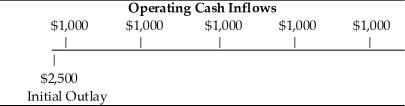 -Given the information in Table 10.1 and 15 percent cost of capital,
(a) compute the net present value.
(b) should the project be accepted?
-Given the information in Table 10.1 and 15 percent cost of capital,
(a) compute the net present value.
(b) should the project be accepted? (Essay)
4.8/5 (96)
(96) A sophisticated capital budgeting technique that can be computed by solving for the discount rate that equates the present value of a project's inflows to the present value of its outflows is called net present value.
(True/False)
4.7/5 (81)
(81) Tangshan Mining Company is considering investing in a new mining project. The firm's cost of capital is 12 percent and the project is expected to have an initial after-tax cost of $5,000,000. Furthermore, the project is expected to provide after-tax operating cash flows of $2,500,000 in year 1, $2,300,000 in year 2, $2,200,000 in year 3, and ($1,300,000) in year 4?
(a) Calculate the project's NPV.
(b) Calculate the project's IRR.
(c) Should the firm make the investment?
(Essay)
4.8/5 (68)
(68) A nonconventional cash flow pattern is one in which an initial inflow is followed by a series of inflows and outflows.
(True/False)
4.8/5 (69)
(69) 
Filters
- Essay(0)
- Multiple Choice(0)
- Short Answer(0)
- True False(0)
- Matching(0)