



 Chat with AI
Exam 10: The Order Entrysales Oesprocess

Exam 1: Introduction to Accounting Information Systems122 Questions
Exam 2: Enterprise Systems141 Questions
Exam 3: Electronic Business E-Business-Systems121 Questions
Exam 4: Documenting Information Systems124 Questions
Exam 5: Database Management Systems175 Questions
Exam 6: Relational Databases and SQL102 Questions
Exam 7: Controlling Information Systems: Introduction to Enterprise Risk Management and Internal Control159 Questions
Exam 8: Controlling Information Systems: Introduction to Pervasive Controls159 Questions
Exam 9: Controlling Information Systems: Business Process and Application Controls134 Questions
Exam 10: The Order Entrysales Oesprocess133 Questions
Exam 11: The Billingaccounts Receivablecash Receipts Barcrprocess134 Questions
Exam 12: The Purchasing Process140 Questions
Exam 13: The Accounts Payablecash Disbursements Apcdprocess118 Questions
Exam 14: The Human Resources Process Hrmanagement and Payroll Processes121 Questions
Exam 15: Integrated Production Processes IPP118 Questions
Exam 16: The General Ledger and Business Reporting Glbrprocess106 Questions
Exam 17: Acquiring and Implementing Accounting Information Systems206 Questions
Select questions type


Below is a narrative of the "Validate sales order" portion of the order entry/sales process.
Narrative Description
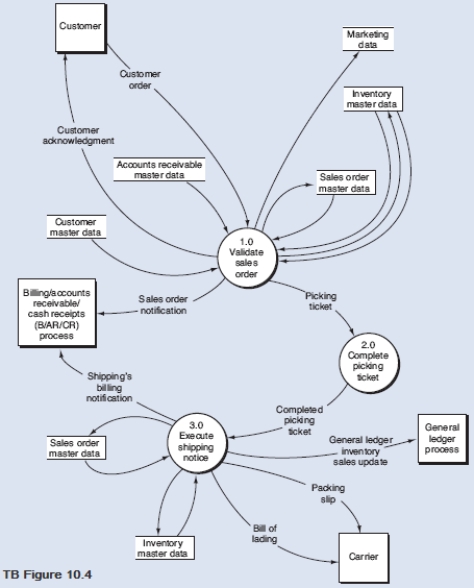
How does the OE/S process then validate a customer order? First,process 1.1 verifies the availability of the requested inventory by consulting the inventory master data.If a sufficient level of inventory is on hand to satisfy the request,the order is forwarded for further processing,as depicted by the data flow "Inventory available order." Conversely,if a customer orders goods that are not in stock,process 1.1 runs a special back order routine.This routine determines the inventory requirement necessary to satisfy the order and then sends the back order request to the purchasing department.This activity is depicted by the "Back order" data flow,which in reality is a specific type of exception routine (i.e. ,a specific type of reject stub).If the customer refuses to accept a back order,then the sales event is terminated and the order is rejected,as shown by the "Reject" data flow.Information from the order (e.g. ,sales region,customer demographics,and order characteristics that reflect buying habits)that has potential value to marketing is recorded in the marketing data store.
After assuring inventory availability,process 1.2 establishes the customer's existence and then evaluates credit.The credit check adds the amount of the order to accounts receivable balances and open sales orders (i.e. ,orders about to be receivables),and compare that total to the credit limit.If the customer has exceeded their credit limit,the order is rejected.
Upon a successful credit approval,process 1.3 performs the following activities simultaneously:
 Required:
From the DFD in TB Figure 10.4 and the narrative description above,explode bubble 1.0 into a lower-level diagram showing the details of that process by identifying the words that belong in items 1 to 18 (TB Figure 10.5).

Required:
From the DFD in TB Figure 10.4 and the narrative description above,explode bubble 1.0 into a lower-level diagram showing the details of that process by identifying the words that belong in items 1 to 18 (TB Figure 10.5).
(Essay)
4.8/5  (85)
(85) When the sales-related data are captured in the sales order department and then the information flows to the managers housed in the marketing department,it is an example of a:
(Multiple Choice)
4.9/5 (67)
(67) In constructing a control matrix for an OE/S process,the principal data input(s)to the information system likely would be:
(Multiple Choice)
4.8/5 (82)
(82) ____ applications in organizations are usually viewed as being focused on either operational or analytical applications.
(Multiple Choice)
4.9/5 (77)
(77) Assuming that we separate the shipping and billing processes,which of the following data stores would you expect to be updated by an OE/S process called execute shipping notice?
(Multiple Choice)
4.8/5 (90)
(90) Customer credit check is a control plan that ensures that the organization protects its resources by dealing only with customers who have demonstrated an ability to satisfy their liabilities.
(True/False)
4.9/5 (69)
(69) The completed picking ticket file provides an audit trail of authorized inventory transfers made between the warehouse and the shipping department.
(True/False)
4.9/5 (75)
(75) Optical character recognition (OCR)devices use light reflection to read differences in code patterns in order to identify a labeled item.
(True/False)
4.8/5 (83)
(83) The flow of information from OE/S to marketing managers is an example of horizontal information flows.
(True/False)
4.8/5 (73)
(73) A valid shipping notice input is one that is supported by both:
(Multiple Choice)
4.8/5 (78)
(78) When a customer service representative enters data into the OE/S system,the first screen prompt is usually for the customer number.
(True/False)
4.8/5 (86)
(86) ______________________________ is used to recognize patterns of handwritten or printed characters.
(Essay)
4.8/5 (91)
(91) ______________________________ are sent to customers to notify them that their orders have been accepted and to inform them of the expected shipping date.
(Essay)
4.8/5 (76)
(76) In the ER diagram for OE/S,STOCK_PICK triggers ______________________________.
(Essay)
4.9/5 (70)
(70) The first step in the OE/S process is typically a data flow from a(n)______________________________.
(Essay)
4.9/5 (77)
(77) In addition to the warehousing function,the three primary departments that you would expect to be part of a typical OE/S process are:
(Multiple Choice)
4.9/5 (81)
(81) When a source document provides authority for a business activity to occur,the source document is said to ______________________________ the activity.
(Essay)
5.0/5 (80)
(80) A packing slip authorizes the warehouse to remove goods from the warehouse and send them to the shipping department.
(True/False)
4.8/5 (88)
(88) If a check of the inventory master data shows that the goods requested on a customer order are not in stock,an exception routine called a(n)______________________________ process is initiated.
(Essay)
4.9/5 (83)
(83) 
Filters
- Essay(0)
- Multiple Choice(0)
- Short Answer(0)
- True False(0)
- Matching(0)