



 Chat with AI
Exam 16: Acid-Base Equilibria

Exam 1: Introduction: Matter and Measurement163 Questions
Exam 2: Atoms, Molecules, and Ions250 Questions
Exam 3: Stoichiometry: Calculations With Chemical Formulas and Equations178 Questions
Exam 4: Aqueous Reactions and Solution Stoichiometry180 Questions
Exam 5: Thermochemistry154 Questions
Exam 6: Electronic Structure of Atoms186 Questions
Exam 7: Periodic Properties of the Elements176 Questions
Exam 8: Basic Concepts of Chemical Bonding147 Questions
Exam 9: Molecular Geometry and Bonding Theories183 Questions
Exam 10: Gases175 Questions
Exam 11: Liquids and Intermolecular Forces124 Questions
Exam 12: Solids and Modern Materials84 Questions
Exam 13: Properties of Solutions160 Questions
Exam 14: Chemical Kinetics134 Questions
Exam 15: Chemical Equilibrium97 Questions
Exam 16: Acid-Base Equilibria139 Questions
Exam 17: Additional Aspects of Aqueous Equilibria116 Questions
Exam 18: Chemistry of the Environment126 Questions
Exam 19: Chemical Thermodynamics125 Questions
Exam 20: Electrochemistry114 Questions
Exam 21: Nuclear Chemistry178 Questions
Exam 22: Chemistry of the Nonmetals194 Questions
Exam 23: Transition Metals and Coordination Chemistry165 Questions
Exam 24: The Chemistry of Life: Organic and Biological Chemistry131 Questions
Select questions type


What is the pH of an aqueous solution at 25.0 °C that contains 3.98 × 10⁻⁹ M hydronium ion?
(Multiple Choice)
4.7/5  (78)
(78) Calculate the molarity of hydroxide ion in an aqueous solution that has a pOH of 3.00.
(Multiple Choice)
4.9/5 (85)
(85) The Ka of acetic acid (HC2H3O2)is 1.8 × 10⁻⁵. What is the pH at 25.0 °C of an aqueous solution that is 0.100 M in acetic acid?
(Multiple Choice)
4.9/5 (83)
(83) Determine the pH of a 0.35 M aqueous solution of CH3NH2 (methylamine). The Kb of methylamine is 4.4 × 10⁻⁴.
(Multiple Choice)
4.8/5 (75)
(75) Using the data in the table, which of the conjugate acids below is the strongest acid? 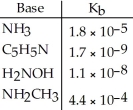
(Multiple Choice)
4.9/5 (85)
(85) What is the pH of an aqueous solution at 25.0 °C in which [H+] is 0.0015 M?
(Multiple Choice)
5.0/5 (94)
(94) A solution of ammonia is 2.0% ionized at 25.0 °C. What was the original concentration (in M)of the ammonia solution? The Kb at 25.0 °C for ammonia is 1.8 × 10⁻⁵.
(Short Answer)
4.9/5 (71)
(71) The Ka of hydrofluoric acid (HF)at 25.0 °C is 6.8 × 10⁻⁴. What is the pH of a 0.45 M aqueous solution of HF?
(Multiple Choice)
4.8/5 (68)
(68) The pH of a 0.60 M aqueous solution of formic acid, HCHO2, at 25.0 °C is 1.98. What is the value of Ka for formic acid?
(Multiple Choice)
4.9/5 (89)
(89) The molar concentration of hydronium ion in pure water at 25 °C is ________.
(Multiple Choice)
4.9/5 (85)
(85) An aqueous solution of ________ will produce an acidic solution.
(Multiple Choice)
4.7/5 (74)
(74) What is the pOH of an aqueous solution at 25.0 °C that contains 3.98 × 10⁻⁹ M hydroxide ion?
(Multiple Choice)
4.8/5 (89)
(89) Of the compounds below, a 0.1 M aqueous solution of ________ will have the highest pH.
(Multiple Choice)
4.8/5 (67)
(67) An aqueous solution contains 0.100 M NaOH at 25.0 °C. The pH of the solution is ________.
(Multiple Choice)
4.9/5 (78)
(78) The Ka of hydrazoic acid (HN3)is 1.9 × 10⁻⁵ at 25.0 °C. What is the pH of a 0.15 M aqueous solution of HN3?
(Multiple Choice)
4.8/5 (78)
(78) Calculate the pH of a 0.500 M aqueous solution of NH3. The Kb of NH3 is 1.77 × 10⁻⁵.
(Multiple Choice)
5.0/5 (74)
(74) Which of the following ions will act as a weak base in water?
(Multiple Choice)
4.9/5 (86)
(86) What is the pH of a sodium acetate (NaC2H3O2)solution prepared by adding 0.820 grams of sodium acetate to 100.0 ml of water at 25.0 °C? The Ka at 25.0 °C for acetic acid is 1.8 × 10⁻⁵.
(Short Answer)
4.9/5 (83)
(83) 
Filters
- Essay(0)
- Multiple Choice(0)
- Short Answer(0)
- True False(0)
- Matching(0)