



 Chat with AI
Exam 11: Liquids and Intermolecular Forces

Exam 1: Introduction: Matter and Measurement163 Questions
Exam 2: Atoms, Molecules, and Ions250 Questions
Exam 3: Stoichiometry: Calculations With Chemical Formulas and Equations178 Questions
Exam 4: Aqueous Reactions and Solution Stoichiometry180 Questions
Exam 5: Thermochemistry154 Questions
Exam 6: Electronic Structure of Atoms186 Questions
Exam 7: Periodic Properties of the Elements176 Questions
Exam 8: Basic Concepts of Chemical Bonding147 Questions
Exam 9: Molecular Geometry and Bonding Theories183 Questions
Exam 10: Gases175 Questions
Exam 11: Liquids and Intermolecular Forces124 Questions
Exam 12: Solids and Modern Materials84 Questions
Exam 13: Properties of Solutions160 Questions
Exam 14: Chemical Kinetics134 Questions
Exam 15: Chemical Equilibrium97 Questions
Exam 16: Acid-Base Equilibria139 Questions
Exam 17: Additional Aspects of Aqueous Equilibria116 Questions
Exam 18: Chemistry of the Environment126 Questions
Exam 19: Chemical Thermodynamics125 Questions
Exam 20: Electrochemistry114 Questions
Exam 21: Nuclear Chemistry178 Questions
Exam 22: Chemistry of the Nonmetals194 Questions
Exam 23: Transition Metals and Coordination Chemistry165 Questions
Exam 24: The Chemistry of Life: Organic and Biological Chemistry131 Questions
Select questions type


The shape of a liquid's meniscus is determined by ________.
(Multiple Choice)
4.9/5  (90)
(90) The substance with the largest heat of vaporization is ________.
(Multiple Choice)
4.7/5 (73)
(73) As a gaseous element condenses, the atoms become ________ and they have ________ attraction for one another.
(Multiple Choice)
4.9/5 (65)
(65) The strongest interparticle attractions exist between particles of a ________, and the weakest interparticle attractions exist between particles of a ________.
(Multiple Choice)
4.7/5 (84)
(84) For a given substance that exhibits liquid-crystalline properties, the liquid-crystalline state exists ________.
(Multiple Choice)
4.8/5 (84)
(84) Based on molecular mass and dipole moment of the five compounds in the table below, which should have the highest boiling point? 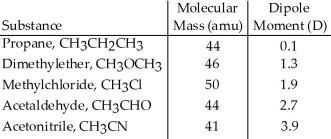
(Multiple Choice)
4.8/5 (91)
(91) A gas is ________ and assumes ________ of its container, whereas a liquid is ________ and assumes ________ of its container.
(Multiple Choice)
4.8/5 (74)
(74) Which one of the following derivatives of methane has the highest boiling point?
(Multiple Choice)
4.9/5 (67)
(67) The initial discovery of a liquid crystal resulted from studies on what compound?
(Short Answer)
4.8/5 (80)
(80)  -Based on the figure above, the boiling point of ethyl alcohol under an external pressure of 0.658 atm is ________ °C.
 (Multiple Choice)
4.8/5 (85)
(85) A substance that expands to fill its container yet has a density approaching that of a liquid, and that can behave as a solvent is called a(n)________.
(Multiple Choice)
4.8/5 (89)
(89) In general, the vapor pressure of a substance increases as ________ increases.
(Multiple Choice)
4.7/5 (86)
(86) Some things take longer to cook at high altitudes than at low altitudes because ________.
(Multiple Choice)
4.7/5 (79)
(79) Which one of the following substances will not have hydrogen bonding as one of its intermolecular forces?
(Multiple Choice)
4.9/5 (68)
(68) Of the following, ________ should have the highest critical temperature.
(Multiple Choice)
4.9/5 (77)
(77) The enthalpy change for converting 10.0 g of ice at -50.0 °C to water at 50.0 °C is ________ kJ. The specific heats of ice, water, and steam are 2.09 J/g-K, 4.18 J/g-K, and 1.84 J/g-K, respectively. For H2O, ΔHfus = 6.01 kJ/mol, and ΔHvap = 40.67 kJ/mol.
(Multiple Choice)
4.9/5 (90)
(90) 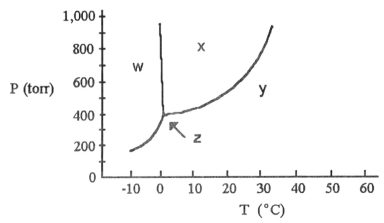 -According to the phase diagram shown above, the normal boiling point of this substance is ________ °C.
 (Multiple Choice)
4.7/5 (82)
(82) 
Filters
- Essay(0)
- Multiple Choice(0)
- Short Answer(0)
- True False(0)
- Matching(0)