



 Chat with AI
Exam 16: Lipids and Membranes

Exam 1: Measurements in Science and Medicine77 Questions
Exam 2: Atoms, Elements, and Compounds76 Questions
Exam 3: Chemical Bonds82 Questions
Exam 4: Energy and Physical Properties73 Questions
Exam 5: Solution Concentration76 Questions
Exam 6: Chemical Reactions68 Questions
Exam 7: Acids and Bases82 Questions
Exam 8: Nuclear Chemistry65 Questions
Exam 9: Hydrocarbons: An Introduction to Organic Molecules72 Questions
Exam 10: Hydration, Dehydration, and Alcohols59 Questions
Exam 11: Carbonyl Compounds and Redox Reactions70 Questions
Exam 12: Organic Acids and Bases62 Questions
Exam 13: Condensation and Hydrolysis Reactions70 Questions
Exam 14: Proteins64 Questions
Exam 15: Carbohydrates73 Questions
Exam 16: Lipids and Membranes75 Questions
Exam 17: Nucleic Acids, Protein Synthesis, and Heredity69 Questions
Select questions type


Consider the complete oxidation of a saturated fatty acid with the formula shown below. 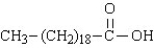 For each of the following questions enter the appropriate number (1,2,3,...)in the blank.
-The citric acid cycle will go through_____cycles for this fatty acid.
For each of the following questions enter the appropriate number (1,2,3,...)in the blank.
-The citric acid cycle will go through_____cycles for this fatty acid. (Short Answer)
4.8/5  (82)
(82) Draw the structure of a 14 carbon, monounsaturated, omega-3 fatty acid.
(Essay)
4.9/5 (73)
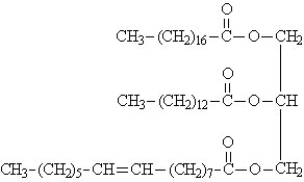
(73) Draw the structures for each of the products produced on the hydrolysis of the following substance using KOH
. 
(Essay)
4.8/5 (88)
(88) Examine the fatty acids given below.The names of the acids are given above the formula and each structure given a letter designation below the structure. 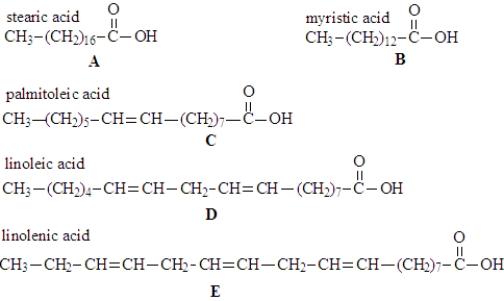 Fill in the blanks with the appropriate letter (A,B,C,D,E).
-To form the following triglyceride would require 1 molecule of ______________________ and 2 molecules of ______________________.
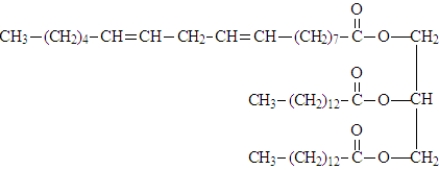
Fill in the blanks with the appropriate letter (A,B,C,D,E).
-To form the following triglyceride would require 1 molecule of ______________________ and 2 molecules of ______________________. (Short Answer)
4.8/5 (83)
(83) Consider the complete oxidation of a saturated fatty acid with the formula shown below. For each of the following questions enter the appropriate number (1,2,3,...)in the blank.
-During the beta oxidation of the acid, _____molecules of ATP are consumed.
For each of the following questions enter the appropriate number (1,2,3,...)in the blank.
-During the beta oxidation of the acid, _____molecules of ATP are consumed. (Short Answer)
4.8/5 (72)
(72) The oxidation of FADH210 H+ across the inner mitochondrial membrane.
(True/False)
4.7/5 (79)
(79) Consider the complete oxidation of a saturated fatty acid with the formula shown below. For each of the following questions enter the appropriate number (1,2,3,...)in the blank.
-During the beta oxidation of the acid, _____molecules of NADH are produced.
For each of the following questions enter the appropriate number (1,2,3,...)in the blank.
-During the beta oxidation of the acid, _____molecules of NADH are produced. (Short Answer)
4.8/5 (88)
(88) Examine the diagram of a mitochondrion shown below. 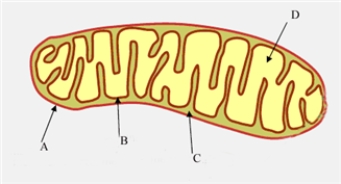 Fill in the blanks with the appropriate letter (A,B,C,D).
-Lipid bilayer:
_____________________
Fill in the blanks with the appropriate letter (A,B,C,D).
-Lipid bilayer:
_____________________ (Short Answer)
4.7/5 (67)
(67) Consider the complete oxidation of a saturated fatty acid with the formula shown below. For each of the following questions enter the appropriate number (1,2,3,...)in the blank.
-For this fatty acid, from beta oxidation through the citric acid cycle, the net production is _____molecules of ATP.
For each of the following questions enter the appropriate number (1,2,3,...)in the blank.
-For this fatty acid, from beta oxidation through the citric acid cycle, the net production is _____molecules of ATP. (Short Answer)
4.8/5 (61)
(61) In the following diagram, what type(s) of gradients would be present across the membrane? 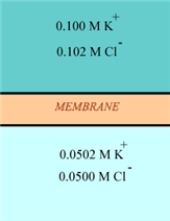
(Multiple Choice)
4.8/5 (85)
(85) Consider the complete oxidation of a saturated fatty acid with the formula shown below. For each of the following questions enter the appropriate number (1,2,3,...)in the blank.
-The citric acid cycle will directly produce_____molecules of ATP for this fatty acid.
For each of the following questions enter the appropriate number (1,2,3,...)in the blank.
-The citric acid cycle will directly produce_____molecules of ATP for this fatty acid. (Short Answer)
4.8/5 (89)
(89) How many H+ must be moved across the inner mitochondrial membrane to produce 6 ATP?
(Multiple Choice)
4.8/5 (68)
(68) Consider the following diagram of a membrane. 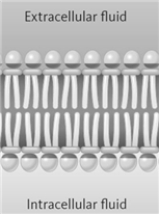 Which of the following cannot pass through this membrane?
 (Multiple Choice)
5.0/5 (78)
(78) Consider the beta oxidation of a saturated fatty acid. For 5 turns of the cycle how many total high energy molecules are produced?
(Multiple Choice)
4.7/5 (78)
(78) What is the overall (net) yield of ATP when one molecule of stearic acid (C18H36O2) is oxidized to CO2?
(Multiple Choice)
4.8/5 (78)
(78) Consider the following diagram of a membrane. 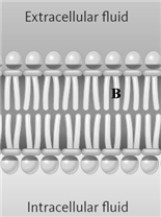 Which of the following might be the portion of the membrane represented by the letter A?
 (Multiple Choice)
4.8/5 (84)
(84) One of the products of the hydrolysis of a triglyceride in sulfuric acid is a carboxylic acid.
(True/False)
4.7/5 (68)
(68) The generation of a concentration of K+ on the outside of membrane to 50 mEq/L and on the inside to 10 mEq/L decreases the potential energy of the system.
(True/False)
4.9/5 (86)
(86) 
Filters
- Essay(0)
- Multiple Choice(0)
- Short Answer(0)
- True False(0)
- Matching(0)