



 Chat with AI
Exam 8: Nuclear Chemistry

Exam 1: Measurements in Science and Medicine77 Questions
Exam 2: Atoms, Elements, and Compounds76 Questions
Exam 3: Chemical Bonds82 Questions
Exam 4: Energy and Physical Properties73 Questions
Exam 5: Solution Concentration76 Questions
Exam 6: Chemical Reactions68 Questions
Exam 7: Acids and Bases82 Questions
Exam 8: Nuclear Chemistry65 Questions
Exam 9: Hydrocarbons: An Introduction to Organic Molecules72 Questions
Exam 10: Hydration, Dehydration, and Alcohols59 Questions
Exam 11: Carbonyl Compounds and Redox Reactions70 Questions
Exam 12: Organic Acids and Bases62 Questions
Exam 13: Condensation and Hydrolysis Reactions70 Questions
Exam 14: Proteins64 Questions
Exam 15: Carbohydrates73 Questions
Exam 16: Lipids and Membranes75 Questions
Exam 17: Nucleic Acids, Protein Synthesis, and Heredity69 Questions
Select questions type


A sample of a radioacitive isotope has an activity of 80 μCi when produced. 60 min later when it is being used the activity has dropped to 10 μCi. What is the half-life of this isotope?
(Multiple Choice)
4.9/5  (81)
(81) The half-life of is bromine-80 is 17.6 min. Approximately how long will it take for the activity of this isotope to drop from to 320 mCi to 10 mCi?
(Multiple Choice)
4.8/5 (86)
(86) The image below is a representation of the formation of radical (X)by different types of radiation (1,2,and 3). 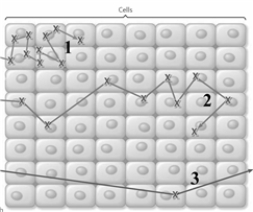 Based on this diagram answer the following questions.
-This type of radiation can produce "secondary" X-ray photons. _____
Based on this diagram answer the following questions.
-This type of radiation can produce "secondary" X-ray photons. _____ (Short Answer)
4.8/5 (73)
(73) The following image could illustrate the process of nuclear fusion. 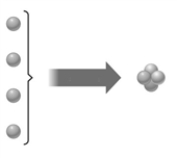
(True/False)
4.8/5 (84)
(84) 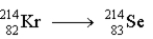 occurs through the emission of
The activity of 1.0 μg of fluorine-18 is 89 Ci. Which of the following is not equivalent to this activity?
(Multiple Choice)
4.8/5 (80)
(80) The following correctly applies to balancing nuclear equations.
"The sums of the mass numbers of the products and reactants must be equal."
(True/False)
4.7/5 (80)
(80) Background radiation is ionizing radiation emitted from natural sources and essentially cannot be avoided.
(True/False)
4.8/5 (91)
(91) The image below is a representation of the formation of radical (X)by different types of radiation (1,2,and 3). Based on this diagram answer the following questions.
-This type of radiation is useful for diagnostic imaging:
_____
Based on this diagram answer the following questions.
-This type of radiation is useful for diagnostic imaging:
_____ (Short Answer)
4.9/5 (84)
(84) Which of the following is true of nuclear fission but not nuclear fusion?
(Multiple Choice)
4.9/5 (87)
(87) 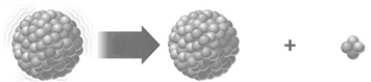
131I has a half life of 8 days. Approximately how long will it take a sample with an activity of 60 mCi to drop to about 3.75 mCi?
(Multiple Choice)
4.7/5 (79)
(79) Consider the process illustrated in the image below. 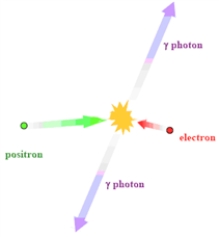 Which of the following is true of this process?
 (Multiple Choice)
4.8/5 (70)
(70) An exposure to equal amounts of energy from nuclear radiation occurred at two different sites. At the first site an employee was exposed to neutrons with a WR of 16 and received a dose of 33 mrem. At the second site a worker was exposed to alpha particles. What dose did this second empolyee receive?
(Short Answer)
4.9/5 (80)
(80) Iodine-131 is used in the treatment of thyroid disorders. 1.0 μg of this isotope produces 3.5 mCi. If a patient is given a dose of 165 mCi, what mass of iodine-131 was in the sample?
(Multiple Choice)
4.8/5 (74)
(74) The fusion of deuterium (  ) and tritium (
 ) holds some promise as a source of nuclear energy. If a neutron is produced, the other product of the reaction is
 .
) and tritium ( ) holds some promise as a source of nuclear energy. If a neutron is produced, the other product of the reaction is . (True/False)
4.9/5 (75)
(75) Consider the graph of activity versus time for a naturally occurring isotope. 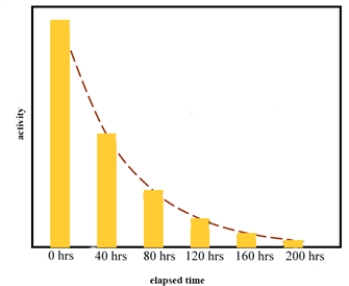 The half-life of this isotope is between 80 and 120 hours.
 (True/False)
4.8/5 (74)
(74) 
Filters
- Essay(0)
- Multiple Choice(0)
- Short Answer(0)
- True False(0)
- Matching(0)