



 Chat with AI
Exam 6: Chemical Reactions

Exam 1: Measurements in Science and Medicine77 Questions
Exam 2: Atoms, Elements, and Compounds76 Questions
Exam 3: Chemical Bonds82 Questions
Exam 4: Energy and Physical Properties73 Questions
Exam 5: Solution Concentration76 Questions
Exam 6: Chemical Reactions68 Questions
Exam 7: Acids and Bases82 Questions
Exam 8: Nuclear Chemistry65 Questions
Exam 9: Hydrocarbons: An Introduction to Organic Molecules72 Questions
Exam 10: Hydration, Dehydration, and Alcohols59 Questions
Exam 11: Carbonyl Compounds and Redox Reactions70 Questions
Exam 12: Organic Acids and Bases62 Questions
Exam 13: Condensation and Hydrolysis Reactions70 Questions
Exam 14: Proteins64 Questions
Exam 15: Carbohydrates73 Questions
Exam 16: Lipids and Membranes75 Questions
Exam 17: Nucleic Acids, Protein Synthesis, and Heredity69 Questions
Select questions type


When the following equation is balanced using integers,  the number of atoms of carbon represented in reactants or products is:
 (Multiple Choice)
4.9/5  (81)
(81) The following represents a balanced chemical equation.
Al(NO3)3(aq) + Na 3PO4 (aq) → AlPO4(s) + 3NaNO3(aq)
(True/False)
4.9/5 (84)
(84) Consider the following energy diagram showing a reaction with and without a catalyst.. 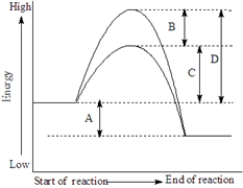 Fill in the blank with the appropriate letter (A,B,C,etc.).
-The activation energy of the catalyzed reaction is represented by_____________________.
Fill in the blank with the appropriate letter (A,B,C,etc.).
-The activation energy of the catalyzed reaction is represented by_____________________. (Short Answer)
4.7/5 (82)
(82) Based on the following energy diagram, the activation energy for the reaction represented is approximately 40 kcal. 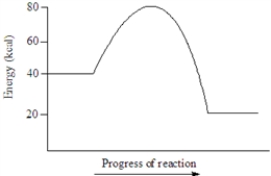
(True/False)
4.8/5 (79)
(79) Consider the following generic reaction.
2 A(s) + 3 B(l) → C(g)
If 58.0 g of A reacted completely with B to produce 100.8 g of C, what mass of B reacted?
(Multiple Choice)
4.8/5 (90)
(90)  This reaction:
Which of the following statements is not true about the reaction as written below? 
(Multiple Choice)
4.7/5 (77)
(77) 
Filters
- Essay(0)
- Multiple Choice(0)
- Short Answer(0)
- True False(0)
- Matching(0)