



 Chat with AI
Exam 17: International Trade

Exam 1: Economics: The Study of Choice145 Questions
Exam 2: Confronting Scarcity: Choices in Production198 Questions
Exam 3: Demand and Supply251 Questions
Exam 4: Applications of Supply and Demand113 Questions
Exam 5: Elasticity: a Measure of Response255 Questions
Exam 6: Markets, Maximizers, and Efficiency239 Questions
Exam 7: The Analysis of Consumer Choice244 Questions
Exam 8: Production and Cost227 Questions
Exam 9: Competitive Markets for Goods and Services265 Questions
Exam 10: Monopoly234 Questions
Exam 11: The World of Imperfect Competition237 Questions
Exam 12: Wages and Employment in Perfect Competition189 Questions
Exam 13: Interest Rates and the Markets for Capital and Natural Resources170 Questions
Exam 14: Imperfectly Competitive Markets for Factors of Production183 Questions
Exam 15: Public Finance and Public Choice188 Questions
Exam 16: Antitrust Policy and Business Regulation137 Questions
Exam 17: International Trade186 Questions
Exam 18: The Economics of the Environment148 Questions
Exam 19: Inequality, Poverty, and Discrimination140 Questions
Select questions type


Use the following to answer question(s): Production Possibilities in Alphaland and Omegaland
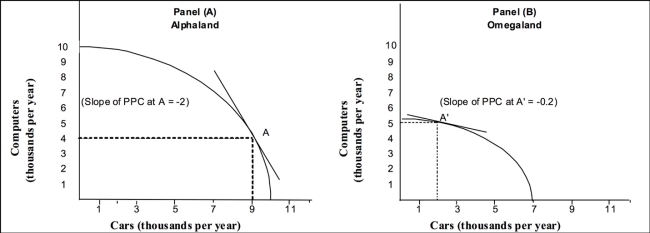 -(Exhibit: Production Possibilities in Alphaland and Omegaland) If the terms of trade established turn out to be 1 car for 1 computer, then:
 (Multiple Choice)
4.9/5  (82)
(82) Assume that the United States imposes a quota on Italian shoes.Relative to the equilibrium world price that would exist in the absence of quotas, the equilibrium price of shoes in the United States will most likely _______ , and the equilibrium price of shoes in Italy will most likely _______ .
(Multiple Choice)
4.9/5 (86)
(86) Compare and contrast protectionist trade policies with strategic trade policies.Give several examples of each and critically evaluate whether or not they can be justified and, if so, from whose perspective?
(Essay)
4.7/5 (79)
(79) Use the following to answer question(s): Production Possibilities in Alphaland and Omegaland
-(Exhibit: Production Possibilities in Alphaland and Omegaland) Once trade opens up between the two countries:
-(Exhibit: Production Possibilities in Alphaland and Omegaland) Once trade opens up between the two countries: (Multiple Choice)
4.8/5 (86)
(86) A policy in which a country restricts the importation of goods and services produced in foreign countries is described by economists as:
(Multiple Choice)
4.8/5 (70)
(70) If the United States imposes a tariff of $5 per bottle on French wine, the most likely effect will be to raise the:
(Multiple Choice)
4.7/5 (77)
(77) The most likely effects of tariffs and/or quotas is to _______ prices and to _______ consumption of the protected goods in the importing country.
(Multiple Choice)
4.8/5 (70)
(70) The net benefits that a nation receives from trade are called its gains from trade.
(True/False)
4.9/5 (69)
(69) If the opportunity cost is 2X = 1Y for country A and 1X = 3Y for country B, then a possible terms of trade is:
(Multiple Choice)
4.9/5 (76)
(76) An exporter is said to be engaged in _______ if it _______ goods and services at a price _______ .
(Multiple Choice)
4.9/5 (93)
(93) Use the following to answer question(s): Heartland and Soulland
Suppose that there are only two countries in the world, Heartland and Soulland.The two countries produce only two goods, corn and drill presses.At its current level of production, Heartland must give up production of 1/4 drill press to produce an additional 100 bushels of corn.Soulland must give up 1 drill press to produce an additional 100 bushels of corn.No trade now occurs between the two economies, and both economies are operating on their respective production possibilities frontiers.
-(Exhibit: Heartland and Soulland) If trade now opens up between the two economies, we can expect that:
(Multiple Choice)
5.0/5 (92)
(92) A tariff imposed on Japanese imports into the United States tends to:
(Multiple Choice)
4.8/5 (84)
(84) Use the following to answer question(s): The Production of Tires and Radios
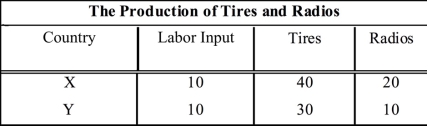 -(Exhibit: The Production of Tires and Radios) Assuming constant costs in the neighborhood of their current levels of production, the exhibit shows the number of tires each country would have to forgo in order to produce the additional radios indicated.Further assume that the only input is labor and that it remains fully employed.Assume that there is unrestricted trade and complete specialization.According to comparative advantage, country:
 (Multiple Choice)
4.9/5 (85)
(85) Opportunity cost reflected on a production possibilities curve is :
(Multiple Choice)
4.9/5 (81)
(81) A direct restriction on the quantity of an import is called a(n):
(Multiple Choice)
4.7/5 (92)
(92) 
Filters
- Essay(0)
- Multiple Choice(0)
- Short Answer(0)
- True False(0)
- Matching(0)