



 Chat with AI
Exam 17: International Trade

Exam 1: Economics: The Study of Choice145 Questions
Exam 2: Confronting Scarcity: Choices in Production198 Questions
Exam 3: Demand and Supply251 Questions
Exam 4: Applications of Supply and Demand113 Questions
Exam 5: Elasticity: a Measure of Response255 Questions
Exam 6: Markets, Maximizers, and Efficiency239 Questions
Exam 7: The Analysis of Consumer Choice244 Questions
Exam 8: Production and Cost227 Questions
Exam 9: Competitive Markets for Goods and Services265 Questions
Exam 10: Monopoly234 Questions
Exam 11: The World of Imperfect Competition237 Questions
Exam 12: Wages and Employment in Perfect Competition189 Questions
Exam 13: Interest Rates and the Markets for Capital and Natural Resources170 Questions
Exam 14: Imperfectly Competitive Markets for Factors of Production183 Questions
Exam 15: Public Finance and Public Choice188 Questions
Exam 16: Antitrust Policy and Business Regulation137 Questions
Exam 17: International Trade186 Questions
Exam 18: The Economics of the Environment148 Questions
Exam 19: Inequality, Poverty, and Discrimination140 Questions
Select questions type


Use the following to answer question(s): Production Possibilities in Alphaland and Omegaland
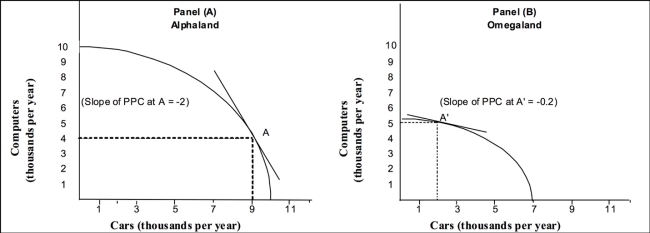 -(Exhibit: Production Possibilities in Alphaland and Omegaland) At point A in Alphaland, ________ additional computer(s) cost(s) _______ additional car(s) and at point A? in Omegaland, _______ additional computer(s) cost(s) _______ car(s).
 (Multiple Choice)
4.8/5  (74)
(74) Use the following to answer question(s): The Production of Tires and Radios
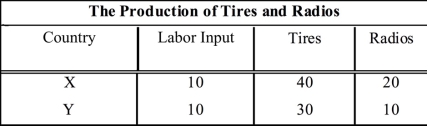 -(Exhibit: The Production of Tires and Radios) Assuming constant costs in the neighborhood of their current levels of production, the exhibit shows the number of tires each country would have to forgo in order to produce the additional radios indicated.Further assume that the only input is labor and that it remains fully employed.We see from the table that Country Y:
 (Multiple Choice)
4.9/5 (76)
(76) If a country removes a tariff on imported shoes, we expect the domestic price of shoes to _______ and the quantity of shoes consumed in the domestic market to ________ .
(Multiple Choice)
4.8/5 (82)
(82) The "increase domestic employment" argument for protection against free trade:
(Multiple Choice)
4.8/5 (80)
(80) Discuss and evaluate the following statement: "Importing goods from foreign nations clearly results in a loss of U.S.jobs.It is also clear to me that the restriction of foreign imports from other nations will result in a saving of our own workers' jobs.I just cannot see any reasons for the excitement people have for free trade arguments."
(Essay)
4.7/5 (80)
(80) Use the following to answer question(s): Production Possibilities Curve
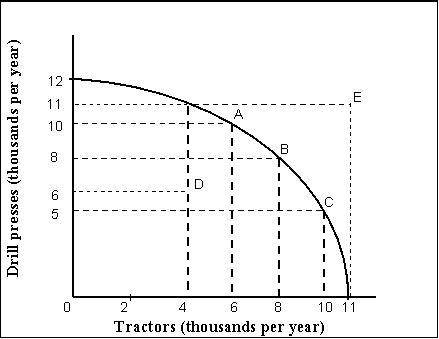 -(Exhibit: Production Possibilities Curve) Which of the following statements is true?
 (Multiple Choice)
4.9/5 (86)
(86) A new domestic industry with potential economies of scale is called a(n):
(Multiple Choice)
4.8/5 (81)
(81) If a country imposes a tariff on imported shoes, we expect the domestic price of shoes to _______ and the quantity of shoes consumed in the domestic market to _______ .
(Multiple Choice)
4.8/5 (79)
(79) An argument against the use of tariffs to keep out the production of "cheap" foreign labor is that:
(Multiple Choice)
4.8/5 (77)
(77) Gains of trade are possible for two countries if they have:
(Multiple Choice)
4.9/5 (92)
(92) Use the following to answer question(s): Production Possibilities Curve
-(Exhibit: Production Possibilities Curve) In order to maximize output, this economy must:
-(Exhibit: Production Possibilities Curve) In order to maximize output, this economy must: (Multiple Choice)
4.7/5 (84)
(84) Use the following to answer question(s): Production Possibilities Schedule for Two Commodities
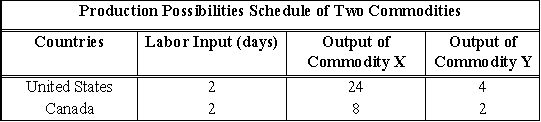 -(Exhibit: Production Possibilities Schedule for Two Commodities) Assuming constant costs in the neighborhood of their current levels of production, the exhibit shows the number of units of commodity X each country would have to forgo to produce the additional units of commodity Y indicated.Further assume that the only input is labor and that it remains fully employed.We see from the table that the United States:
 (Multiple Choice)
4.9/5 (91)
(91) Suppose that Brazil and Peru exchange coffee and leather.Brazil can produce both coffee and leather more efficiently than Peru, but Brazil can produce coffee more efficiently than leather.Comparative advantage states that:
(Multiple Choice)
4.9/5 (87)
(87) The absolute value of the slope of the production possibilities curve at any point:
(Multiple Choice)
4.9/5 (90)
(90) Use the following to answer question(s): Heartland and Soulland
Suppose that there are only two countries in the world, Heartland and Soulland.The two countries produce only two goods, corn and drill presses.At its current level of production, Heartland must give up production of 1/4 drill press to produce an additional 100 bushels of corn.Soulland must give up 1 drill press to produce an additional 100 bushels of corn.No trade now occurs between the two economies, and both economies are operating on their respective production possibilities frontiers.
-(Exhibit: Heartland and Soulland) The country with a comparative advantage in the production of drill presses is:
(Multiple Choice)
5.0/5 (86)
(86) A direct restriction on the quantity of an import is called a tariff.
(True/False)
5.0/5 (86)
(86) 
Filters
- Essay(0)
- Multiple Choice(0)
- Short Answer(0)
- True False(0)
- Matching(0)