



 Chat with AI
Exam 17: International Trade

Exam 1: Economics: The Study of Choice145 Questions
Exam 2: Confronting Scarcity: Choices in Production198 Questions
Exam 3: Demand and Supply251 Questions
Exam 4: Applications of Supply and Demand113 Questions
Exam 5: Elasticity: a Measure of Response255 Questions
Exam 6: Markets, Maximizers, and Efficiency239 Questions
Exam 7: The Analysis of Consumer Choice244 Questions
Exam 8: Production and Cost227 Questions
Exam 9: Competitive Markets for Goods and Services265 Questions
Exam 10: Monopoly234 Questions
Exam 11: The World of Imperfect Competition237 Questions
Exam 12: Wages and Employment in Perfect Competition189 Questions
Exam 13: Interest Rates and the Markets for Capital and Natural Resources170 Questions
Exam 14: Imperfectly Competitive Markets for Factors of Production183 Questions
Exam 15: Public Finance and Public Choice188 Questions
Exam 16: Antitrust Policy and Business Regulation137 Questions
Exam 17: International Trade186 Questions
Exam 18: The Economics of the Environment148 Questions
Exam 19: Inequality, Poverty, and Discrimination140 Questions
Select questions type


Use the following to answer question(s): Production Possibilities Schedule for Two Commodities
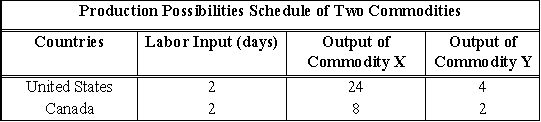 -(Exhibit: Production Possibilities Schedule for Two Commodities) Assuming constant costs in the neighborhood of their current levels of production, the exhibit shows the number of units of commodity X each country would have to forgo to produce the additional units of commodity Y indicated.Further assume that the only input is labor and that it remains fully employed.If there is no trade between the United States and Canada, the costs of X and Y are such that:
 (Multiple Choice)
4.8/5  (81)
(81) The Case in Point on trade in water suggests that _____ trade in water appears to be a growth industry.
(Multiple Choice)
5.0/5 (87)
(87) Use the following to answer question(s): The Production of Tires and Radios
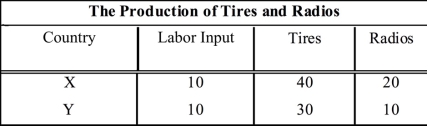 -(Exhibit: The Production of Tires and Radios) Assuming constant costs in the neighborhood of their current levels of production, the exhibit shows the number of tires each country would have to forgo in order to produce the additional radios indicated.Further assume that the only input is labor and that it remains fully employed.Assume that there is unrestricted trade and complete specialization.According to comparative advantage, country:
 (Multiple Choice)
4.8/5 (94)
(94) The relative costs of two goods produced by two countries can be determined by comparing the slopes of their production possibilities curves at their respective current levels of production.
(True/False)
4.8/5 (80)
(80) If the United States, at the point where it is currently producing, must give up the production of 500 bicycles (B) to produce 20 additional tractors (T) with the same resources, the opportunity cost of producing 5 tractors is _______ bicycles.
(Multiple Choice)
4.8/5 (79)
(79) If the executives of the U.S.silicon-chip industry lobby Congress for protection from imports on the grounds that foreign producers are selling silicon chips in the United States below production costs, they are using the:
(Multiple Choice)
5.0/5 (83)
(83) Use the following to answer question(s): Production Possibilities in Alphaland and Omegaland
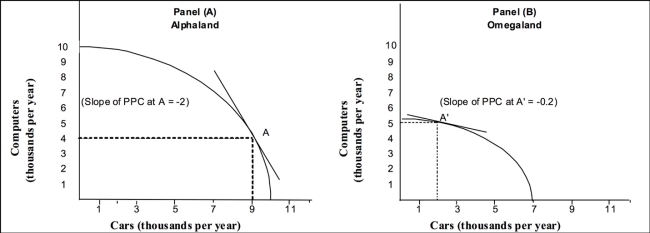 -(Exhibit: Production Possibilities in Alphaland and Omegaland) Which of the following statements is true?
 (Multiple Choice)
4.9/5 (82)
(82) Use the following to answer question(s): The Production of Tires and Radios
-(Exhibit: The Production of Tires and Radios) Assuming constant costs in the neighborhood of their current levels of production, the exhibit shows the number of tires each country would have to forgo in order to produce the additional radios indicated.Further assume that the only input is labor and that it remains fully employed.The cost to country X of producing an additional tire is _______ radio(s).
-(Exhibit: The Production of Tires and Radios) Assuming constant costs in the neighborhood of their current levels of production, the exhibit shows the number of tires each country would have to forgo in order to produce the additional radios indicated.Further assume that the only input is labor and that it remains fully employed.The cost to country X of producing an additional tire is _______ radio(s). (Multiple Choice)
4.9/5 (77)
(77) If the executives of the U.S.silicon-chip industry lobby Congress for protection from imports on the grounds that the military should have an unrestricted domestic supply of silicon chips, they are using the:
(Multiple Choice)
4.8/5 (98)
(98) Use the following to answer question(s): Production Possibilities in Alphaland and Omegaland
-(Exhibit: Production Possibilities in Alphaland and Omegaland) If the final terms of trade are 1 computer = 1 car, then:
-(Exhibit: Production Possibilities in Alphaland and Omegaland) If the final terms of trade are 1 computer = 1 car, then: (Multiple Choice)
4.9/5 (79)
(79) The net benefits a nation receives from free trade are called the costs of trade.
(True/False)
4.9/5 (68)
(68) If one country has the ability to produce all goods and services more efficiently than any other country, then:
(Multiple Choice)
4.9/5 (89)
(89) The single most important source of protectionist policies against trade, according to the text, is the:
(Multiple Choice)
4.9/5 (85)
(85) Use the following to answer question(s): Production Possibilities Curve
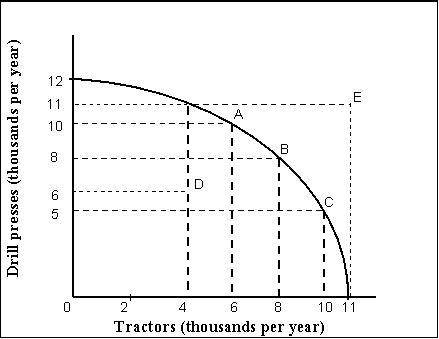 -(Exhibit: Production Possibilities Curve) Which of the following statements is true?
 (Multiple Choice)
4.9/5 (87)
(87) Use the following to answer question(s): Production Possibilities in Alphaland and Omegaland
-(Exhibit: Production Possibilities in Alphaland and Omegaland) The slopes of the production possibilities curves (PPCs) in the two countries are:
-(Exhibit: Production Possibilities in Alphaland and Omegaland) The slopes of the production possibilities curves (PPCs) in the two countries are: (Multiple Choice)
4.8/5 (56)
(56) If a country has a comparative advantage in the production of a good:
(Multiple Choice)
4.8/5 (59)
(59) A tax imposed by a government on imported goods or services is a:
(Multiple Choice)
4.8/5 (85)
(85) If two countries find that neither has a comparative advantage in the production of any good or service:
(Multiple Choice)
4.8/5 (67)
(67) 
Filters
- Essay(0)
- Multiple Choice(0)
- Short Answer(0)
- True False(0)
- Matching(0)