



 Chat with AI
Exam 8: Production and Cost

Exam 1: Economics: The Study of Choice145 Questions
Exam 2: Confronting Scarcity: Choices in Production198 Questions
Exam 3: Demand and Supply251 Questions
Exam 4: Applications of Supply and Demand113 Questions
Exam 5: Elasticity: a Measure of Response255 Questions
Exam 6: Markets, Maximizers, and Efficiency239 Questions
Exam 7: The Analysis of Consumer Choice244 Questions
Exam 8: Production and Cost227 Questions
Exam 9: Competitive Markets for Goods and Services265 Questions
Exam 10: Monopoly234 Questions
Exam 11: The World of Imperfect Competition237 Questions
Exam 12: Wages and Employment in Perfect Competition189 Questions
Exam 13: Interest Rates and the Markets for Capital and Natural Resources170 Questions
Exam 14: Imperfectly Competitive Markets for Factors of Production183 Questions
Exam 15: Public Finance and Public Choice188 Questions
Exam 16: Antitrust Policy and Business Regulation137 Questions
Exam 17: International Trade186 Questions
Exam 18: The Economics of the Environment148 Questions
Exam 19: Inequality, Poverty, and Discrimination140 Questions
Select questions type


Use the following to answer question(s): Short-Run Costs
 -(Exhibit: Short-Run Costs) The vertical difference between curve B and curve C at any quantity of output is:
Free
(Multiple Choice)
4.9/5  (92)
(92) Correct Answer: Verified
C
Economies and diseconomies of scale account for the shape of the:
Free
(Multiple Choice)
4.9/5 (86)
(86) Correct Answer:Verified
VerifiedC
Marginal cost, mathematically, is the slope of the:
Free
(Multiple Choice)
4.9/5 (78)
(78) Correct Answer:Verified
VerifiedD
At 76 units of labor, a firm finds that average product of labor equals 39.6 and marginal product of labor equals 42.9.We can conclude that the average product curve at 76 units of labor is:
(Multiple Choice)
4.8/5 (85)
(85) Increasing marginal returns for the first four units of a variable input is exhibited by the total product sequence:
(Multiple Choice)
4.8/5 (95)
(95) The costs incurred by a firm in its use of variable factors of production are:
(Multiple Choice)
4.9/5 (73)
(73) Use the following to answer question(s): Long-Run Average Cost
 -(Exhibit: Long-Run Average Cost) In the region from O to A, output per period is _______ and long-run average cost is _______ .
 (Multiple Choice)
4.8/5 (74)
(74) Use the following for questions 37-43.
Exhibit: Total Product
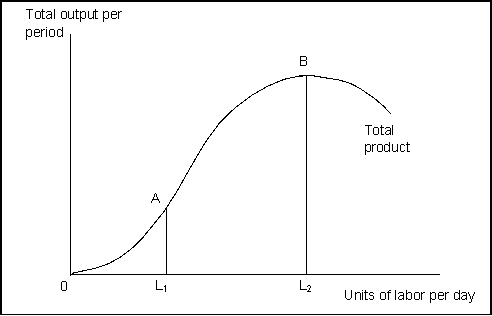 -(Exhibit: Total Product) Between points A and B, which of the following is (are) true?
 (Multiple Choice)
5.0/5 (78)
(78) Suppose a firm is using labor and capital and obtaining the maximum possible output for a given total cost.If the price of labor increases, all other things unchanged, then the firm will:
(Multiple Choice)
4.8/5 (81)
(81) Use the following to answer question(s): A Firm's Cost Curves
 -(Exhibit: A Firm's Cost Curves) The curve X represents the firm's _______ curve.
 (Multiple Choice)
4.9/5 (82)
(82) If your plant is operating in the positively-sloped portion of a long-run average cost curve, this could be the result of:
(Multiple Choice)
4.9/5 (81)
(81) Firms seek to use factors in the most efficient way in order to maximize profits.
(True/False)
4.9/5 (78)
(78) Use the following for questions 44-50.
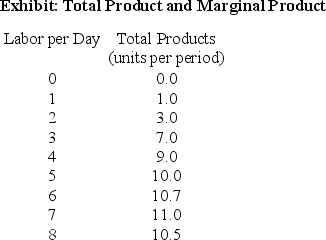 -(Exhibit: Total Product and Marginal Product) The marginal product of the second worker is:
 (Multiple Choice)
4.7/5 (75)
(75) When diseconomies of scale outweigh economies of scale, the long-run average cost curve rises.
(True/False)
4.8/5 (85)
(85) Use the following for questions 37-43.
Exhibit: Total Product
-(Exhibit: Total Product) As units of labor are hired between quantities L₁ and L₂, _______ is ________ and _______ is ________.
-(Exhibit: Total Product) As units of labor are hired between quantities L₁ and L₂, _______ is ________ and _______ is ________. (Multiple Choice)
5.0/5 (93)
(93) 
Filters
- Essay(0)
- Multiple Choice(0)
- Short Answer(0)
- True False(0)
- Matching(0)