



 Chat with AI
Exam 8: Production and Cost

Exam 1: Economics: The Study of Choice145 Questions
Exam 2: Confronting Scarcity: Choices in Production198 Questions
Exam 3: Demand and Supply251 Questions
Exam 4: Applications of Supply and Demand113 Questions
Exam 5: Elasticity: a Measure of Response255 Questions
Exam 6: Markets, Maximizers, and Efficiency239 Questions
Exam 7: The Analysis of Consumer Choice244 Questions
Exam 8: Production and Cost227 Questions
Exam 9: Competitive Markets for Goods and Services265 Questions
Exam 10: Monopoly234 Questions
Exam 11: The World of Imperfect Competition237 Questions
Exam 12: Wages and Employment in Perfect Competition189 Questions
Exam 13: Interest Rates and the Markets for Capital and Natural Resources170 Questions
Exam 14: Imperfectly Competitive Markets for Factors of Production183 Questions
Exam 15: Public Finance and Public Choice188 Questions
Exam 16: Antitrust Policy and Business Regulation137 Questions
Exam 17: International Trade186 Questions
Exam 18: The Economics of the Environment148 Questions
Exam 19: Inequality, Poverty, and Discrimination140 Questions
Select questions type


Use the following to answer question(s): A Firm's Cost Curves
 -(Exhibit: A Firm's Cost Curves) The vertical distance between curves X and W decreases as output increases.This results from:
 (Multiple Choice)
4.9/5  (89)
(89) The total product curve can be used to directly derive the:
(Multiple Choice)
4.8/5 (79)
(79) The slope of a long-run average cost curve exhibiting diseconomies of scale is:
(Multiple Choice)
4.8/5 (73)
(73) At 125,000 units of output, a firm's marginal cost is $0.48 and its average total cost is $0.87.We can conclude that at this quantity of output the firm's average total cost curve is:
(Multiple Choice)
4.7/5 (79)
(79) If a firm produces 10 units of output and incurs $30 in average variable cost and $35 in average total cost, total fixed cost is:
(Multiple Choice)
4.7/5 (74)
(74) Use the following for questions 37-43.
Exhibit: Total Product
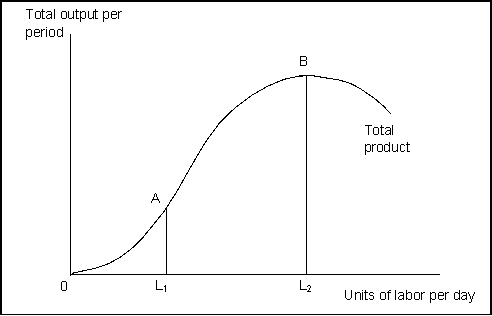 -(Exhibit: Total Product) Between points A and B the marginal product of labor is:
 (Multiple Choice)
4.7/5 (84)
(84) When an additional unit of a variable factor of production adds less to total product than the previous unit, the firm must be experiencing:
(Multiple Choice)
4.8/5 (79)
(79) Given constant quantities of all other factors, when additional units of a variable factor of production reduce total output, the firm is experiencing:
(Multiple Choice)
4.9/5 (80)
(80) At 150,000 units of output, a firm's marginal cost is $0.87 and its average total cost is $0.48.We can conclude that at this quantity of output the firm's average total cost curve is:
(Multiple Choice)
5.0/5 (81)
(81) A fixed factor of production is defined in the text as one:
(Multiple Choice)
4.9/5 (66)
(66) As compared to consumer choice theory, the marginal decision rule when applied in the theory of the firm is:
(Multiple Choice)
4.9/5 (88)
(88) Use the following for questions 44-50.
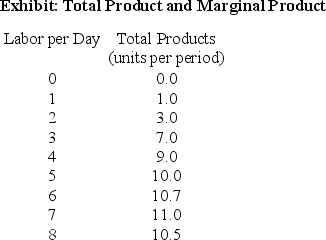 -(Exhibit: Total Product and Marginal Product) The marginal product of the 8th worker is ________ units.
 (Multiple Choice)
4.9/5 (80)
(80) If an increase in output results in a decrease in average total cost, the corresponding marginal cost is:
(Multiple Choice)
4.8/5 (79)
(79) Use the following to answer question(s): 
 -(Exhibit: Costs of Producing Bagels) The average total cost of producing two bagels is:
 (Multiple Choice)
4.9/5 (74)
(74) Use the following for questions 37-43.
Exhibit: Total Product
-(Exhibit: Total Product) Hiring L₂ units of labor results in total product attaining a _______ and the marginal product of labor _______ .
-(Exhibit: Total Product) Hiring L₂ units of labor results in total product attaining a _______ and the marginal product of labor _______ . (Multiple Choice)
4.8/5 (75)
(75) If a firm produces 10 units of output and incurs $35 in average total cost and $5 in average fixed cost, average variable cost is:
(Multiple Choice)
4.8/5 (77)
(77) 
Filters
- Essay(0)
- Multiple Choice(0)
- Short Answer(0)
- True False(0)
- Matching(0)