



 Chat with AI
Exam 10: Monopoly

Exam 1: Economics: The Study of Choice145 Questions
Exam 2: Confronting Scarcity: Choices in Production198 Questions
Exam 3: Demand and Supply251 Questions
Exam 4: Applications of Supply and Demand113 Questions
Exam 5: Elasticity: a Measure of Response255 Questions
Exam 6: Markets, Maximizers, and Efficiency239 Questions
Exam 7: The Analysis of Consumer Choice244 Questions
Exam 8: Production and Cost227 Questions
Exam 9: Competitive Markets for Goods and Services265 Questions
Exam 10: Monopoly234 Questions
Exam 11: The World of Imperfect Competition237 Questions
Exam 12: Wages and Employment in Perfect Competition189 Questions
Exam 13: Interest Rates and the Markets for Capital and Natural Resources170 Questions
Exam 14: Imperfectly Competitive Markets for Factors of Production183 Questions
Exam 15: Public Finance and Public Choice188 Questions
Exam 16: Antitrust Policy and Business Regulation137 Questions
Exam 17: International Trade186 Questions
Exam 18: The Economics of the Environment148 Questions
Exam 19: Inequality, Poverty, and Discrimination140 Questions
Select questions type


A monopoly firm will never operate in the _______ range of the _______ curve.

Free
(Multiple Choice)
4.9/5  (85)
(85) Correct Answer: Verified
C
Use the following to answer question(s): Monopoly Model
 -(Exhibit: Monopoly Model) When the firm is in equilibrium, its profit is the area of rectangle:
Free
(Multiple Choice)
4.8/5 (83)
(83) Correct Answer:Verified
VerifiedA
Maximum total economic profits are price minus ATC times the quantity of output where MR = MC for the monopoly firm.
Free
(True/False)
4.9/5 (85)
(85) Correct Answer:Verified
VerifiedTrue
In contrast to a monopoly firm, a perfectly competitive firm:
(Multiple Choice)
4.8/5 (71)
(71) A statement that best reflects an evaluation of monopoly firms is that:
(Multiple Choice)
4.8/5 (66)
(66) Use the following to answer question(s): Demand, Elasticity, and Total Revenue
 -(Exhibit: Demand, Elasticity, and Total Revenue) When price is P and quantity is Q in Panel (a), which of the following is (are) true?
 (Multiple Choice)
4.8/5 (74)
(74) A _______ price charged by a monopoly than would be the case if P = MC _______ consumer surplus.
(Multiple Choice)
4.7/5 (65)
(65) In the _______ range of demand, total revenue _______ with an increase in price.
(Multiple Choice)
4.9/5 (86)
(86) A profit-maximizing firm finds that its marginal costs have risen by $10 per unit.In response to the increase in costs it will change its price and it will experience:
(Multiple Choice)
4.8/5 (74)
(74) Use the following to answer question(s): Short-Run Monopoly
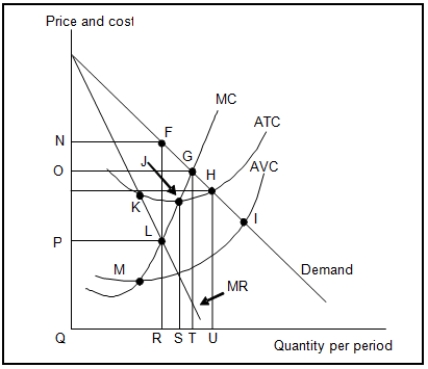 -(Exhibit: Short-Run Monopoly) The profit-maximizing quantity of output is quantity:
 (Multiple Choice)
4.7/5 (87)
(87) By adhering to the MC = MR principle, a monopoly will assure itself:
(Multiple Choice)
4.9/5 (84)
(84) Use the following to answer question(s): Computing Monopoly Profit
 -(Exhibit: Computing Monopoly Profit) The profit-maximizing price is _______ and will generate total economic profit of _______ .
 (Multiple Choice)
4.9/5 (86)
(86) In the _______ range of demand, total revenue _______ with an increase in quantity.
(Multiple Choice)
4.9/5 (72)
(72) A monopoly is likely to _______ and _______ than otherwise equivalent competitive firms.
(Multiple Choice)
4.9/5 (76)
(76) Use the following to answer question(s): Demand, Elasticity, and Total Revenue
-(Exhibit: Demand, Elasticity, and Total Revenue) In Panel (a), which of the following is true?
-(Exhibit: Demand, Elasticity, and Total Revenue) In Panel (a), which of the following is true? (Multiple Choice)
4.9/5 (76)
(76) The pricing in monopoly prevents some mutually beneficial trades from taking place.The value of these unrealized mutually beneficial trades is called:
(Multiple Choice)
4.9/5 (85)
(85) 
Filters
- Essay(0)
- Multiple Choice(0)
- Short Answer(0)
- True False(0)
- Matching(0)