



 Chat with AI
Exam 10: Monopoly

Exam 1: Economics: The Study of Choice145 Questions
Exam 2: Confronting Scarcity: Choices in Production198 Questions
Exam 3: Demand and Supply251 Questions
Exam 4: Applications of Supply and Demand113 Questions
Exam 5: Elasticity: a Measure of Response255 Questions
Exam 6: Markets, Maximizers, and Efficiency239 Questions
Exam 7: The Analysis of Consumer Choice244 Questions
Exam 8: Production and Cost227 Questions
Exam 9: Competitive Markets for Goods and Services265 Questions
Exam 10: Monopoly234 Questions
Exam 11: The World of Imperfect Competition237 Questions
Exam 12: Wages and Employment in Perfect Competition189 Questions
Exam 13: Interest Rates and the Markets for Capital and Natural Resources170 Questions
Exam 14: Imperfectly Competitive Markets for Factors of Production183 Questions
Exam 15: Public Finance and Public Choice188 Questions
Exam 16: Antitrust Policy and Business Regulation137 Questions
Exam 17: International Trade186 Questions
Exam 18: The Economics of the Environment148 Questions
Exam 19: Inequality, Poverty, and Discrimination140 Questions
Select questions type


Answer each of the following:
a.What are the major characteristics of monopoly?
b.What are the barriers to entry that make a monopoly possible?
c.In monopoly, why is P >MR for every level of output except for the first?
(Essay)
4.8/5  (77)
(77) In the case of a natural monopoly, production by a single firm results in lower costs of production.
(True/False)
4.8/5 (87)
(87) Define, identify, and/or explain each of the following:
a.barriers to entry
b.deadweight loss
c.monopoly power
d.monopoly
(Essay)
4.8/5 (74)
(74) The Aluminum Company of America gained monopoly power because:
(Multiple Choice)
4.9/5 (67)
(67) A decrease in the demand facing a monopoly firm would _______ quantity and _______ price.
(Multiple Choice)
4.9/5 (83)
(83) A profit-maximizing monopoly firm finds that its marginal costs have risen by $10 per unit.It will:
(Multiple Choice)
4.9/5 (73)
(73) Use the following to answer question(s): Demand, Elasticity, and Total Revenue
 -(Exhibit: Demand, Elasticity, and Total Revenue) At point G in Panel (b), which of the following is (are) true?
 (Multiple Choice)
4.7/5 (85)
(85) Use the following to answer question(s): Computing Monopoly Profit
 -(Exhibit: Computing Monopoly Profit) Which of the following is (are) true?
 (Multiple Choice)
4.8/5 (78)
(78) A monopoly responds to an increase in demand by _______ price and _______ output.
(Multiple Choice)
4.9/5 (81)
(81) A sunk cost is an expenditure that is not made because it would be unprofitable to do so.
(True/False)
4.7/5 (80)
(80) Suppose that a profit-maximizing monopoly firm experiences a substantial technological change that reduces its marginal and average total costs by $40.Suppose also that the firm lowers its price in response to the reduction in its costs of production.Lowering its price will cause the firm's total revenue to:
(Multiple Choice)
4.9/5 (79)
(79) Use the following to answer question(s): Short-Run Monopoly
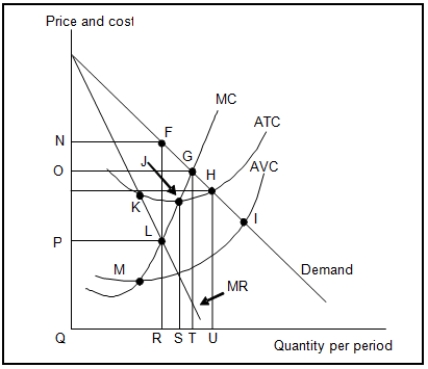 -(Exhibit: Short-Run Monopoly) The profit-maximizing rule is satisfied by the intersection at point:
 (Multiple Choice)
4.7/5 (80)
(80) An expenditure that has already been made and cannot be recovered is called a _______ cost.
(Multiple Choice)
4.8/5 (83)
(83) Price and total revenue move in the same direction when demand is elastic.
(True/False)
4.8/5 (73)
(73) 
Filters
- Essay(0)
- Multiple Choice(0)
- Short Answer(0)
- True False(0)
- Matching(0)