



 Chat with AI
Exam 10: Monopoly

Exam 1: Economics: The Study of Choice145 Questions
Exam 2: Confronting Scarcity: Choices in Production198 Questions
Exam 3: Demand and Supply251 Questions
Exam 4: Applications of Supply and Demand113 Questions
Exam 5: Elasticity: a Measure of Response255 Questions
Exam 6: Markets, Maximizers, and Efficiency239 Questions
Exam 7: The Analysis of Consumer Choice244 Questions
Exam 8: Production and Cost227 Questions
Exam 9: Competitive Markets for Goods and Services265 Questions
Exam 10: Monopoly234 Questions
Exam 11: The World of Imperfect Competition237 Questions
Exam 12: Wages and Employment in Perfect Competition189 Questions
Exam 13: Interest Rates and the Markets for Capital and Natural Resources170 Questions
Exam 14: Imperfectly Competitive Markets for Factors of Production183 Questions
Exam 15: Public Finance and Public Choice188 Questions
Exam 16: Antitrust Policy and Business Regulation137 Questions
Exam 17: International Trade186 Questions
Exam 18: The Economics of the Environment148 Questions
Exam 19: Inequality, Poverty, and Discrimination140 Questions
Select questions type


A monopoly responds to an increase in marginal cost by _______ price and _______ output.
(Multiple Choice)
5.0/5  (70)
(70) Use the following to answer question(s): Demand, Elasticity, and Total Revenue
 -(Exhibit: Demand, Elasticity, and Total Revenue) At point A on the demand curve in Panel (a), the price elasticity of demand is:
 (Multiple Choice)
4.9/5 (79)
(79) Explain in detail the relationships among total revenue, price, marginal revenue, and the concept of the price elasticity of demand.Include in your answer a graph of total revenue, demand, and marginal revenue and show the various elasticities along the demand curve (you may use a linear demand and marginal revenue curve).
(Essay)
4.9/5 (82)
(82) The XYZ Company is a profit-maximizing firm with a monopoly in the production of pennants.The firm sells its pennants for $10 each.We can conclude that the XYZ Company is producing a level of output at which:
(Multiple Choice)
4.9/5 (78)
(78) A monopoly is a market that usually consists of a single firm, but, in some cases, may have up to four firms and still be considered a monopoly.
(True/False)
4.8/5 (85)
(85) Use the following to answer question(s): Monopoly Model
 -(Exhibit: Monopoly Model) When the firm is in equilibrium, its total cost is the area of rectangle:
 (Multiple Choice)
4.8/5 (83)
(83) Use the following to answer question(s): Demand, Elasticity, and Total Revenue
-(Exhibit: Demand, Elasticity, and Total Revenue) Panels (a) and (b) show that:
-(Exhibit: Demand, Elasticity, and Total Revenue) Panels (a) and (b) show that: (Multiple Choice)
4.9/5 (89)
(89) Use the following to answer question(s): A Profit-Maximizing Monopoly Firm
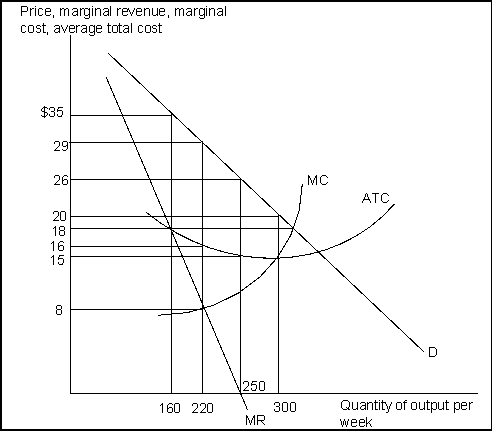 -(Exhibit: A Profit-Maximizing Monopoly Firm) This profit-maximizing monopoly firm's price per unit is:
 (Multiple Choice)
4.9/5 (71)
(71) The United States bans most efforts to create a monopoly when:
(Multiple Choice)
4.8/5 (70)
(70) Suppose that a monopolist increases production from 10 units to 11 units.If the market price declines from $30 per unit to $29 per unit, marginal revenue for the eleventh unit is:
(Multiple Choice)
4.8/5 (77)
(77) If regulation of a monopoly results in a price equal to marginal cost, but price is below average total cost:
(Multiple Choice)
4.8/5 (75)
(75) In perfect competition, price will _______ marginal cost.In monopoly, price will _______ marginal cost.
(Multiple Choice)
4.9/5 (86)
(86) 
Filters
- Essay(0)
- Multiple Choice(0)
- Short Answer(0)
- True False(0)
- Matching(0)