



 Chat with AI
Exam 17: International Trade

Exam 1: Economics: The Study of Choice145 Questions
Exam 2: Confronting Scarcity: Choices in Production198 Questions
Exam 3: Demand and Supply251 Questions
Exam 4: Applications of Supply and Demand113 Questions
Exam 5: Elasticity: a Measure of Response255 Questions
Exam 6: Markets, Maximizers, and Efficiency239 Questions
Exam 7: The Analysis of Consumer Choice244 Questions
Exam 8: Production and Cost227 Questions
Exam 9: Competitive Markets for Goods and Services265 Questions
Exam 10: Monopoly234 Questions
Exam 11: The World of Imperfect Competition237 Questions
Exam 12: Wages and Employment in Perfect Competition189 Questions
Exam 13: Interest Rates and the Markets for Capital and Natural Resources170 Questions
Exam 14: Imperfectly Competitive Markets for Factors of Production183 Questions
Exam 15: Public Finance and Public Choice188 Questions
Exam 16: Antitrust Policy and Business Regulation137 Questions
Exam 17: International Trade186 Questions
Exam 18: The Economics of the Environment148 Questions
Exam 19: Inequality, Poverty, and Discrimination140 Questions
Select questions type


A nation that has a comparative advantage in a product will not import any of it.
(True/False)
4.8/5  (93)
(93) Use the following to answer question(s): Production Possibilities Schedule for Two Commodities
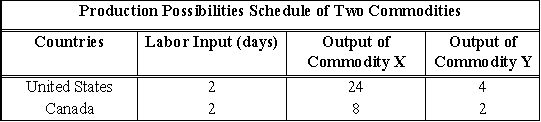 -(Exhibit: Production Possibilities Schedule for Two Commodities) Assuming constant costs in the neighborhood of their current levels of production, the exhibit shows the number of units of commodity X each country would have to forgo to produce the additional units of commodity Y indicated.Further assume that the only input is labor and that it remains fully employed.If there were unrestricted trade and specialization according to the law of comparative advantage:
 (Multiple Choice)
4.8/5 (74)
(74) The point on the production possibilities curve at which an economy will operate is determined by:
(Multiple Choice)
4.9/5 (79)
(79) If Britain, at the point where it is currently producing, must give up the production of 75 hats to produce 25 additional sweaters, the opportunity cost of producing 4 sweaters is _______ hats.
(Multiple Choice)
4.8/5 (72)
(72) Compare and contrast the effect of tariffs, quotas, voluntary export restrictions, and nontariff barriers on the consumers and producers in both the importing and exporting country.
(Essay)
4.8/5 (90)
(90) A new domestic industry with potential economies of scale is called an infant industry.
(True/False)
4.9/5 (93)
(93) According to Matthew Slaughter, as reported in the Case in Point on outsourcing, which of the following is a reason that suggests outsourcing might actually increase domestic employment?
(Multiple Choice)
4.8/5 (66)
(66) The job-protection argument states that trade restrictions are needed to speed the reallocation of workers to new jobs in domestic industries.
(True/False)
4.8/5 (80)
(80) If the United States exports 6 million bushels of corn to Japan and thereby earns income with which it imports 3 million digital video recorders from Japan, the United States' terms of trade with Japan for corn and digital video recorders is 2:1.
(True/False)
4.8/5 (89)
(89) Use the following to answer question(s): Production Possibilities for Machinery and Petroleum
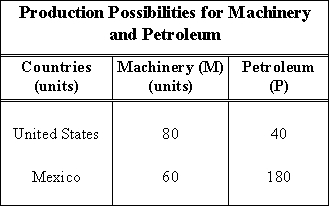 -(Exhibit: Production Possibilities for Machinery and Petroleum.) Assuming constant costs in the neighborhood of their current levels of production, the exhibit shows the number of units of machinery each country would have to forgo in order to produce the additional petroleum indicated.The opportunity cost in Mexico of producing 210 units of petroleum is _______ units of machinery.
 (Multiple Choice)
4.9/5 (91)
(91) Use the following to answer question(s): Production Possibilities in Alphaland and Omegaland
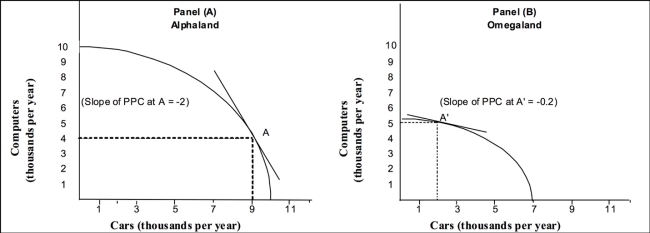 -(Exhibit: Production Possibilities in Alphaland and Omegaland) Before trade, computer producers in Alphaland could exchange _______ computer(s) for _______ car(s).
 (Multiple Choice)
4.9/5 (89)
(89) Use the following to answer question(s): Production Possibilities for Machinery and Petroleum
-(Exhibit: Production Possibilities for Machinery and Petroleum) Assuming constant costs in the neighborhood of their current levels of production, the exhibit shows the number of units of machinery each country would have to forgo in order to produce the additional petroleum indicated.The opportunity cost in the United States of producing 60 units of petroleum is _______ units of machinery.
-(Exhibit: Production Possibilities for Machinery and Petroleum) Assuming constant costs in the neighborhood of their current levels of production, the exhibit shows the number of units of machinery each country would have to forgo in order to produce the additional petroleum indicated.The opportunity cost in the United States of producing 60 units of petroleum is _______ units of machinery. (Multiple Choice)
4.8/5 (86)
(86) The relative costs of two goods produced by two countries can be determined by comparing the ________ of their ________.
(Multiple Choice)
4.7/5 (86)
(86) If the executives of the U.S.silicon-chip industry lobby Congress for protection from imports on the grounds that foreign nations gain an unfair advantage in the silicon-chip market because they exploit their workers by paying low wages, they are using the:
(Multiple Choice)
4.8/5 (78)
(78) Use the following to answer question(s): Heartland and Soulland
Suppose that there are only two countries in the world, Heartland and Soulland.The two countries produce only two goods, corn and drill presses.At its current level of production, Heartland must give up production of 1/4 drill press to produce an additional 100 bushels of corn.Soulland must give up 1 drill press to produce an additional 100 bushels of corn.No trade now occurs between the two economies, and both economies are operating on their respective production possibilities frontiers.
-(Exhibit: Heartland and Soulland) The country with a comparative advantage in the production of corn is:
(Multiple Choice)
4.9/5 (86)
(86) In the importing country, the most likely effects of tariffs and/or import quotas is to _______ prices and ________ consumption of the protected goods.
(Multiple Choice)
4.9/5 (93)
(93) In the last few decades, the United States has generally experienced trade deficits.
(True/False)
4.8/5 (80)
(80) 
Filters
- Essay(0)
- Multiple Choice(0)
- Short Answer(0)
- True False(0)
- Matching(0)