



 Chat with AI
Exam 11: The World of Imperfect Competition

Exam 1: Economics: The Study of Choice145 Questions
Exam 2: Confronting Scarcity: Choices in Production198 Questions
Exam 3: Demand and Supply251 Questions
Exam 4: Applications of Supply and Demand113 Questions
Exam 5: Elasticity: a Measure of Response255 Questions
Exam 6: Markets, Maximizers, and Efficiency239 Questions
Exam 7: The Analysis of Consumer Choice244 Questions
Exam 8: Production and Cost227 Questions
Exam 9: Competitive Markets for Goods and Services265 Questions
Exam 10: Monopoly234 Questions
Exam 11: The World of Imperfect Competition237 Questions
Exam 12: Wages and Employment in Perfect Competition189 Questions
Exam 13: Interest Rates and the Markets for Capital and Natural Resources170 Questions
Exam 14: Imperfectly Competitive Markets for Factors of Production183 Questions
Exam 15: Public Finance and Public Choice188 Questions
Exam 16: Antitrust Policy and Business Regulation137 Questions
Exam 17: International Trade186 Questions
Exam 18: The Economics of the Environment148 Questions
Exam 19: Inequality, Poverty, and Discrimination140 Questions
Select questions type


An example of monopolistic competition is the _______ market.
(Multiple Choice)
4.9/5  (83)
(83) The largest HHI possible is in the case of _______ and the index is _______ .
(Multiple Choice)
4.8/5 (74)
(74) The Case in Point on Costa Rica's National Parks indicated that the parks charged _____ prices for foreign visitors because their demand was more _____ than that of local citizens.
(Multiple Choice)
4.8/5 (82)
(82) Use the following for questions 22-31.
Exhibit: Profit Maximization in Monopolistic Competition
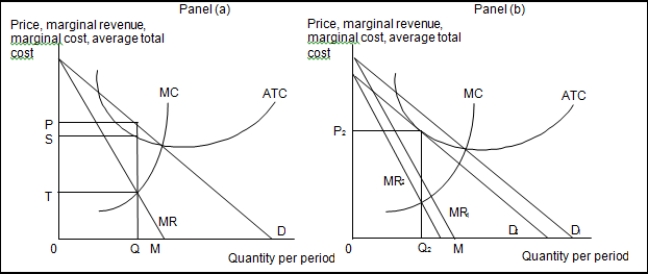 -(Exhibit: Profit Maximization in Monopolistic Competition) In monopolistic competition, long-run equilibrium is characterized by:
 (Multiple Choice)
4.8/5 (86)
(86) In the eyeglasses industry, it was found that advertising led to lower prices.
(True/False)
4.8/5 (85)
(85) The industry characterized by a few interdependent firms where there are barriers to entry is called:
(Multiple Choice)
4.9/5 (73)
(73) Use the following to answer question(s): Monopoly Through Collusion
 -(Exhibit: Monopoly Through Collusion) An exhibit similar to this one was used by the authors of the text to illustrate how firms might operate in an industry characterized as:
 (Multiple Choice)
5.0/5 (78)
(78) An unwritten, unspoken agreement through which firms limit competition among themselves is:
(Multiple Choice)
5.0/5 (73)
(73) The demand curve for a firm under monopolistic competition is:
(Multiple Choice)
4.9/5 (92)
(92) A key characteristic of monopolistic competition is product differentiation.
(True/False)
5.0/5 (75)
(75) Firms in an industry that informally agree to charge the same price as the largest firm is an example of:
(Multiple Choice)
4.7/5 (78)
(78) Use the following for questions 22-31.
Exhibit: Profit Maximization in Monopolistic Competition
-(Exhibit: Profit Maximization in Monopolistic Competition) A firm in monopolistic competition will maximize profits by producing the level of output where:
-(Exhibit: Profit Maximization in Monopolistic Competition) A firm in monopolistic competition will maximize profits by producing the level of output where: (Multiple Choice)
4.9/5 (82)
(82) Unwritten or unspoken understandings through which firms collude to restrict competition are called:
(Multiple Choice)
5.0/5 (89)
(89) The concentration ratio in a duopoly industry is likely to be lower than industries characterized by monopolistic competition.
(True/False)
4.9/5 (83)
(83) Use the following for questions 43-51.
Exhibit: Firms in Monopolistic Competition
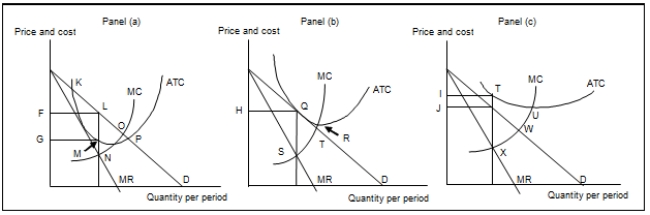 -(Exhibit: Firms in Monopolistic Competition) In Panel (a), economic profit per unit is amount:
 (Multiple Choice)
4.9/5 (86)
(86) 
Filters
- Essay(0)
- Multiple Choice(0)
- Short Answer(0)
- True False(0)
- Matching(0)