



 Chat with AI
Exam 11: The World of Imperfect Competition

Exam 1: Economics: The Study of Choice145 Questions
Exam 2: Confronting Scarcity: Choices in Production198 Questions
Exam 3: Demand and Supply251 Questions
Exam 4: Applications of Supply and Demand113 Questions
Exam 5: Elasticity: a Measure of Response255 Questions
Exam 6: Markets, Maximizers, and Efficiency239 Questions
Exam 7: The Analysis of Consumer Choice244 Questions
Exam 8: Production and Cost227 Questions
Exam 9: Competitive Markets for Goods and Services265 Questions
Exam 10: Monopoly234 Questions
Exam 11: The World of Imperfect Competition237 Questions
Exam 12: Wages and Employment in Perfect Competition189 Questions
Exam 13: Interest Rates and the Markets for Capital and Natural Resources170 Questions
Exam 14: Imperfectly Competitive Markets for Factors of Production183 Questions
Exam 15: Public Finance and Public Choice188 Questions
Exam 16: Antitrust Policy and Business Regulation137 Questions
Exam 17: International Trade186 Questions
Exam 18: The Economics of the Environment148 Questions
Exam 19: Inequality, Poverty, and Discrimination140 Questions
Select questions type


Suppose that each of two prisoners has the independent choice of confessing to a crime or not confessing.If neither confesses, they spend 2 years in jail; if both confess, they spend 3 years in jail; and if one confesses while the other does not, the confessor gets off with 1 year in jail while the other gets 6 years in jail.According to game theory, the likely strategy by the prisoners is:
(Multiple Choice)
4.8/5  (85)
(85) An industry dominated by a few firms, where each of those firms recognizes that its own choices will affect the choices of its rivals and that its rivals' choices will affect it, is a(n):
(Multiple Choice)
4.9/5 (61)
(61) Suppose that the sales of the six largest firms in an industry are 90,000, 85,000, 80,000, 75,000, 70,000, and 65,000 units, respectively.If the industry's total sales are 1 million units, the four-firm concentration ratio is:
(Multiple Choice)
4.8/5 (88)
(88) Compare, contrast, and discuss the marginal rules involved in profit maximization in the pricing decisions of firms in perfect competition and monopolistic competition.Include a graph showing the long-run equilibrium for each market structure to support your answers.
(Essay)
4.7/5 (77)
(77) Use the following for questions 22-31.
Exhibit: Profit Maximization in Monopolistic Competition
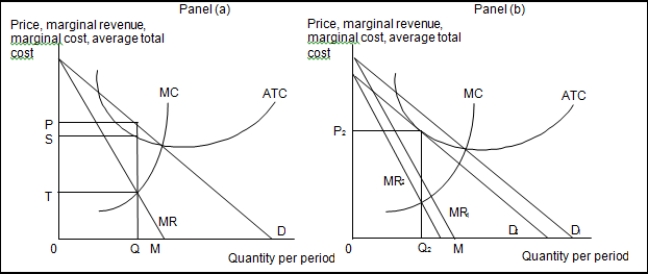 -(Exhibit: Profit Maximization in Monopolistic Competition).When the demand curve for a firm in monopolistic competition shifts, the marginal revenue curve:
 (Multiple Choice)
4.7/5 (72)
(72) Use the following to answer question(s): The Restaurant Model
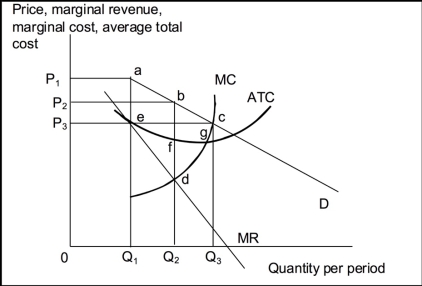 -(Exhibit: The Restaurant Market) The exhibit shows curves facing a typical restaurant in a community.Assume that the market is characterized by many firms, differentiated products, easy entry and easy exit.The restaurant shown here will maximize profits at a quantity of:
 (Multiple Choice)
4.9/5 (79)
(79) The sum of the squared market shares of each firm in an industry is the:
(Multiple Choice)
4.9/5 (90)
(90) The excess capacity in monopolistic competition may be viewed as:
(Multiple Choice)
4.9/5 (78)
(78) Use the following to answer question(s): Monopoly Through Collusion
 -(Exhibit: Monopoly Through Collusion) The exhibit illustrates the situation in an industry that consists of two firms facing identical demand curves; the demand curve for each firm is D₁.f the firms collude and agree to share the market demand equally, then each firm will act as if its marginal revenue curve is given by:
 (Multiple Choice)
4.8/5 (80)
(80) For a firm to maximize profits in monopolistic competition it should produce where P = MC.
(True/False)
4.8/5 (87)
(87) Firms in a duopoly situation may collude to choose the monopoly solution to the determination of quantity to produce and the price at which to sell their products.
(True/False)
4.8/5 (78)
(78) Suppose that each of two firms has the independent choice of advertising its product or not advertising.If neither advertises, each gets $10 million in profit; if both advertise, their profits will be $5 million each; and if one advertises while the other does not, the advertiser gets $15 million profit while the other gets $2 million profit.According to game theory, the likely strategy by the firms is:
(Multiple Choice)
4.7/5 (82)
(82) Advertising is a multi-billion industry in the United States.The costs involved in only a few seconds of advertising during the "Superbowl" run into the millions of dollars.Discuss in some detail the economics of advertising; that is, what are the positive and negative aspects of advertising from an economist's viewpoint?
(Essay)
4.7/5 (71)
(71) The municipal swimming pool charges lower entrance fees to local residents than to nonresidents.Assuming that this pricing strategy increases the profits of the pool, we can conclude that nonresidents must have a _______ for swimming at the pool than residents.
(Multiple Choice)
4.8/5 (81)
(81) The percentage of total industry output accounted for by the largest firms in the industry is the:
(Multiple Choice)
4.8/5 (70)
(70) 
Filters
- Essay(0)
- Multiple Choice(0)
- Short Answer(0)
- True False(0)
- Matching(0)