



 Chat with AI
Exam 11: The World of Imperfect Competition

Exam 1: Economics: The Study of Choice145 Questions
Exam 2: Confronting Scarcity: Choices in Production198 Questions
Exam 3: Demand and Supply251 Questions
Exam 4: Applications of Supply and Demand113 Questions
Exam 5: Elasticity: a Measure of Response255 Questions
Exam 6: Markets, Maximizers, and Efficiency239 Questions
Exam 7: The Analysis of Consumer Choice244 Questions
Exam 8: Production and Cost227 Questions
Exam 9: Competitive Markets for Goods and Services265 Questions
Exam 10: Monopoly234 Questions
Exam 11: The World of Imperfect Competition237 Questions
Exam 12: Wages and Employment in Perfect Competition189 Questions
Exam 13: Interest Rates and the Markets for Capital and Natural Resources170 Questions
Exam 14: Imperfectly Competitive Markets for Factors of Production183 Questions
Exam 15: Public Finance and Public Choice188 Questions
Exam 16: Antitrust Policy and Business Regulation137 Questions
Exam 17: International Trade186 Questions
Exam 18: The Economics of the Environment148 Questions
Exam 19: Inequality, Poverty, and Discrimination140 Questions
Select questions type


A way to measure the degree of concentration in oligopoly is to use:
(Multiple Choice)
4.7/5  (73)
(73) The demand curve for a firm under monopolistic competition is:
(Multiple Choice)
4.9/5 (79)
(79) Use the following for questions 22-31.
Exhibit: Profit Maximization in Monopolistic Competition
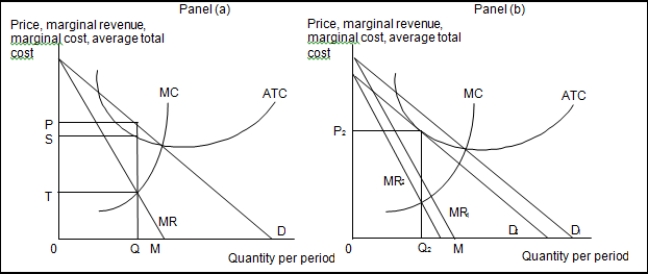 -(Exhibit: Profit Maximization in Monopolistic Competition) In Panel (b), the long-run equilibrium will result in:
 (Multiple Choice)
4.7/5 (91)
(91) An analytical approach through which strategic choices can be assessed is called:
(Multiple Choice)
4.8/5 (90)
(90) Use the following for questions 43-51.
Exhibit: Firms in Monopolistic Competition
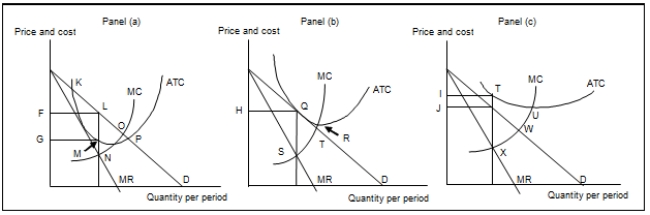 -(Exhibit: Firms in Monopolistic Competition) Negative economic profit or economic loss is incurred if the profit-maximizing price is price _______ in Panel _______ .
 (Multiple Choice)
4.9/5 (97)
(97) If the only two firms in an industry openly agree to fix the price at a given level, then this is an example of:
(Multiple Choice)
4.8/5 (80)
(80) Use the following to answer question(s): Collusion
 -(Exhibit: Collusion) Panel (c) gives the combined marginal revenue, demand, and marginal cost curves for an industry containing several firms.Panels (a) and (b) give marginal cost curves for two of those firms.The quantity of output produced by the industry under collusion is given by:
 (Multiple Choice)
4.7/5 (85)
(85) The census data sometimes _______ the degree to which a few firms dominate the market, for example, the _______ industry, in which the industries are defined too ________ .
(Multiple Choice)
4.9/5 (87)
(87) Suppose that there is an increase in the demand for dry-cleaning services in Madison, Wisconsin.What will happen to price and output for these services in the short run and in the long run? Illustrate and explain.Defend your choice of a model to analyze this problem.
(Essay)
4.9/5 (81)
(81) A feature of monopolistic competition that makes it different from monopoly is the:
(Multiple Choice)
4.7/5 (85)
(85) To practice effective price discrimination, a monopolist must be able to:
(Multiple Choice)
4.9/5 (72)
(72) Use the following for questions 43-51.
Exhibit: Firms in Monopolistic Competition
-(Exhibit: Firms in Monopolistic Competition) In Panel (c), the profit-maximizing quantity of output is generated by the intersection at point:
-(Exhibit: Firms in Monopolistic Competition) In Panel (c), the profit-maximizing quantity of output is generated by the intersection at point: (Multiple Choice)
5.0/5 (83)
(83) An oligopoly knows that its _______ affect(s) its _______ and that the _______ of its rivals will affect it.
(Multiple Choice)
4.8/5 (61)
(61) According to the text exhibit on concentration ratios and Herfindahl-Hirschman Indexes, which of the following industries has the lowest HHI?
(Multiple Choice)
4.8/5 (86)
(86) 
Filters
- Essay(0)
- Multiple Choice(0)
- Short Answer(0)
- True False(0)
- Matching(0)