



 Chat with AI
Exam 11: The World of Imperfect Competition

Exam 1: Economics: The Study of Choice145 Questions
Exam 2: Confronting Scarcity: Choices in Production198 Questions
Exam 3: Demand and Supply251 Questions
Exam 4: Applications of Supply and Demand113 Questions
Exam 5: Elasticity: a Measure of Response255 Questions
Exam 6: Markets, Maximizers, and Efficiency239 Questions
Exam 7: The Analysis of Consumer Choice244 Questions
Exam 8: Production and Cost227 Questions
Exam 9: Competitive Markets for Goods and Services265 Questions
Exam 10: Monopoly234 Questions
Exam 11: The World of Imperfect Competition237 Questions
Exam 12: Wages and Employment in Perfect Competition189 Questions
Exam 13: Interest Rates and the Markets for Capital and Natural Resources170 Questions
Exam 14: Imperfectly Competitive Markets for Factors of Production183 Questions
Exam 15: Public Finance and Public Choice188 Questions
Exam 16: Antitrust Policy and Business Regulation137 Questions
Exam 17: International Trade186 Questions
Exam 18: The Economics of the Environment148 Questions
Exam 19: Inequality, Poverty, and Discrimination140 Questions
Select questions type


Use the following to answer question(s): Monopoly Through Collusion
 -(Exhibit: Monopoly Through Collusion) Given the duopoly industry illustrated in the exhibit, if the two firms colluded to maximize their joint profits, the market price they would set would be _______ and each firm's economic profit would be _______ .
 (Multiple Choice)
4.8/5  (88)
(88) When firms openly agree on price, output, and other decisions aimed at achieving monopoly profits, those firms are practicing:
(Multiple Choice)
4.8/5 (78)
(78) If a firm wants to discriminate in regard to prices, it must be a price setter.
(True/False)
4.9/5 (74)
(74) A monopolist or an imperfectly competitive firm practices price discrimination primarily to:
(Multiple Choice)
4.8/5 (76)
(76) Except for the number of firms in the industry, monopolistic competition and perfect competition are identical market structures.
(True/False)
4.7/5 (70)
(70) Price leadership refers to the tendency of oligopolistic firms to follow the MC = MR principle of price and output determination.
(True/False)
4.8/5 (79)
(79) Use the following to answer question(s): The Restaurant Model
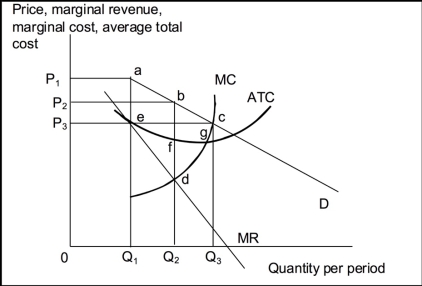 -(Exhibit: The Restaurant Market) The exhibit shows curves facing a typical restaurant in a community.Assume that the market is characterized by many firms, differentiated products, easy entry and easy exit.If the restaurant shown here is typical of others in the community, then in the long-run, prices charged by firms in the market are likely to:
 (Multiple Choice)
4.8/5 (76)
(76) Use the following to answer question(s): Collusion
 -(Exhibit: Collusion) Panel (c) gives the combined marginal revenue, demand, and marginal cost curves for an industry containing several firms.Panels (a) and (b) give marginal cost curves for two of those firms.The quantity of output produced by Firm 2 under collusion is given by:
 (Multiple Choice)
4.9/5 (86)
(86) The Case in Point on Craft Brewers suggested that this industry is an example of:
(Multiple Choice)
4.9/5 (80)
(80) In the long run, monopolistically competitive firms tend to experience:
(Multiple Choice)
4.9/5 (85)
(85) If advertising _______ competition, it tends to _______ prices.
(Multiple Choice)
4.8/5 (86)
(86) The market for plumbing services in a city can be characterized by the model of monopolistic competition.Suppose that the market is initially in long-run equilibrium, and then there is an increase in demand for plumbing services.We expect that in the short run the price:
(Multiple Choice)
4.9/5 (85)
(85) Because tourist demand for airline flights is relatively _______ , small _______ in price will result in relatively _______ in additional tourists.
(Multiple Choice)
4.9/5 (79)
(79) Use the following to answer question(s): Monopoly Through Collusion
-(Exhibit: Monopoly Through Collusion) Given the duopoly industry illustrated in the exhibit, if the two firms colluded to maximize their combined economic profits, the market price they would set would be _______ and combined economic profits of the firms would be _______ .
-(Exhibit: Monopoly Through Collusion) Given the duopoly industry illustrated in the exhibit, if the two firms colluded to maximize their combined economic profits, the market price they would set would be _______ and combined economic profits of the firms would be _______ . (Multiple Choice)
4.9/5 (68)
(68) Use the following for questions 22-31.
Exhibit: Profit Maximization in Monopolistic Competition
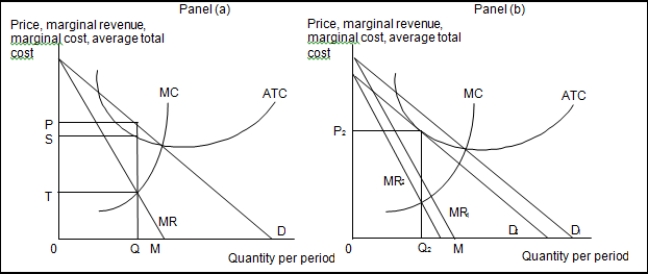 -(Exhibit: Profit Maximization in Monopolistic Competition) In Panel (a), if the firm raises its price above P, it will:
 (Multiple Choice)
4.9/5 (62)
(62) The city bus system charges lower fares to senior citizens than to other passengers.Assuming that this pricing strategy increases the profits of the bus system, we can conclude that senior citizens must have a _______ for bus service than other passengers.
(Multiple Choice)
4.9/5 (77)
(77) 
Filters
- Essay(0)
- Multiple Choice(0)
- Short Answer(0)
- True False(0)
- Matching(0)