



 Chat with AI
Exam 6: Markets, Maximizers, and Efficiency

Exam 1: Economics: The Study of Choice145 Questions
Exam 2: Confronting Scarcity: Choices in Production198 Questions
Exam 3: Demand and Supply251 Questions
Exam 4: Applications of Supply and Demand113 Questions
Exam 5: Elasticity: a Measure of Response255 Questions
Exam 6: Markets, Maximizers, and Efficiency239 Questions
Exam 7: The Analysis of Consumer Choice244 Questions
Exam 8: Production and Cost227 Questions
Exam 9: Competitive Markets for Goods and Services265 Questions
Exam 10: Monopoly234 Questions
Exam 11: The World of Imperfect Competition237 Questions
Exam 12: Wages and Employment in Perfect Competition189 Questions
Exam 13: Interest Rates and the Markets for Capital and Natural Resources170 Questions
Exam 14: Imperfectly Competitive Markets for Factors of Production183 Questions
Exam 15: Public Finance and Public Choice188 Questions
Exam 16: Antitrust Policy and Business Regulation137 Questions
Exam 17: International Trade186 Questions
Exam 18: The Economics of the Environment148 Questions
Exam 19: Inequality, Poverty, and Discrimination140 Questions
Select questions type


Suppose that the expected exam scores from studying economics for 0, 1, 2, or 3 hours are 65, 80, 90, and 95 points, respectively, while the expected exam scores for studying 0, 1, 2, or 3 hours of accounting are 50, 65, 70, and 70 points, respectively.With 3 total hours of study time, your combined scores can reach a maximum of _______ points.
(Multiple Choice)
4.8/5  (82)
(82) Use the following to answer question(s): Markets and Efficiency
 -(Exhibit: Markets and Efficiency) The exhibit illustrates that the marketplace can be thought of as a:
 (Multiple Choice)
4.9/5 (75)
(75) Public goods are not sold in efficient quantities in the marketplace because:
(Multiple Choice)
4.7/5 (78)
(78) The difference between a firm's total revenue and its total economic cost is:
(Multiple Choice)
4.8/5 (65)
(65) Use the following for questions 111-115.

 -(Exhibit: The Demand for Golf Balls) Assume that 3 dozen golf balls are purchased for $14 per dozen.Consumer surplus is:
 (Multiple Choice)
4.9/5 (82)
(82) When public goods are provided by private firms, with no government involvement, we expect that:
(Multiple Choice)
4.8/5 (76)
(76) If the price of popcorn is $0.50 per box and the price of peanuts is $0.25 per bag, and you have $5 to spend on both goods, the maximum quantity of popcorn that you can purchase is _______ boxes.
(Multiple Choice)
4.7/5 (73)
(73) The marginal decision rule requires that for an individual to maximize utility, MB>MC.
(True/False)
4.8/5 (78)
(78) The marginal cost is the amount by which an additional unit of activity increases total cost.
(True/False)
4.8/5 (59)
(59) If the price of popcorn is $0.50 per box and the price of peanuts is $0.25 per bag, and you have $10 to spend on both goods, the maximum quantity of peanuts that you can purchase is _______ bags.
(Multiple Choice)
4.9/5 (70)
(70) Suppose that the expected exam scores from studying economics for 0, 1, 2, or 3 hours are 65, 80, 90, and 95 points, respectively, while the expected exam scores for studying 0, 1, 2, or 3 hours of accounting are 50, 65, 70, and 70 points, respectively.With 3 total hours of study time, the opportunity (or marginal) cost in terms of your accounting score of spending the first hour studying economics is ________ points.
(Multiple Choice)
4.7/5 (77)
(77) If the market supply and demand curves for computers include all costs or benefits, then in this case:
(Multiple Choice)
4.8/5 (65)
(65) Use the following to answer question(s): Surplus and Supply
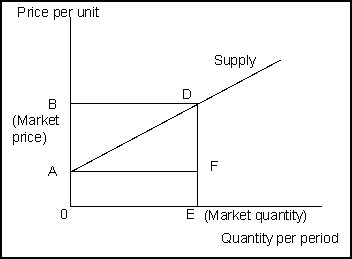 -(Exhibit: Surplus and Supply) The difference between the total revenue received by sellers and their total cost is called _______ surplus, and for output level OE is depicted by the area enclosed in _______ .
 (Multiple Choice)
4.7/5 (86)
(86) An efficient allocation of resources is one that achieves the maximum net benefit from all activities.
(True/False)
5.0/5 (80)
(80) Use the following to answer question(s): Markets and Efficiency
-(Exhibit: Markets and Efficiency) In Panel (b) demand shifted from D₁ to D₂, reflecting a change in consumer preferences.The price of apples will change to the new equilibrium price:
-(Exhibit: Markets and Efficiency) In Panel (b) demand shifted from D₁ to D₂, reflecting a change in consumer preferences.The price of apples will change to the new equilibrium price: (Multiple Choice)
4.8/5 (86)
(86) 
Filters
- Essay(0)
- Multiple Choice(0)
- Short Answer(0)
- True False(0)
- Matching(0)