



 Chat with AI
Exam 6: Markets, Maximizers, and Efficiency

Exam 1: Economics: The Study of Choice145 Questions
Exam 2: Confronting Scarcity: Choices in Production198 Questions
Exam 3: Demand and Supply251 Questions
Exam 4: Applications of Supply and Demand113 Questions
Exam 5: Elasticity: a Measure of Response255 Questions
Exam 6: Markets, Maximizers, and Efficiency239 Questions
Exam 7: The Analysis of Consumer Choice244 Questions
Exam 8: Production and Cost227 Questions
Exam 9: Competitive Markets for Goods and Services265 Questions
Exam 10: Monopoly234 Questions
Exam 11: The World of Imperfect Competition237 Questions
Exam 12: Wages and Employment in Perfect Competition189 Questions
Exam 13: Interest Rates and the Markets for Capital and Natural Resources170 Questions
Exam 14: Imperfectly Competitive Markets for Factors of Production183 Questions
Exam 15: Public Finance and Public Choice188 Questions
Exam 16: Antitrust Policy and Business Regulation137 Questions
Exam 17: International Trade186 Questions
Exam 18: The Economics of the Environment148 Questions
Exam 19: Inequality, Poverty, and Discrimination140 Questions
Select questions type


If the price of popcorn is $0.50 per box and the price of peanuts is $0.25 per bag, and you have $10 to spend on both goods, the maximum quantity of popcorn that you can purchase is _______ boxes.
(Multiple Choice)
4.8/5  (85)
(85) To determine the quantity of any activity that will maximize net benefit, economists employ the ________ rule.
(Multiple Choice)
4.9/5 (73)
(73) How does a competitive market guide the maximizing choices made by consumers and firms?
(Essay)
4.9/5 (85)
(85) Use the following for questions 111-115.

 -(Exhibit: The Demand for Golf Balls) Assume that 4 dozen golf balls are purchased for $12 per dozen.Consumer surplus is:
 (Multiple Choice)
4.9/5 (86)
(86) If the marginal benefit received from a good is less than the marginal cost of production, then:
(Multiple Choice)
4.9/5 (76)
(76) An allocation of resources that achieves the maximum net benefit from all activities is:
(Multiple Choice)
4.9/5 (88)
(88) Use the following to answer question(s): Markets and Efficiency
 -(Exhibit: Markets and Efficiency) In panel (a):
 (Multiple Choice)
4.9/5 (94)
(94) An _______ results from any action that creates benefits for others outside of any market exchange.
(Multiple Choice)
4.9/5 (79)
(79) Use the following to answer question 160.
Exhibit: Market Failure 2
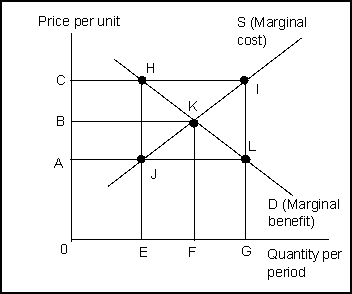 -(Exhibit: Market Failure 2) If a competitive market has an external cost of the amount AC, and if the government imposes a fee to cover the cost, the market will achieve the equilibrium point:
 (Multiple Choice)
4.8/5 (82)
(82) The best example of a private good, exchanged in competitive markets and for which exclusion is possible, is:
(Multiple Choice)
4.8/5 (93)
(93) The best example of a public good, produced by the government and for which exclusion is not possible, is:
(Multiple Choice)
4.9/5 (98)
(98) Use the following for questions 55-59.
Exhibit: Marginal Benefit, Marginal Cost, and Net Benefit
 -(Exhibit: Marginal Benefit, Marginal Cost, and Net Benefit) In Panel (b) at activity level E, _______ , and in Panel (c) at activity level J, _______ .
 (Multiple Choice)
4.8/5 (78)
(78) All of the following are examples of external cost EXCEPT:
(Multiple Choice)
4.9/5 (77)
(77) As consumers make choices in the marketplace, they reveal information about their:
(Multiple Choice)
4.7/5 (89)
(89) When we judge the performance of the economy, we must consider:
(Multiple Choice)
4.7/5 (71)
(71) The market failure of external cost is most likely to result if Peanuts 'R' Us:
(Multiple Choice)
4.9/5 (89)
(89) 
Filters
- Essay(0)
- Multiple Choice(0)
- Short Answer(0)
- True False(0)
- Matching(0)