



 Chat with AI
Exam 6: Markets, Maximizers, and Efficiency

Exam 1: Economics: The Study of Choice145 Questions
Exam 2: Confronting Scarcity: Choices in Production198 Questions
Exam 3: Demand and Supply251 Questions
Exam 4: Applications of Supply and Demand113 Questions
Exam 5: Elasticity: a Measure of Response255 Questions
Exam 6: Markets, Maximizers, and Efficiency239 Questions
Exam 7: The Analysis of Consumer Choice244 Questions
Exam 8: Production and Cost227 Questions
Exam 9: Competitive Markets for Goods and Services265 Questions
Exam 10: Monopoly234 Questions
Exam 11: The World of Imperfect Competition237 Questions
Exam 12: Wages and Employment in Perfect Competition189 Questions
Exam 13: Interest Rates and the Markets for Capital and Natural Resources170 Questions
Exam 14: Imperfectly Competitive Markets for Factors of Production183 Questions
Exam 15: Public Finance and Public Choice188 Questions
Exam 16: Antitrust Policy and Business Regulation137 Questions
Exam 17: International Trade186 Questions
Exam 18: The Economics of the Environment148 Questions
Exam 19: Inequality, Poverty, and Discrimination140 Questions
Select questions type


The failure to achieve an efficient allocation of resources is called market failure.
(True/False)
4.8/5  (76)
(76) Net benefit is maximized when marginal benefit _______ marginal cost.
(Multiple Choice)
4.9/5 (69)
(69) The amount by which an additional unit of an activity increases total benefit is:
(Multiple Choice)
5.0/5 (72)
(72) An efficient allocation of resources is also an equitable allocation of resources.
(True/False)
4.9/5 (83)
(83) Whenever MB < MC, the decisionmaker should do _______ of the activity.
(Multiple Choice)
4.9/5 (88)
(88) An external cost is imposed when an action imposes costs on others outside the context of market exchange.
(True/False)
4.7/5 (78)
(78) If the price of popcorn is $0.50 per box and the price of peanuts is $0.25 per bag, and you have $10 to spend and decide to purchase 20 bags of peanuts, the maximum quantity of popcorn that you can purchase is _______ boxes.
(Multiple Choice)
4.9/5 (64)
(64) Because individuals are unlikely to reveal their demand for public goods, private firms will produce a _______ quantity of public goods than is _______ .
(Multiple Choice)
4.9/5 (85)
(85) An efficient allocation of resources is one that maximizes the net benefits of each activity.
(True/False)
4.9/5 (94)
(94) The marginal benefit is the amount by which an additional unit of activity increases total benefit.
(True/False)
4.9/5 (72)
(72) Market power exerted by either buyers or sellers is an example of:
(Multiple Choice)
5.0/5 (85)
(85) Automobile emissions generate pollution and cause higher costs and discomfort to residents of a city.In this case:
(Multiple Choice)
4.9/5 (79)
(79) According to the authors of your text, whatever distribution of income society chooses, an ________ allocation of resources is preferred to an _______ one.
(Multiple Choice)
4.9/5 (84)
(84) Activities that generate external costs will likely be carried out at levels that _______ those that would be efficient.
(Multiple Choice)
4.8/5 (64)
(64) Use the following to answer question(s): Markets and Efficiency
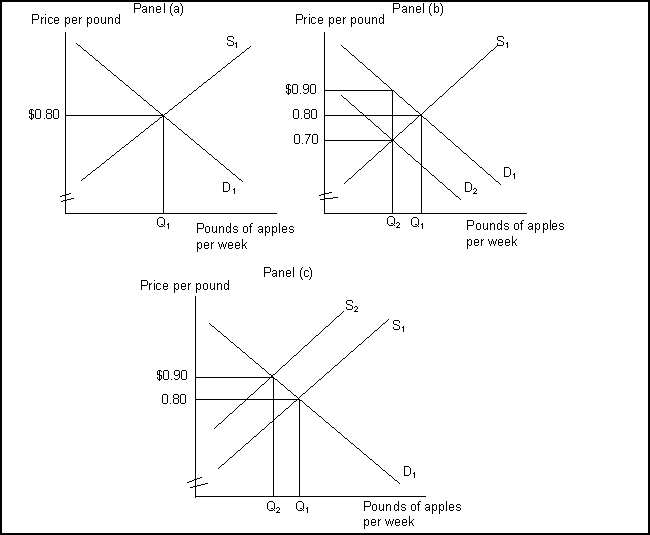 -(Exhibit: Markets and Efficiency) Refer to Panel (c).Suppose the costs to apple producers rise.This will:
 (Multiple Choice)
4.8/5 (93)
(93) The marginal cost of an additional unit of a private good is zero.
(True/False)
4.8/5 (85)
(85) 
Filters
- Essay(0)
- Multiple Choice(0)
- Short Answer(0)
- True False(0)
- Matching(0)