



 Chat with AI
Exam 6: Markets, Maximizers, and Efficiency

Exam 1: Economics: The Study of Choice145 Questions
Exam 2: Confronting Scarcity: Choices in Production198 Questions
Exam 3: Demand and Supply251 Questions
Exam 4: Applications of Supply and Demand113 Questions
Exam 5: Elasticity: a Measure of Response255 Questions
Exam 6: Markets, Maximizers, and Efficiency239 Questions
Exam 7: The Analysis of Consumer Choice244 Questions
Exam 8: Production and Cost227 Questions
Exam 9: Competitive Markets for Goods and Services265 Questions
Exam 10: Monopoly234 Questions
Exam 11: The World of Imperfect Competition237 Questions
Exam 12: Wages and Employment in Perfect Competition189 Questions
Exam 13: Interest Rates and the Markets for Capital and Natural Resources170 Questions
Exam 14: Imperfectly Competitive Markets for Factors of Production183 Questions
Exam 15: Public Finance and Public Choice188 Questions
Exam 16: Antitrust Policy and Business Regulation137 Questions
Exam 17: International Trade186 Questions
Exam 18: The Economics of the Environment148 Questions
Exam 19: Inequality, Poverty, and Discrimination140 Questions
Select questions type


Use the following to answer question(s): Marginal Benefits and Marginal Costs
 -(Exhibit: Marginal Benefits and Marginal Costs) In the exhibit, more time spent studying economics adds points to economics scores but subtracts points from accounting scores.The marginal benefit of studying economics when the student is at 2 hours is _______ points and the marginal cost is _______ points.
 (Multiple Choice)
4.8/5  (70)
(70) According to the Case in Point on wildlife and property rights:
(Multiple Choice)
4.8/5 (79)
(79) Use the following to answer question(s): Surplus and Supply
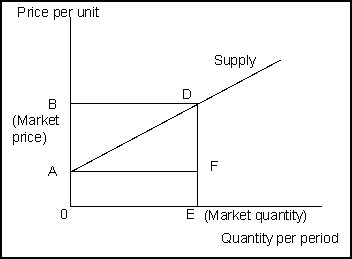 -(Exhibit: Surplus and Supply) At output level OE, the total costs to sellers is _______ , the total revenues to sellers is _______ , and the producer surplus is _______ .
 (Multiple Choice)
4.9/5 (72)
(72) When price signals reflect _______ benefits and _______ costs of choices, we expect that the allocation of resources will be _______ .
(Multiple Choice)
4.8/5 (74)
(74) An external cost would cause _______ production of the good and may require a _______ to internalize the externality into the market.
(Multiple Choice)
4.9/5 (98)
(98) If the marginal benefit received from a good is greater than the marginal cost of production, then:
(Multiple Choice)
4.8/5 (79)
(79) Making a statement about an equitable or inequitable distribution of income:
(Multiple Choice)
4.8/5 (66)
(66) Public goods are goods for which the cost of exclusion is prohibitive.
(True/False)
4.9/5 (99)
(99) To be effective in facilitating exchange, property rights must be:
(Multiple Choice)
4.8/5 (68)
(68) An inefficient allocation of resources is one that does not maximize the net benefits of each activity.
(True/False)
4.7/5 (85)
(85) Use the following to answer question(s): Market Failure 1
 -(Exhibit: Market Failure 1) If the market produces quantity G, then:
 (Multiple Choice)
4.7/5 (77)
(77) When the net benefits of all economic activities are maximized, economists say the allocation of resources is _______ .
(Multiple Choice)
5.0/5 (72)
(72) Explain the approach through which decisionmakers can maximize the return from an activity.
(Essay)
4.9/5 (77)
(77) Common property resources have never been a serious problem in the efficient allocation of resources.
(True/False)
4.9/5 (80)
(80) A boundary that limits the range of choices an individual or a firm can make is:
(Multiple Choice)
4.8/5 (94)
(94) 
Filters
- Essay(0)
- Multiple Choice(0)
- Short Answer(0)
- True False(0)
- Matching(0)