



 Chat with AI
Exam 7: Human Populations

Exam 1: Understanding Our Environment51 Questions
Exam 2: Principles of Science and Systems26 Questions
Exam 3: Matter, Energy, and Life60 Questions
Exam 4: Evolution, Biological Communities, and Species Interactions48 Questions
Exam 5: Biomes58 Questions
Exam 6: Population Biology40 Questions
Exam 7: Human Populations66 Questions
Exam 8: Environmental Health and Toxicology63 Questions
Exam 9: Food and Hunger35 Questions
Exam 10: Farming: Conventional and Sustainable Practices82 Questions
Exam 11: Biodiversity55 Questions
Exam 12: Biodiversity: Preserving Landscapes49 Questions
Exam 13: Restoration Ecology41 Questions
Exam 14: Geology and Earth Resources47 Questions
Exam 15: Climate Change63 Questions
Exam 16: Air Pollution59 Questions
Exam 17: Water Use and Management42 Questions
Exam 18: Water Pollution49 Questions
Exam 19: Conventional Energy53 Questions
Exam 20: Sustainable Energy43 Questions
Exam 21: Solid, Toxic, and Hazardous Waste47 Questions
Exam 22: Urbanization and Sustainable Cities41 Questions
Exam 23: Ecological Economics55 Questions
Exam 24: Environmental Policy, Law, and Planning55 Questions
Exam 25: What Then Shall We Do37 Questions
Select questions type


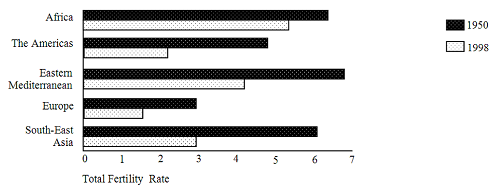 -According to the graph, which region has the greatest fertility reduction?
 (Multiple Choice)
4.9/5  (86)
(86) The message from author Garret Hardin's "lifeboat ethics" is that
(Multiple Choice)
4.8/5 (82)
(82) Which of the following factors does not usually affect the crude death rates of a population?
(Multiple Choice)
4.8/5 (68)
(68) Draw a graph that shows the relationship of education for females and infant mortality rates.Appropriately label the x and y axes.
(Essay)
4.9/5 (69)
(69) Use the following demographic data on three hypothetical countries
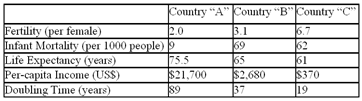 -The most industrialized country listed is
 (Multiple Choice)
5.0/5 (85)
(85) 
Filters
- Essay(0)
- Multiple Choice(0)
- Short Answer(0)
- True False(0)
- Matching(0)