



 Chat with AI
Exam 22: Developing Countries: Growth, Crisis, and Reform

Exam 1: Introduction39 Questions
Exam 2: World Trade: An Overview25 Questions
Exam 3: Labor Productivity and Comparative Advantage: The Ricardian Model66 Questions
Exam 4: Specific Factors and Income Distribution68 Questions
Exam 5: Resources and Trade: The Heckscher-Ohlin Model63 Questions
Exam 6: The Standard Trade Model43 Questions
Exam 7: External Economies of Scale and the International Location of Production29 Questions
Exam 8: Firms in the Global Economy: Export Decisions, Outsourcing, and Multinational Enterprises64 Questions
Exam 9: The Instruments of Trade Policy62 Questions
Exam 10: The Political Economy of Trade Policy61 Questions
Exam 11: Trade Policy in Developing Countries43 Questions
Exam 12: Controversies in Trade Policy47 Questions
Exam 13: National Income Accounting and the Balance of Payments78 Questions
Exam 14: Exchange Rates and the Foreign Exchange Market: An Asset Approach76 Questions
Exam 15: Money, Interest Rates, and Exchange Rates65 Questions
Exam 16: Price Levels and the Exchange Rate in the Long Run80 Questions
Exam 17: Output and the Exchange Rate in the Short Run111 Questions
Exam 18: Fixed Exchange Rates and Foreign Exchange Intervention80 Questions
Exam 19: International Monetary Systems: An Historical Overview162 Questions
Exam 20: Optimum Currency Areas and the European Experience95 Questions
Exam 21: Financial Globalization: Opportunity and Crisis125 Questions
Exam 22: Developing Countries: Growth, Crisis, and Reform129 Questions
Select questions type


As of 2010, how large is the debt of developing countries to the rest of the world?
(Multiple Choice)
4.8/5  (83)
(83) Please consider Table 22-2 below. 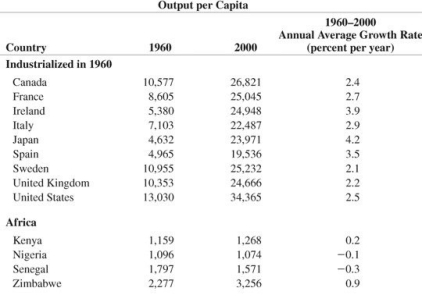
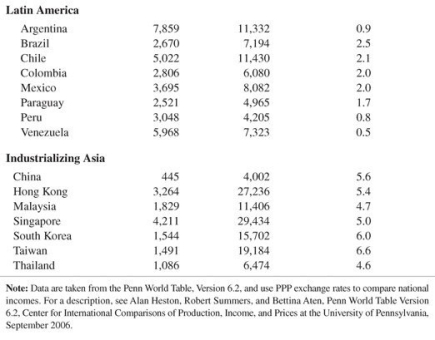 Assuming constant Annual Average Growth Rate in the future, calculate the output per capita for the United States and South Korea for the year 2040.
 (Essay)
4.9/5 (80)
(80) In 1991, Argentina established a radical institutional reform after experiencing a decade marked by financial instability. This program was called the new Convertibility Law. What did this law do?
(Multiple Choice)
4.8/5 (73)
(73) In the instances where a loan has been issued under certain terms and has to be repaid, what happens when the borrower does not uphold these stipulations?
(Multiple Choice)
4.8/5 (79)
(79) A considerable advantage that richer countries have over poorer ones is exemplified by the fact that:
(Multiple Choice)
4.8/5 (76)
(76) Explain the following simple algebra of moral hazard. Suppose a real estate deal, which requires 100 million as investment today will yield 120 million with probability of 10 percent and will lose 20 million with probability of 90 percent. Suppose that the interest rate is 5 percent per annum.
(a) Without government intervention, would anyone invest in this deal?
(b) Suppose that now the deal is backed by full government guarantee. What will be the outcome? Does your answer depend on the attitude of the investor toward risk?
(c) Suppose that now government guarantying only 80 percent of the initial investment. What will be the outcome? Does your answer depend on the attitude of the investor toward risk?
(Essay)
4.8/5 (81)
(81) The main factors that discourage investment in capital and skills in developing countries are:
(Multiple Choice)
4.9/5 (82)
(82) Explain how Brazil was able to reduce the rate of inflation from 2,669 percent in 1994 to less than 10 percent in 1997?
(Essay)
4.7/5 (73)
(73) How was South Korea able to become one of the East Asian Economic Miracles?
(Essay)
4.7/5 (82)
(82) Which Latin American country defaulted on loans in 2005 and paid off their creditors at only 1/3 value?
(Multiple Choice)
4.8/5 (70)
(70) The world's economies can be divided into four main categories according to their annual per-capita income levels: low-income, lower middle-income, upper middle-income and high-income economies. What category would Korea fall under?
(Multiple Choice)
4.8/5 (95)
(95) A trend that has been reinforced by many developing countries is privatization. Privatization refers to:
(Multiple Choice)
4.7/5 (78)
(78) Explain why Argentina, one of the world's richest countries at the start of the twentieth century, has become progressively poorer relative to the industrial countries. [An alternative question: What explains Argentina's regress from riches to rags?]
(Essay)
4.8/5 (82)
(82) Why may equity finance be preferred to debt finance for developing countries?
(Multiple Choice)
4.9/5 (74)
(74) Countries in Africa have grown at rates far ________ those of the main industrial countries.
(Multiple Choice)
4.7/5 (73)
(73) Explain why East Asian countries have done so well relative to South American countries.
(Essay)
4.9/5 (79)
(79) 
Filters
- Essay(0)
- Multiple Choice(0)
- Short Answer(0)
- True False(0)
- Matching(0)