



 Chat with AI
Exam 6: The Standard Trade Model

Exam 1: Introduction39 Questions
Exam 2: World Trade: An Overview25 Questions
Exam 3: Labor Productivity and Comparative Advantage: The Ricardian Model66 Questions
Exam 4: Specific Factors and Income Distribution68 Questions
Exam 5: Resources and Trade: The Heckscher-Ohlin Model63 Questions
Exam 6: The Standard Trade Model43 Questions
Exam 7: External Economies of Scale and the International Location of Production29 Questions
Exam 8: Firms in the Global Economy: Export Decisions, Outsourcing, and Multinational Enterprises64 Questions
Exam 9: The Instruments of Trade Policy62 Questions
Exam 10: The Political Economy of Trade Policy61 Questions
Exam 11: Trade Policy in Developing Countries43 Questions
Exam 12: Controversies in Trade Policy47 Questions
Exam 13: National Income Accounting and the Balance of Payments78 Questions
Exam 14: Exchange Rates and the Foreign Exchange Market: An Asset Approach76 Questions
Exam 15: Money, Interest Rates, and Exchange Rates65 Questions
Exam 16: Price Levels and the Exchange Rate in the Long Run80 Questions
Exam 17: Output and the Exchange Rate in the Short Run111 Questions
Exam 18: Fixed Exchange Rates and Foreign Exchange Intervention80 Questions
Exam 19: International Monetary Systems: An Historical Overview162 Questions
Exam 20: Optimum Currency Areas and the European Experience95 Questions
Exam 21: Financial Globalization: Opportunity and Crisis125 Questions
Exam 22: Developing Countries: Growth, Crisis, and Reform129 Questions
Select questions type


If Slovenia were a large country in world trade, then if it instituted a large set of subsidies for its exports, this must

Free
(Multiple Choice)
4.8/5  (63)
(63) Correct Answer: Verified
A
If Slovenia is a small country in world trade terms, then if it imposes a large series of tariffs on many of its imports, this would
Free
(Multiple Choice)
5.0/5 (83)
(83) Correct Answer:Verified
VerifiedA
If two countries with diminishing returns and different marginal rates of substitution between two products were to engage in trade, then
Free
(Multiple Choice)
4.8/5 (70)
(70) Correct Answer:Verified
VerifiedA
An export subsidy has the opposite effect on terms of trade to the effect of an import tariff. Domestically a tariff will raise the price of the import good, deteriorating the domestic terms of trade. A production subsidy for the export product will lower the local price of the export good, lowering the domestic terms of trade for the country. Hence the export subsidy and the import tariff have the same effect. This analysis seems to contradict the first sentence in this paragraph. Discuss this paradox.
(Essay)
4.8/5 (65)
(65) An export subsidy will cause the terms of trade of the ________ country to ________ and will ________ the country.
(Multiple Choice)
4.8/5 (81)
(81) A country will be able to consume a combination of goods that is not attainable solely from domestic production if
(Multiple Choice)
4.9/5 (65)
(65) If Slovenia is a large country in world trade, then if it imposes a large set of tariffs on many of its imports, this would
(Multiple Choice)
4.8/5 (71)
(71) An export subsidy will cause the relative demand for ________ to ________ and the relative supply for ________ to ________.
(Multiple Choice)
4.8/5 (73)
(73) Other things being equal, a rise in a country's terms of trade increases its welfare. What would happen if we relax the ceteris paribus assumption, and allow for the law of demand to operate internationally?
(Essay)
4.9/5 (70)
(70) 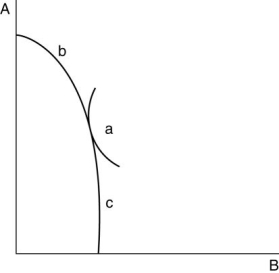 -Refer to above figure. Now, suppose that the relative price of A is actually not higher than Albania's autarkic level of 1, but quite the opposite (e.g., PA/PB = 0.5). Would Albania still be able to gain from trade? If so, where would be its production point? Given the information in this question, where is Albania's comparative advantage?
 (Essay)
4.7/5 (74)
(74) If points A and B are two locations on a country's production possibility frontier, then
(Multiple Choice)
5.0/5 (95)
(95) When the production possibility frontier shifts out relatively more in one direction, we have
(Multiple Choice)
4.8/5 (77)
(77) If the ratio of price of cloth (PC) divided by the price of food (PF) increases in the international marketplace, then
(Multiple Choice)
4.7/5 (84)
(84) 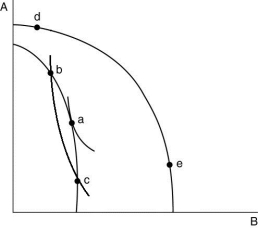 -Refer to the figure above, which shows a country's possible production possibility frontiers and indifference curves. If the country is producing at ________, then moving to ________ will cause utility to ________.
 (Multiple Choice)
4.9/5 (67)
(67) If a small country were to levy a tariff on its imports then this would
(Multiple Choice)
4.8/5 (84)
(84) 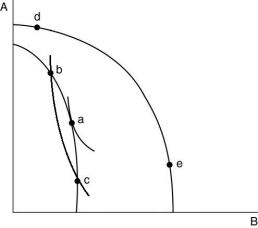 -Refer to the figure above, which shows a country's possible production possibility frontiers and indifference curves. If the country is producing at ________, then moving to ________ will cause utility to ________.
 (Multiple Choice)
4.9/5 (75)
(75) Suppose that a country experiences growth strongly biased toward its export, cloth,
(Multiple Choice)
4.9/5 (82)
(82)
-Refer to above figure. Albania refused to engage in international trade for ideological reasons. To maximize its economic welfare it would choose to produce at which point in the diagram above? Suppose the PA/PB at point a was equal to 1. Given this information, in which good (A or
B) does Albania enjoy a comparative advantage?
Now that the Cold War is over, Albania is interested in obtaining economic welfare gains from trade. The relevant international relative price is PA/PB = 2. Albania would therefore choose to produce at which point (a, b, or c)? Given this additional information, in which good does Albania enjoy a comparative advantage?
-Refer to above figure. Albania refused to engage in international trade for ideological reasons. To maximize its economic welfare it would choose to produce at which point in the diagram above? Suppose the PA/PB at point a was equal to 1. Given this information, in which good (A or
B) does Albania enjoy a comparative advantage?
Now that the Cold War is over, Albania is interested in obtaining economic welfare gains from trade. The relevant international relative price is PA/PB = 2. Albania would therefore choose to produce at which point (a, b, or c)? Given this additional information, in which good does Albania enjoy a comparative advantage? (Essay)
4.8/5 (69)
(69) The price of ________ consumption in terms of ________ consumption is ________.
(Multiple Choice)
4.9/5 (80)
(80) If the ratio of price of cloth (PC) divided by the price of food (PF) increases in the international marketplace, then
(Multiple Choice)
4.9/5 (76)
(76) 
Filters
- Essay(0)
- Multiple Choice(0)
- Short Answer(0)
- True False(0)
- Matching(0)