



 Chat with AI
Exam 6: The Standard Trade Model

Exam 1: Introduction39 Questions
Exam 2: World Trade: An Overview25 Questions
Exam 3: Labor Productivity and Comparative Advantage: The Ricardian Model66 Questions
Exam 4: Specific Factors and Income Distribution68 Questions
Exam 5: Resources and Trade: The Heckscher-Ohlin Model63 Questions
Exam 6: The Standard Trade Model43 Questions
Exam 7: External Economies of Scale and the International Location of Production29 Questions
Exam 8: Firms in the Global Economy: Export Decisions, Outsourcing, and Multinational Enterprises64 Questions
Exam 9: The Instruments of Trade Policy62 Questions
Exam 10: The Political Economy of Trade Policy61 Questions
Exam 11: Trade Policy in Developing Countries43 Questions
Exam 12: Controversies in Trade Policy47 Questions
Exam 13: National Income Accounting and the Balance of Payments78 Questions
Exam 14: Exchange Rates and the Foreign Exchange Market: An Asset Approach76 Questions
Exam 15: Money, Interest Rates, and Exchange Rates65 Questions
Exam 16: Price Levels and the Exchange Rate in the Long Run80 Questions
Exam 17: Output and the Exchange Rate in the Short Run111 Questions
Exam 18: Fixed Exchange Rates and Foreign Exchange Intervention80 Questions
Exam 19: International Monetary Systems: An Historical Overview162 Questions
Exam 20: Optimum Currency Areas and the European Experience95 Questions
Exam 21: Financial Globalization: Opportunity and Crisis125 Questions
Exam 22: Developing Countries: Growth, Crisis, and Reform129 Questions
Select questions type


An import tariff will cause the relative demand for ________ to ________ and the relative supply for ________ to ________.
(Multiple Choice)
4.9/5  (66)
(66) If the U.S. (a large country) imposes a tariff on its imported good, this will tend to
(Multiple Choice)
4.9/5 (87)
(87) Suppose that a "small country" experiences growth strongly biased toward its export, cloth,
(Multiple Choice)
5.0/5 (94)
(94) If Slovenia were a large country in world trade, then if it imposes a large set of tariffs on its imports, this must
(Multiple Choice)
4.8/5 (91)
(91) Rapidly growing developing countries tend to be borrowers on the international capital markets. From this information we may surmise that they have a comparative advantage in
(Multiple Choice)
4.9/5 (88)
(88) 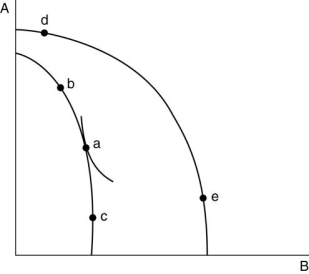 -Suppose, as a result of various dynamic factors associated with exposure to international competition, Albania's economy grew, and is now represented by the rightmost production possibility frontier in the figure above. If its point of production with trade was point c, would you consider this growth to be export-biased or import biased? If Albania were a large country with respect to the world trade of A and B, how would this growth affect Albania's terms of trade? Its real income?
 (Essay)
4.7/5 (87)
(87) If Slovenia were a large country in world trade, then if it instituted a large set of subsidies for its exports, this must
(Multiple Choice)
4.8/5 (88)
(88) International borrowing and lending may be interpreted as one form of
(Multiple Choice)
4.9/5 (72)
(72) It may be argued that theoretically, international capital movements
(Multiple Choice)
4.8/5 (84)
(84) If the economy is producing at point a on its production possibility frontier, then
(Multiple Choice)
4.7/5 (64)
(64) A country cannot produce a mix of products with a higher value than where
(Multiple Choice)
4.7/5 (96)
(96)
-Suppose Albania is exporting product B, and experienced economic growth biased in favor of product B as seen in the figure above. We are also told that Albania's new consumption point is at point d. Would you still consider the economic growth, which took place biased in favor of B? If Albania were a large country how would this growth affect its terms of trade?
-Suppose Albania is exporting product B, and experienced economic growth biased in favor of product B as seen in the figure above. We are also told that Albania's new consumption point is at point d. Would you still consider the economic growth, which took place biased in favor of B? If Albania were a large country how would this growth affect its terms of trade? (Essay)
4.8/5 (87)
(87) An increase in a country's net commodity terms of trade will
(Multiple Choice)
4.8/5 (71)
(71) 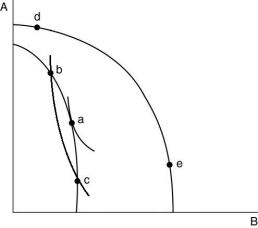 -Refer to the figure above, which shows a country's possible production possibility frontiers and indifference curves. If the country is producing at ________, then moving to ________ will cause utility to ________.
 (Multiple Choice)
4.8/5 (73)
(73) An import tariff will cause the terms of trade of the ________ country to ________ and will ________ the country.
(Multiple Choice)
4.8/5 (73)
(73)
-Suppose, as a result of various dynamic factors associated with exposure to international competition, Albania's economy grew, and is now represented by the rightmost production possibility frontier in the figure above. If its point of production with trade was point b, would you consider this growth to be export-biased or import biased? If Albania were a large country with respect to the world trade of A and B, how would this growth affect Albania's terms of trade? Its real income? What if Albania were a small country?
-Suppose, as a result of various dynamic factors associated with exposure to international competition, Albania's economy grew, and is now represented by the rightmost production possibility frontier in the figure above. If its point of production with trade was point b, would you consider this growth to be export-biased or import biased? If Albania were a large country with respect to the world trade of A and B, how would this growth affect Albania's terms of trade? Its real income? What if Albania were a small country? (Essay)
4.9/5 (60)
(60) If a country began exporting product A and importing product B, then, as compared to the autarky (no-trade) situation, the marginal cost of product A will
(Multiple Choice)
4.9/5 (67)
(67) 
Filters
- Essay(0)
- Multiple Choice(0)
- Short Answer(0)
- True False(0)
- Matching(0)