



 Chat with AI
Exam 21: Financial Globalization: Opportunity and Crisis

Exam 1: Introduction39 Questions
Exam 2: World Trade: An Overview25 Questions
Exam 3: Labor Productivity and Comparative Advantage: The Ricardian Model66 Questions
Exam 4: Specific Factors and Income Distribution68 Questions
Exam 5: Resources and Trade: The Heckscher-Ohlin Model63 Questions
Exam 6: The Standard Trade Model43 Questions
Exam 7: External Economies of Scale and the International Location of Production29 Questions
Exam 8: Firms in the Global Economy: Export Decisions, Outsourcing, and Multinational Enterprises64 Questions
Exam 9: The Instruments of Trade Policy62 Questions
Exam 10: The Political Economy of Trade Policy61 Questions
Exam 11: Trade Policy in Developing Countries43 Questions
Exam 12: Controversies in Trade Policy47 Questions
Exam 13: National Income Accounting and the Balance of Payments78 Questions
Exam 14: Exchange Rates and the Foreign Exchange Market: An Asset Approach76 Questions
Exam 15: Money, Interest Rates, and Exchange Rates65 Questions
Exam 16: Price Levels and the Exchange Rate in the Long Run80 Questions
Exam 17: Output and the Exchange Rate in the Short Run111 Questions
Exam 18: Fixed Exchange Rates and Foreign Exchange Intervention80 Questions
Exam 19: International Monetary Systems: An Historical Overview162 Questions
Exam 20: Optimum Currency Areas and the European Experience95 Questions
Exam 21: Financial Globalization: Opportunity and Crisis125 Questions
Exam 22: Developing Countries: Growth, Crisis, and Reform129 Questions
Select questions type


What are the three types of transactions between the residents of different countries?

Free
(Essay)
4.7/5  (83)
(83) Correct Answer: Verified
The three types are:
(1) Trades of goods and services for goods or services
(2) Trades of goods and services for assets, and
(3) Trades of assets for assets.
Calculate the expected payoff for the following cases with the formula: (P1) * (payoff if state 1) + (P2) * (payoff if state 2), where P1 and P2 are the probabilities of state 1 and 2, respectively. 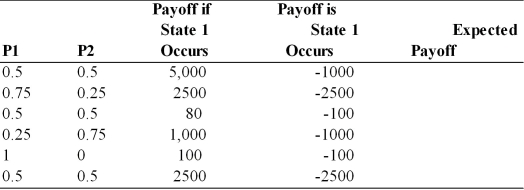
Free
(Essay)
4.8/5 (66)
(66) Correct Answer:Verified
Verified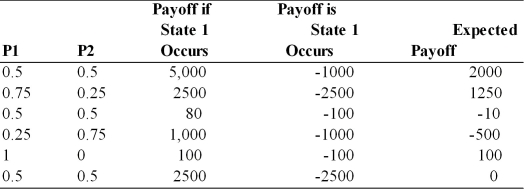
Suppose one is offered a gamble in which you win $1,000 half the time but lose $1,000 half the time. Since in this case one is as likely to win as to lose the $1,000, the average payoff on this gamble its expected value is: 0.5 ∗ $1,000 + 0.5 ∗ (-$1,000) = 0.
Under such circumstances:
(Multiple Choice)
4.8/5 (90)
(90) If you are offered a gamble in which you win 500 dollars 3/8 of the time and you lose 500 dollars 5/8 of the time, what is your expected payoff and your behavior given that you are a risk-lover?
(Multiple Choice)
5.0/5 (85)
(85) Imagine that there are two countries, Home and Far Far Away, and that residents of each own only one asset, domestic land yielding an annual harvest of mangoes. Assume that the yield on the land is uncertain. Half the time, Home's land yields a harvest of 5,000 tons of mangoes at the same time as Far Far Away's land yields a harvest of 2,500 tons. The other half of the time the outcomes are reversed. The average for each country mango harvest is:
(Multiple Choice)
4.9/5 (72)
(72) "There is evidence that the string of U.S. bank closings in the early 1930s helped start and worsen the Great Depression." Discuss.
(Essay)
4.8/5 (86)
(86) Calculate the expected payoff for the following cases, where q1 and q2 are the probabilities of state 1 and 2, respectively. 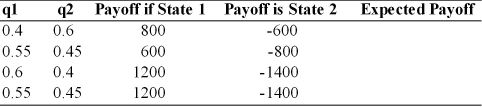
(Essay)
4.7/5 (97)
(97) Why might a country's savings rate have a high positive correlation to its investment rate?
(Multiple Choice)
4.9/5 (83)
(83) Suppose that trade in asset is not allowed but the two countries sign a treaty that guarantee the sending of 25 tons of kiwi in good time by the high output country in that season. What will the outcome of such a treaty? Explain why.
(Essay)
4.8/5 (89)
(89) Describe the extensive "safety net" that has been set up in the United States in order to reduce the risk of bank failure.
(Essay)
4.7/5 (74)
(74) Describe the role of offshore banking and of offshore currency (eurocurrencies) trading
(Essay)
4.9/5 (83)
(83) 
Suppose you are offered a gamble in which you win $1,000 half the time but lose $1,000 half the time. If you are risk averter will you take the gamble?
(Essay)
4.9/5 (87)
(87) Suppose the two countries can trade shares in the ownership of their perspective assets. Further, assume that a Home owner of a 10 percent share in Foreign land. He will receive 10 percent share in Foreign land, and thus receives 10 percent of the annual Foreign kiwi fruit harvest. Further assume that a Foreign owner of a 10 percent share in Home land is permitted. In this case, a Foreigner is entitled to 10 percent of the Home harvest. Calculate the expected value of kiwi fruit for each investor. Is the investor better off?
(Essay)
4.9/5 (88)
(88) Explain the issues involved with the Fed acting as a lender of Last Resort (LLR).
(Essay)
4.9/5 (70)
(70) 
Filters
- Essay(0)
- Multiple Choice(0)
- Short Answer(0)
- True False(0)
- Matching(0)