



 Chat with AI
Exam 19: International Monetary Systems: An Historical Overview

Exam 1: Introduction39 Questions
Exam 2: World Trade: An Overview25 Questions
Exam 3: Labor Productivity and Comparative Advantage: The Ricardian Model66 Questions
Exam 4: Specific Factors and Income Distribution68 Questions
Exam 5: Resources and Trade: The Heckscher-Ohlin Model63 Questions
Exam 6: The Standard Trade Model43 Questions
Exam 7: External Economies of Scale and the International Location of Production29 Questions
Exam 8: Firms in the Global Economy: Export Decisions, Outsourcing, and Multinational Enterprises64 Questions
Exam 9: The Instruments of Trade Policy62 Questions
Exam 10: The Political Economy of Trade Policy61 Questions
Exam 11: Trade Policy in Developing Countries43 Questions
Exam 12: Controversies in Trade Policy47 Questions
Exam 13: National Income Accounting and the Balance of Payments78 Questions
Exam 14: Exchange Rates and the Foreign Exchange Market: An Asset Approach76 Questions
Exam 15: Money, Interest Rates, and Exchange Rates65 Questions
Exam 16: Price Levels and the Exchange Rate in the Long Run80 Questions
Exam 17: Output and the Exchange Rate in the Short Run111 Questions
Exam 18: Fixed Exchange Rates and Foreign Exchange Intervention80 Questions
Exam 19: International Monetary Systems: An Historical Overview162 Questions
Exam 20: Optimum Currency Areas and the European Experience95 Questions
Exam 21: Financial Globalization: Opportunity and Crisis125 Questions
Exam 22: Developing Countries: Growth, Crisis, and Reform129 Questions
Select questions type


Supporters of a floating exchange rate cited all of the following as advantages over the Bretton Woods system except

Free
(Multiple Choice)
4.9/5  (82)
(82) Correct Answer: Verified
C
The costs of inflation have been most apparent in the post-war period in countries like
Free
(Multiple Choice)
4.8/5 (65)
(65) Correct Answer:Verified
VerifiedA
Refer to the payoff matrix below, which ________ a prisoner's dilemma. If both countries go it alone, Home will choose Policy ________ and Foreign will choose Policy ________. 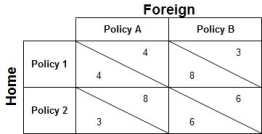
Free
(Multiple Choice)
4.9/5 (71)
(71) Correct Answer:Verified
VerifiedA
The mechanism behind the inflation insulation provided by a floating exchange rate is:
(Multiple Choice)
4.8/5 (80)
(80) In the case of a domestic monetary shock, floating exchange rates:
(Multiple Choice)
4.9/5 (76)
(76) It is claimed that L. Frank Baum's classic 1900 children's book, The Wonderful Wizard of Oz, is an allegorical rendition of the U.S. political struggle over gold.
(Essay)
4.7/5 (69)
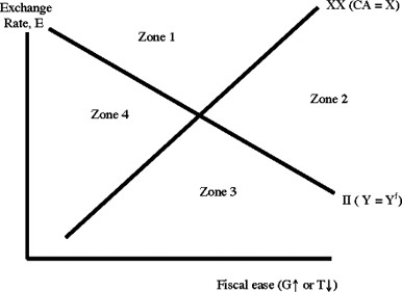
(69) 
How did the international monetary system influenced macroeconomic policy-making and performance during the gold standard era (1870-1914)?
(Essay)
4.8/5 (82)
(82) Which of the following is not a result of a permanent fall in foreign demand on one country's exports under floating exchange rate?
(Multiple Choice)
4.9/5 (87)
(87) A person holding dollar deposits during the devaluation of the dollar would
(Multiple Choice)
4.8/5 (77)
(77) Under purchasing power parity (PPP), if U.S. monetary growth leads to a long run doubling of the U.S. price level, while Germany's price level remains constant, PPP predicts that the
(Multiple Choice)
4.8/5 (79)
(79) "Fixed exchange rates are not even an option for most countries." Discuss.
(Essay)
4.7/5 (82)
(82) Advocates of flexible exchange rates claim that under flexible exchange rates,
(Multiple Choice)
4.9/5 (84)
(84) Comparing fixed to flexible exchange rate, the response of an economy to a temporary fall in foreign demand for its exports is
(Multiple Choice)
4.7/5 (78)
(78) A country is said to be in balance of payments equilibrium, when the sum of its current and its
(Multiple Choice)
5.0/5 (82)
(82) If the demand for Home exports decreased abroad, the Home fall in output would be greatest:
(Multiple Choice)
4.9/5 (86)
(86) 
Filters
- Essay(0)
- Multiple Choice(0)
- Short Answer(0)
- True False(0)
- Matching(0)