



 Chat with AI
Exam 19: International Monetary Systems: An Historical Overview

Exam 1: Introduction39 Questions
Exam 2: World Trade: An Overview25 Questions
Exam 3: Labor Productivity and Comparative Advantage: The Ricardian Model66 Questions
Exam 4: Specific Factors and Income Distribution68 Questions
Exam 5: Resources and Trade: The Heckscher-Ohlin Model63 Questions
Exam 6: The Standard Trade Model43 Questions
Exam 7: External Economies of Scale and the International Location of Production29 Questions
Exam 8: Firms in the Global Economy: Export Decisions, Outsourcing, and Multinational Enterprises64 Questions
Exam 9: The Instruments of Trade Policy62 Questions
Exam 10: The Political Economy of Trade Policy61 Questions
Exam 11: Trade Policy in Developing Countries43 Questions
Exam 12: Controversies in Trade Policy47 Questions
Exam 13: National Income Accounting and the Balance of Payments78 Questions
Exam 14: Exchange Rates and the Foreign Exchange Market: An Asset Approach76 Questions
Exam 15: Money, Interest Rates, and Exchange Rates65 Questions
Exam 16: Price Levels and the Exchange Rate in the Long Run80 Questions
Exam 17: Output and the Exchange Rate in the Short Run111 Questions
Exam 18: Fixed Exchange Rates and Foreign Exchange Intervention80 Questions
Exam 19: International Monetary Systems: An Historical Overview162 Questions
Exam 20: Optimum Currency Areas and the European Experience95 Questions
Exam 21: Financial Globalization: Opportunity and Crisis125 Questions
Exam 22: Developing Countries: Growth, Crisis, and Reform129 Questions
Select questions type


In L. Frank Baum's classic 1900 children's book, The Wonderful Wizard of Oz, the name "oz" is a reference to
(Multiple Choice)
4.7/5  (79)
(79) What is the nature of the trilemma that is encountered when choosing monetary arrangements?
(Multiple Choice)
4.8/5 (67)
(67) "No central bank can be indifferent to its currency's value in the foreign exchange market." Discuss.
(Essay)
4.7/5 (94)
(94) Use the following table to illustrate the importance of macroeconomic policy coordination. Show that the two governments would have been happier if the two of them had adopted looser monetary policies, but given the policies that the other government did adopt, it is not in the interest of any individual government to change its course. Assume that each country wishes to get the biggest reduction in inflation rate at the lowest cost in terms of unemployment. This means that each country maximizes-ΔΠ/ΔU, the inflation reduction per point of increased unemployment. 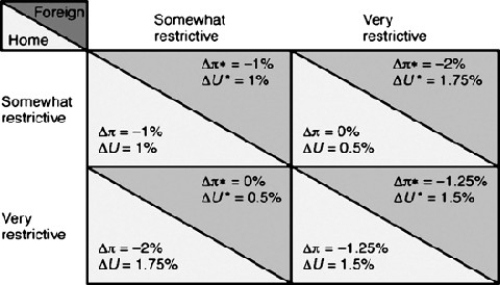
(Essay)
4.9/5 (75)
(75) (a) Assume that R denotes the domestic interest rate and R denotes the foreign interest rate. Under a fixed exchange rate what is the relation between R and R
(b) Assume E denotes the domestic currency price of the dollar for a country which is not the United States. If one wants to analyze only the short run effects of a policy, what does one assume about the Home and Foreign price levels, P and P, respectively.
(c) Assume that there is no ongoing balance of payment crisis. What is this assumption really assume?
(d) Assume a fixed exchange rate system. What does this tell you about E?
(e) Under the above assumptions what are the conditions for internal balance?
(f) How is your answer to Part D above would change if P is unstable due to foreign inflation.
(g) Given the definitions above, how one defines the real exchange rate?
(h) Write the condition for internal balance.
(i) Define the variable not defined before in Part G above.
(j) Using the equation for internal balance derived above, given our assumptions analyze the effects of a fiscal expansion.
(k) What would happen if the government of that country, which is not the United States under Bretton Woods, decides to devaluate its currency?
(l) What would happen if the government of that country, which is not the United States under Bretton Woods, decides to use monetary policy rather than fiscal policy?
(m) Given all of the above, what is the relation between the exchange rate, E, and fiscal ease, i.e., an increase in G or a reduction in T?
(n) Assume that the economy is at internal balance. What will happen if G goes up for a given level of E?
(o) Assume that the economy is at internal balance. What will happen if G goes down for a given level of E?
(Essay)
4.8/5 (91)
(91) An attempt by a central bank to alter the money supply by buying or selling domestic assets
(Multiple Choice)
5.0/5 (86)
(86) When the exchange rate, E, and the foreign price level, P*, is fixed, domestic inflation depends primarily on:
(Multiple Choice)
4.9/5 (78)
(78) Explain how a country with a current account deficit is a ripe candidate for currency devaluation.
(Essay)
4.8/5 (77)
(77) What is the difference between an expenditure-changing policy and an expenditure-switching policy?
(Essay)
4.9/5 (76)
(76) What are the outcomes of the following games, assuming the max-min criteria is used? 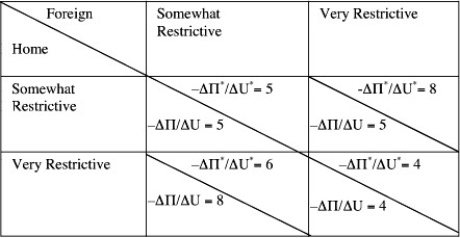
(Essay)
4.8/5 (82)
(82) The following figure introduces the relationship between industrial production and wholesale price index changes between the years 1929-1935. What is the purpose of the following figure? 
(Essay)
4.9/5 (82)
(82) 
Filters
- Essay(0)
- Multiple Choice(0)
- Short Answer(0)
- True False(0)
- Matching(0)