



 Chat with AI
Exam 19: International Monetary Systems: An Historical Overview

Exam 1: Introduction39 Questions
Exam 2: World Trade: An Overview25 Questions
Exam 3: Labor Productivity and Comparative Advantage: The Ricardian Model66 Questions
Exam 4: Specific Factors and Income Distribution68 Questions
Exam 5: Resources and Trade: The Heckscher-Ohlin Model63 Questions
Exam 6: The Standard Trade Model43 Questions
Exam 7: External Economies of Scale and the International Location of Production29 Questions
Exam 8: Firms in the Global Economy: Export Decisions, Outsourcing, and Multinational Enterprises64 Questions
Exam 9: The Instruments of Trade Policy62 Questions
Exam 10: The Political Economy of Trade Policy61 Questions
Exam 11: Trade Policy in Developing Countries43 Questions
Exam 12: Controversies in Trade Policy47 Questions
Exam 13: National Income Accounting and the Balance of Payments78 Questions
Exam 14: Exchange Rates and the Foreign Exchange Market: An Asset Approach76 Questions
Exam 15: Money, Interest Rates, and Exchange Rates65 Questions
Exam 16: Price Levels and the Exchange Rate in the Long Run80 Questions
Exam 17: Output and the Exchange Rate in the Short Run111 Questions
Exam 18: Fixed Exchange Rates and Foreign Exchange Intervention80 Questions
Exam 19: International Monetary Systems: An Historical Overview162 Questions
Exam 20: Optimum Currency Areas and the European Experience95 Questions
Exam 21: Financial Globalization: Opportunity and Crisis125 Questions
Exam 22: Developing Countries: Growth, Crisis, and Reform129 Questions
Select questions type


Advocates of floating rate suggested it is favorable for economies for the following reasons except
(Multiple Choice)
4.8/5  (88)
(88) "Even under flexible exchange rate regime, governments could not be indifferent to the behavior of exchange rates and inevitably surrendered some of their policy autonomy in other areas to prevent exchange rate movements they viewed as harmful to their economies." Discuss.
(True/False)
4.9/5 (86)
(86) Which system of interest rates is theoretically worst for policy coordination among the industrial countries of the world? How has this played out since the 1980s?
(Essay)
4.8/5 (80)
(80) Advocates of flexible exchange rates claim that under flexible exchange rates, the central bank of
(Multiple Choice)
4.8/5 (89)
(89) Which of the following is one component of the "trilemma" that is faced by policy makers in choosing monetary arrangements?
(Multiple Choice)
4.9/5 (88)
(88) The costs of inflation have been most apparent in the post-war period in countries like
(Multiple Choice)
4.9/5 (94)
(94) Under the flexible exchange rate, lowering the price of a foreign currency will
(Multiple Choice)
4.9/5 (81)
(81) Which of the following is one component of the "trilemma" that is faced by policy makers in choosing monetary arrangements?
(Multiple Choice)
4.9/5 (90)
(90) Refute the claim by mercantilists who claimed that without severe restrictions on international trade and payments, a country might find itself impoverished and without an adequate supply of circulating monetary gold as a result of balance of payments deficits.
(Essay)
4.7/5 (89)
(89) A two-tier gold market like the one created during the Bretton Woods System refers to
(Multiple Choice)
4.8/5 (86)
(86) Under fixed exchange rate, the response of an economy to a temporary fall in foreign demand for its exports is
(Multiple Choice)
4.8/5 (79)
(79) If central banks were no longer obliged to intervene in currency markets to fix exchange rates, governments would be able to use monetary policy to reach
(Multiple Choice)
4.9/5 (80)
(80) Which of the following does not occur if Home starts a policy of permanent fiscal expansion:
(Multiple Choice)
4.7/5 (70)
(70) Refer to the graph below. The movement from point 1 to point 2 is stimulated by a disequilibrium in which there is domestic ________ and ________. 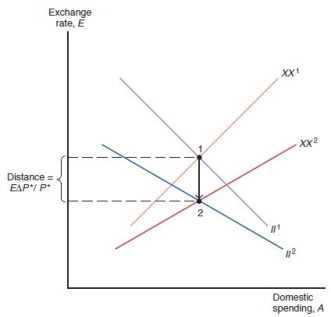
(Multiple Choice)
4.7/5 (87)
(87) Advocates of flexible exchange rates claim that under flexible exchange rates, a currency
(Multiple Choice)
4.8/5 (84)
(84) 
Filters
- Essay(0)
- Multiple Choice(0)
- Short Answer(0)
- True False(0)
- Matching(0)