



 Chat with AI
Exam 19: International Monetary Systems: An Historical Overview

Exam 1: Introduction39 Questions
Exam 2: World Trade: An Overview25 Questions
Exam 3: Labor Productivity and Comparative Advantage: The Ricardian Model66 Questions
Exam 4: Specific Factors and Income Distribution68 Questions
Exam 5: Resources and Trade: The Heckscher-Ohlin Model63 Questions
Exam 6: The Standard Trade Model43 Questions
Exam 7: External Economies of Scale and the International Location of Production29 Questions
Exam 8: Firms in the Global Economy: Export Decisions, Outsourcing, and Multinational Enterprises64 Questions
Exam 9: The Instruments of Trade Policy62 Questions
Exam 10: The Political Economy of Trade Policy61 Questions
Exam 11: Trade Policy in Developing Countries43 Questions
Exam 12: Controversies in Trade Policy47 Questions
Exam 13: National Income Accounting and the Balance of Payments78 Questions
Exam 14: Exchange Rates and the Foreign Exchange Market: An Asset Approach76 Questions
Exam 15: Money, Interest Rates, and Exchange Rates65 Questions
Exam 16: Price Levels and the Exchange Rate in the Long Run80 Questions
Exam 17: Output and the Exchange Rate in the Short Run111 Questions
Exam 18: Fixed Exchange Rates and Foreign Exchange Intervention80 Questions
Exam 19: International Monetary Systems: An Historical Overview162 Questions
Exam 20: Optimum Currency Areas and the European Experience95 Questions
Exam 21: Financial Globalization: Opportunity and Crisis125 Questions
Exam 22: Developing Countries: Growth, Crisis, and Reform129 Questions
Select questions type


Coordination of economic policies among nations is a prisoner's ________ because if all countries go it alone, they will choose to ________.
(Multiple Choice)
4.7/5  (71)
(71) Under flexible exchange rate, the response of an economy to a temporary fall in foreign demand for its exports is
(Multiple Choice)
4.9/5 (90)
(90) Coordination of economic policies among nations is a prisoner's ________ because all countries will be better off if they ________.
(Multiple Choice)
4.7/5 (78)
(78) Explain how a country with a current account surplus is a ripe candidate for currency revaluation.
(Essay)
4.7/5 (80)
(80) Why do governments prefer to avoid excessive current account surpluses? Or, why are growing domestic claims to foreign wealth ever a problem?
(Essay)
4.8/5 (83)
(83) "No central bank can be indifferent to its currency's value in the foreign exchange market." Discuss.
(Essay)
4.9/5 (83)
(83) "The line distinguishing between external and internal goals can be fuzzy." Discuss.
(Essay)
4.9/5 (71)
(71) How did the international monetary system influenced macroeconomic policy-making and performance during the interwar period (1918-1939)?
(Essay)
4.7/5 (75)
(75) Advocates of flexible exchange rates claim that under flexible exchange rates,
(Multiple Choice)
4.8/5 (85)
(85) Some claim that the long and agonizing periods of speculation preceding exchange rate realignments would
(Multiple Choice)
4.9/5 (73)
(73) The main policy goal for a country according to the mercantilists is
(Multiple Choice)
4.8/5 (68)
(68) 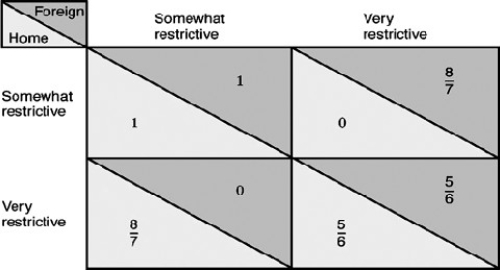 -Refer to the above figure. Use the DD-AA model to examine and compare the response of an economy under fixed and floating exchange rate to a permanent fall in foreign demand for its exports.
 (Essay)
4.9/5 (80)
(80) Imagine a world with two large countries, Home and Foreign. Evaluate how Home's macroeconomic policies affect Foreign. Compare the small and the large country cases; consider both permanent monetary and fiscal policies.
(Essay)
4.9/5 (76)
(76) 
Filters
- Essay(0)
- Multiple Choice(0)
- Short Answer(0)
- True False(0)
- Matching(0)