



 Chat with AI
Exam 22: Developing Countries: Growth, Crisis, and Reform

Exam 1: Introduction39 Questions
Exam 2: World Trade: An Overview25 Questions
Exam 3: Labor Productivity and Comparative Advantage: The Ricardian Model66 Questions
Exam 4: Specific Factors and Income Distribution68 Questions
Exam 5: Resources and Trade: The Heckscher-Ohlin Model63 Questions
Exam 6: The Standard Trade Model43 Questions
Exam 7: External Economies of Scale and the International Location of Production29 Questions
Exam 8: Firms in the Global Economy: Export Decisions, Outsourcing, and Multinational Enterprises64 Questions
Exam 9: The Instruments of Trade Policy62 Questions
Exam 10: The Political Economy of Trade Policy61 Questions
Exam 11: Trade Policy in Developing Countries43 Questions
Exam 12: Controversies in Trade Policy47 Questions
Exam 13: National Income Accounting and the Balance of Payments78 Questions
Exam 14: Exchange Rates and the Foreign Exchange Market: An Asset Approach76 Questions
Exam 15: Money, Interest Rates, and Exchange Rates65 Questions
Exam 16: Price Levels and the Exchange Rate in the Long Run80 Questions
Exam 17: Output and the Exchange Rate in the Short Run111 Questions
Exam 18: Fixed Exchange Rates and Foreign Exchange Intervention80 Questions
Exam 19: International Monetary Systems: An Historical Overview162 Questions
Exam 20: Optimum Currency Areas and the European Experience95 Questions
Exam 21: Financial Globalization: Opportunity and Crisis125 Questions
Exam 22: Developing Countries: Growth, Crisis, and Reform129 Questions
Select questions type


Until recently, per-capita income increased in East Asian countries such as Hong Kong, Singapore, South Korea, and Taiwan by ________-fold every generation
(Multiple Choice)
4.9/5  (76)
(76) When one compares per-capital output growth rates among countries,
(Multiple Choice)
4.9/5 (81)
(81) The relationship between annual real per-capita GDP and corruption across countries has been found to be:
(Multiple Choice)
4.7/5 (74)
(74) In the early 1960s South Korea was an extremely poor country. However, in 1963, the country began a remarkable economic ascent. What was a direct cause of this?
(Multiple Choice)
5.0/5 (86)
(86) List and explain 3 major channels through which developing countries have financed their external deficits.
(Essay)
4.9/5 (80)
(80) While many developing countries have reformed their economies in order to imitate the success of the successful industrial economies, the process remains incomplete and most developing countries tend to be characterized by all of the following except:
(Multiple Choice)
4.9/5 (76)
(76) The world's economies can be divided into four main categories according to their annual per-capita income levels: low-income, lower middle-income, upper middle-income and high-income economies. What category would Malaysia falls under?
(Multiple Choice)
4.9/5 (70)
(70) For many developing countries, natural resources or agricultural commodities make up ________ share of exports
(Multiple Choice)
4.9/5 (76)
(76) Based on the case study, answer the following question: Can currency boards make low-inflation policies credible?
(Essay)
4.7/5 (95)
(95) "Sharp contractions in a country's output and employment invariably result from a crisis in which the country suddenly loses access to all foreign sources of funds." Explain how the current account identity necessitates these contractions.
(Essay)
4.7/5 (84)
(84) Which of the following countries had a larger growth rate since 1960?
(Multiple Choice)
4.8/5 (77)
(77) Since 1960, South Korea and Singapore enjoyed an average per-capita growth rate well ________ the average industrialized world.
(Multiple Choice)
4.9/5 (85)
(85) The world's economies can be divided into four main categories according to their annual per-capita income levels: low-income, lower middle-income, upper middle-income and high-income economies. What category would the South Africa falls under?
(Multiple Choice)
4.9/5 (76)
(76) Please consider Table 22-2 below. 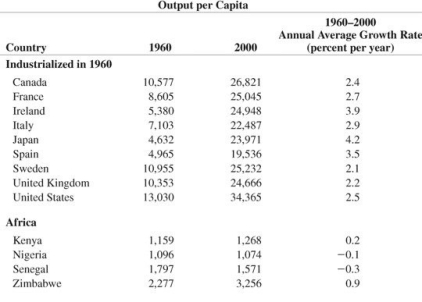
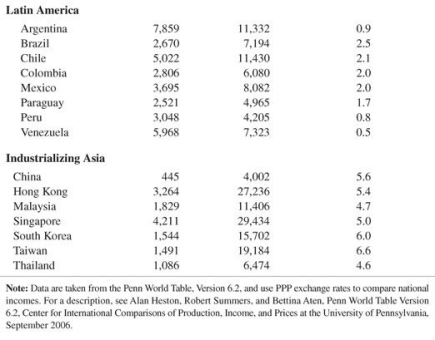 At that Annual Average Growth Rate, how many years does it take for the output per capita to double in both the United States and South Korea.
 (Essay)
4.9/5 (83)
(83) 
Filters
- Essay(0)
- Multiple Choice(0)
- Short Answer(0)
- True False(0)
- Matching(0)