



 Chat with AI
Exam 22: Developing Countries: Growth, Crisis, and Reform

Exam 1: Introduction39 Questions
Exam 2: World Trade: An Overview25 Questions
Exam 3: Labor Productivity and Comparative Advantage: The Ricardian Model66 Questions
Exam 4: Specific Factors and Income Distribution68 Questions
Exam 5: Resources and Trade: The Heckscher-Ohlin Model63 Questions
Exam 6: The Standard Trade Model43 Questions
Exam 7: External Economies of Scale and the International Location of Production29 Questions
Exam 8: Firms in the Global Economy: Export Decisions, Outsourcing, and Multinational Enterprises64 Questions
Exam 9: The Instruments of Trade Policy62 Questions
Exam 10: The Political Economy of Trade Policy61 Questions
Exam 11: Trade Policy in Developing Countries43 Questions
Exam 12: Controversies in Trade Policy47 Questions
Exam 13: National Income Accounting and the Balance of Payments78 Questions
Exam 14: Exchange Rates and the Foreign Exchange Market: An Asset Approach76 Questions
Exam 15: Money, Interest Rates, and Exchange Rates65 Questions
Exam 16: Price Levels and the Exchange Rate in the Long Run80 Questions
Exam 17: Output and the Exchange Rate in the Short Run111 Questions
Exam 18: Fixed Exchange Rates and Foreign Exchange Intervention80 Questions
Exam 19: International Monetary Systems: An Historical Overview162 Questions
Exam 20: Optimum Currency Areas and the European Experience95 Questions
Exam 21: Financial Globalization: Opportunity and Crisis125 Questions
Exam 22: Developing Countries: Growth, Crisis, and Reform129 Questions
Select questions type


Compare the macroeconomic performances in the 1990s of the following countries under the following exchange-rate regimes: floating exchange rates, Mexico and Brazil; capital control, China and Malaysia; and currency boards, Estonia and Hong Kong; dollarization, Argentina.
(Essay)
4.8/5  (85)
(85) Economists Eichengreen and Hausmann coined the phrase original sin to describe developing countries inability to borrow in their own currencies. Where do they believe that this inability comes from? What are other beliefs on this topic?
(Essay)
4.9/5 (82)
(82) The world's economies can be divided into four main categories according to their annual per-capita income levels: low-income, lower middle-income, upper middle-income and high-income economies. What category would the Poland, Hungary, and the Czech and Slovak Republics fall under?
(Multiple Choice)
4.9/5 (75)
(75) The upper middle-income countries enjoy only about ________ of the per-capita GNP of the industrial group.
(Multiple Choice)
5.0/5 (68)
(68) The world's economies can be divided into four main categories according to their annual per-capita income levels: low-income, lower middle-income, upper middle-income and high-income economies. What category would Pakistan and India fall under?
(Multiple Choice)
4.9/5 (94)
(94) During the time period of 1981-1983 what dramatic world issue happened?
(Multiple Choice)
4.9/5 (92)
(92) Please consider Table 22-2 below. 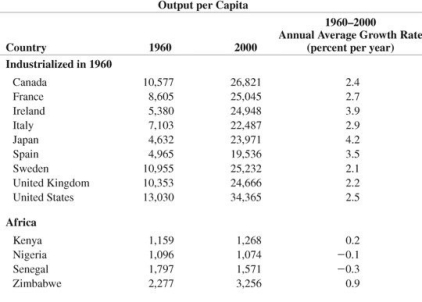
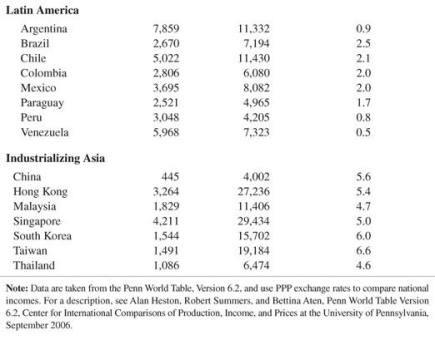 Assuming constant Annual Average Growth Rate in the future, determine the year in which the United States will have the same output per capita as South Korea?
 (Essay)
4.9/5 (81)
(81) The world's economies can be divided into four main categories according to their annual per-capita income levels: low-income, lower middle-income, upper middle-income and high-income economies. What category would mainland China fall under?
(Multiple Choice)
4.8/5 (79)
(79) Average per-capita GNP in the richest, most prosperous economies is ________ times that of the average in the ________ economies.
(Multiple Choice)
4.8/5 (84)
(84) When a government defaults on its obligations, the event is called a
(Multiple Choice)
4.9/5 (74)
(74) The world's economies can be divided into four main categories according to their annual per-capita income levels: low-income, lower middle-income, upper middle-income and high-income economies. What category would the Saudi Arabia falls under?
(Multiple Choice)
4.9/5 (77)
(77) Describe some of the features hindering developing countries from growing faster.
(Essay)
4.9/5 (82)
(82) The term Original Sin by two economists Barry Eichengreen and Ricardo Hausmann is used to describe what?
(Multiple Choice)
4.8/5 (85)
(85) Describe alternative forms of capital inflow to finance external deficits and explain why these methods were used in different times?
(Essay)
4.7/5 (79)
(79) The 1980s are considered as the "lost decade" of Latin American growth. Explain why?
(Essay)
4.8/5 (73)
(73) Based on the case study, answer the following question: Can currency boards make fixed exchange rates credible?
(Essay)
4.8/5 (73)
(73) 
Filters
- Essay(0)
- Multiple Choice(0)
- Short Answer(0)
- True False(0)
- Matching(0)