



 Chat with AI
Exam 10: The Order Entrysales Oes Process

Exam 1: Introduction to Accounting Information Systems122 Questions
Exam 2: Enterprise Systems141 Questions
Exam 3: Electronic Business E-Business Systems122 Questions
Exam 4: Documenting Information Systems129 Questions
Exam 5: Database Management Systems175 Questions
Exam 6: Relational Databases and SQL103 Questions
Exam 7: Controlling Information Systems: Introduction to Enterprise Risk Management and Internal Control161 Questions
Exam 8: Controlling Information Systems: Introduction to Pervasive Controls159 Questions
Exam 9: Controlling Information Systems: Business Process and Application Controls135 Questions
Exam 10: The Order Entrysales Oes Process134 Questions
Exam 11: The Billingaccounts Receivablecash Receipts Barcr Process134 Questions
Exam 12: The Purchasing Process141 Questions
Exam 13: The Accounts Payablecash Disbursements Apcd Process118 Questions
Exam 14: The Human Resources Process HR Management and Payroll Processes121 Questions
Exam 15: Integrated Production Processes IPP118 Questions
Exam 16: The General Ledger and Business Reporting GLBR Process107 Questions
Exam 17: Acquiring and Implementing Accounting Information Systems206 Questions
Select questions type


The concept behind ____ is to cultivate customer relationships by prospecting, acquiring, servicing, and retaining customers.
(Multiple Choice)
4.8/5  (82)
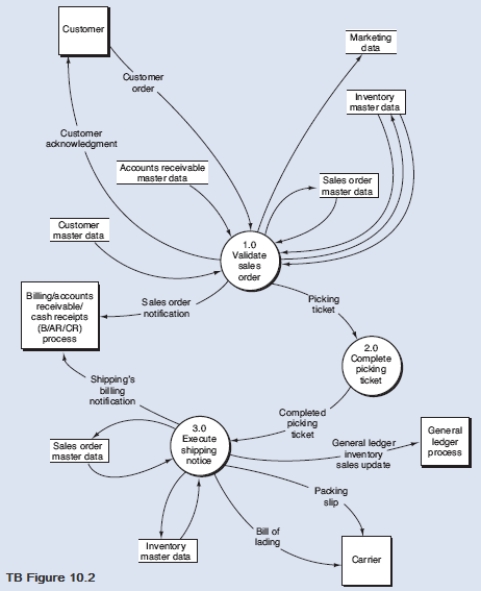
(82) Below is a narrative of the "Validate sales order" portion (i.e., bubble 1.0) of the order entry/sales process.
Narrative Description
How does the OE/S process then validate a customer order? First, process 1.1 verifies the availability of the requested inventory by consulting the inventory master data. If a sufficient level of inventory is on hand to satisfy the request, the order is forwarded for further processing, as depicted by the data flow "Inventory available order." Conversely, if a customer orders goods that are not in stock, process 1.1 runs a special back order routine. This routine determines the inventory requirement necessary to satisfy the order and then sends the back order request to the purchasing department. This activity is depicted by the "Back order" data flow, which in reality is a specific type of exception routine (i.e., a specific type of reject stub). If the customer refuses to accept a back order, then the sales event is terminated and the order is rejected, as shown by the "Reject" data flow. Information from the order (e.g., sales region, customer demographics, and order characteristics that reflect buying habits) that has potential value to marketing is recorded in the marketing data store.
After assuring inventory availability, process 1.2 establishes the customer's existence and then evaluates credit. The credit check adds the amount of the order to accounts receivable balances and open sales orders (i.e., orders about to be receivables), and compare that total to the credit limit. If the customer has exceeded their credit limit, the order is rejected.
Upon a successful credit approval, process 1.3 performs the following activities simultaneously:
.
.
Required:
From the DFD in TB Figure 10.2 and the narrative description above, explode bubble 1.0 into a lower-level diagram showing the details of that process.
(Essay)
4.8/5 (86)
(86) A customer request for goods might take the physical form of a telephone call, an EDI transmission, an entry on a Web site, or a faxed or mailed customer order.
(True/False)
4.8/5 (76)
(76) The flow of information from OE/S to the credit department is an example of vertical information flows.
(True/False)
4.8/5 (84)
(84) Digital image processing systems are capable of performing all of the following except:
(Multiple Choice)
4.8/5 (70)
(70) One of the primary functions of the OE/S is to create information flows which support the repetitive work routines of the sales order department, credit department, and shipping department.
(True/False)
4.8/5 (78)
(78) A valid shipping notice input is one that is supported by both:
(Multiple Choice)
4.9/5 (84)
(84) The OE/S process addresses the decision needs of managers of various sales and marketing functions through the use of:
(Multiple Choice)
5.0/5 (75)
(75) The entity-relationship (E-R) diagram below represents an order entry/sales process, but with the names of certain entities, characteristics of relationships, and relationship cardinalities removed from the diagram. The names omitted are:
CUSTOMERS INVENTORY SHIPMENTS activate billed-to generate SALES-RELATIONS trigger
Required:
Complete TB Figure 10.8 by:
a. Inserting the names from the above lists into the rectangles (entities) or diamonds (characteristics of the relationships), respectively, where they belong
b. Inserting a 1 or an N where necessary next to the connecting lines to indicate the cardinality of the relationships
(Essay)
4.8/5 (79)
(79) A customer acknowledgement is sent to the billing department to notify them of a pending shipment.
(True/False)
4.9/5 (74)
(74) ____ applications in organizations are usually viewed as being focused on either operational or analytical applications.
(Multiple Choice)
4.9/5 (81)
(81) When the sales order department acknowledges a customer order, it is an example of a:
(Multiple Choice)
4.9/5 (82)
(82) The completed picking ticket file provides an audit trail of authorized inventory transfers made between the warehouse and the shipping department.
(True/False)
4.9/5 (100)
(100) Bar code readers are used to recognize patterns of handwritten or printed characters.
(True/False)
4.8/5 (68)
(68) The control plan preformatted screens is directed primarily toward achieving the information process control goal of ensuring:
(Multiple Choice)
4.9/5 (89)
(89) Online prompting in the OE/S process is a control plan that advises the customer service representative to check their data entries for accuracy before moving on.
(True/False)
4.8/5 (75)
(75) A(n) ______________________________ is the document representing the contract between the shipping company and the carrier.
(Short Answer)
4.9/5 (91)
(91) A bill of lading is the document representing the contract between the shipping company and the common carrier.
(True/False)
4.9/5 (79)
(79) In the OE/S process, the document that represents an independent authorization to ship goods to the customer is the:
(Multiple Choice)
4.8/5 (81)
(81) 
Filters
- Essay(0)
- Multiple Choice(0)
- Short Answer(0)
- True False(0)
- Matching(0)