



 Chat with AI
Exam 12: The Design of the Tax System

Exam 1: Ten Principles of Economics439 Questions
Exam 2: Thinking Like an Economist617 Questions
Exam 3: Interdependence and the Gains From Trade527 Questions
Exam 4: The Market Forces of Supply and Demand698 Questions
Exam 5: Elasticity and Its Application595 Questions
Exam 6: Supply, Demand, and Government Policies644 Questions
Exam 7: Consumers, Producers, and the Efficiency of Markets549 Questions
Exam 8: Application: The Costs of Taxation511 Questions
Exam 9: Application: International Trade493 Questions
Exam 10: Externalities524 Questions
Exam 11: Public Goods and Common Resources433 Questions
Exam 12: The Design of the Tax System551 Questions
Exam 13: The Costs of Production420 Questions
Exam 14: Firms in Competitive Markets543 Questions
Exam 15: Monopoly637 Questions
Exam 16: Monopolistic Competition587 Questions
Exam 17: Oligopoly496 Questions
Exam 18: The Markets for the Factors of Production564 Questions
Exam 19: Earnings and Discrimination490 Questions
Exam 20: Income Inequality and Poverty457 Questions
Exam 21: The Theory of Consumer Choice440 Questions
Exam 22: Frontiers of Microeconomics441 Questions
Select questions type


Table 12-25
 -Refer to Table 12-25. Which plan illustrates a regressive tax?
 (Essay)
4.8/5  (97)
(97) The largest budgetary expense for a typical state or local government is
(Multiple Choice)
4.8/5 (91)
(91) An efficient tax system is one that imposes small deadweight losses and small administrative burdens.
(True/False)
4.8/5 (61)
(61) Suppose that in 2020 the average citizen's federal tax bill is $11,987, and total federal spending is $12,294 per person. In 2020, the federal government will have
(Multiple Choice)
4.8/5 (78)
(78) In the United States, the marginal tax rate on individual federal income tax
(Multiple Choice)
4.7/5 (64)
(64) When the government taxes labor earnings we can expect people to
(Multiple Choice)
4.9/5 (70)
(70) Under a progressive tax system, the marginal tax rate could be equal to the average tax rate only when a taxpayer
(Multiple Choice)
4.8/5 (77)
(77) In which of the following tax systems do taxes increase as income increases?
(Multiple Choice)
5.0/5 (82)
(82) Table 12-10
 -Refer to Table 12-10. If Willie has $170,000 in taxable income, his average tax rate is
 (Multiple Choice)
4.8/5 (94)
(94) Individual income taxes generate roughly 25% of the tax revenue for the federal government.
(True/False)
5.0/5 (77)
(77) Table 12-24
 -Refer to Table 12-24. Does the tax system achieve vertical equity?
 (Essay)
5.0/5 (81)
(81) Table 12-7
The following table shows the marginal tax rates for unmarried individuals for two years.
 -Refer to Table 12-7. For an individual who earned $80,000 in both years, which of the following statements is true regarding the individual's marginal tax rate?
 (Multiple Choice)
4.8/5 (81)
(81) Table 12-9
United States Income Tax Rates for a Single Individual, 2012 and 2013.
 -Refer to Table 12-9. Bill is a single person whose taxable income is $35,000 a year. What is his average tax rate in 2013?
 (Multiple Choice)
4.8/5 (87)
(87) Table 12-18
United States Income Tax Rates for a Single Individual, 2009 and 2010.
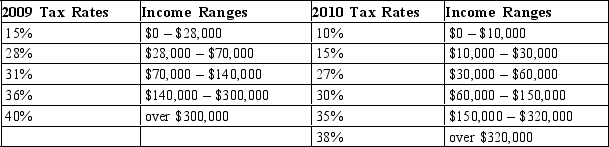 -Refer to Table 12-18. What type of tax structure does the United States have in 2010 for single individuals?
 (Multiple Choice)
5.0/5 (78)
(78) In practice, the U.S. income tax system is filled with special provisions that alter a family's tax based on its specific circumstances.
(True/False)
4.8/5 (71)
(71) Scenario 12-2
Suppose that Bob places a value of $10 on a movie ticket and that Lisa places a value of $7 on a movie ticket. In addition, suppose the price of a movie ticket is $5.
-Refer to Scenario 12-2. Suppose the government levies a tax of $1 on each movie ticket and that, as a result, the price of a movie ticket increases to $6.00. If Bob and Lisa both purchase a movie ticket, what is total consumer surplus for Bob and Lisa?
(Multiple Choice)
4.8/5 (67)
(67) In 2011, the U.S. federal government collected approximately what percentage of the taxes in the economy?
(Multiple Choice)
4.8/5 (72)
(72) The revenue that the federal government collects from payroll taxes is earmarked to pay for
(Multiple Choice)
4.9/5 (70)
(70) Sue earns income of $80,000 per year. Her average tax rate is 30 percent. Sue paid 20 percent in taxes on the first $30,000 she earned. What was the marginal tax rate on the rest of her income?
(Multiple Choice)
4.7/5 (81)
(81) The administrative burden of any tax system is part of the inefficiency it creates.
(True/False)
4.8/5 (75)
(75) 
Filters
- Essay(0)
- Multiple Choice(0)
- Short Answer(0)
- True False(0)
- Matching(0)