



 Chat with AI
Exam 12: The Design of the Tax System

Exam 1: Ten Principles of Economics439 Questions
Exam 2: Thinking Like an Economist617 Questions
Exam 3: Interdependence and the Gains From Trade527 Questions
Exam 4: The Market Forces of Supply and Demand698 Questions
Exam 5: Elasticity and Its Application595 Questions
Exam 6: Supply, Demand, and Government Policies644 Questions
Exam 7: Consumers, Producers, and the Efficiency of Markets549 Questions
Exam 8: Application: The Costs of Taxation511 Questions
Exam 9: Application: International Trade493 Questions
Exam 10: Externalities524 Questions
Exam 11: Public Goods and Common Resources433 Questions
Exam 12: The Design of the Tax System551 Questions
Exam 13: The Costs of Production420 Questions
Exam 14: Firms in Competitive Markets543 Questions
Exam 15: Monopoly637 Questions
Exam 16: Monopolistic Competition587 Questions
Exam 17: Oligopoly496 Questions
Exam 18: The Markets for the Factors of Production564 Questions
Exam 19: Earnings and Discrimination490 Questions
Exam 20: Income Inequality and Poverty457 Questions
Exam 21: The Theory of Consumer Choice440 Questions
Exam 22: Frontiers of Microeconomics441 Questions
Select questions type


Sue earns income of $80,000 per year. Her average tax rate is 40 percent. Sue paid $4,500 in taxes on the first $30,000 she earned. What was the marginal tax rate on the rest of her income?
(Multiple Choice)
4.7/5  (78)
(78) Economists play an important role in the complex debates over tax policy by
(Multiple Choice)
4.9/5 (66)
(66) The deadweight loss associated with a tax on a commodity is generated by
(Multiple Choice)
4.8/5 (87)
(87) Table 12-21
The dollar amounts in the last three columns are the taxes owed under the three different tax systems.
 -Refer to Table 12-21. Which of the three tax systems is regressive?
 (Multiple Choice)
4.8/5 (76)
(76) Suppose New York City passes a local "big gulp" tax that taxes carbonated beverages larger than 20 ounces if they contain sugar or high fructose corn syrup. If the revenue from the "big gulp" tax is earmarked for diabetes research, the "big gulp" tax may be justified
(Multiple Choice)
4.9/5 (88)
(88) Briefly describe some of the demographic trends that are predicted to increase the government's budget deficit.
(Essay)
4.8/5 (67)
(67) In 1950 there were approximately 7 working age people for every elderly person; however, in 2050 there will be
(Multiple Choice)
4.9/5 (79)
(79) Table 12-9
United States Income Tax Rates for a Single Individual, 2012 and 2013.
 -Refer to Table 12-9. Harry is a single person whose taxable income is $35,000 a year. What is his marginal tax rate in 2012?
 (Multiple Choice)
4.8/5 (70)
(70) Rank the following state and local government expenditure categories from largest to smallest.
(Multiple Choice)
4.9/5 (79)
(79) Deadweight losses and administrative burdens are key factors considered when determining the efficiency of the tax system.
(True/False)
4.7/5 (84)
(84) Scenario 12-3
Suppose Roger and Regina receive great satisfaction from their consumption of cheesecake. Regina would be willing to purchase only one slice and would pay up to $8 for it. Roger would be willing to pay $11 for his first slice,$9 for his second slice, and $5 for his third slice. The current market price is $5 per slice.
-Refer to Scenario 12-3. Assume that the government places a $4 tax on each slice of cheesecake and that the new equilibrium price is $9. What is the deadweight loss of the tax?
(Multiple Choice)
4.8/5 (80)
(80) 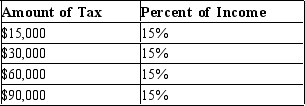 -Refer to Table 12-19. The tax system is
Most people agree that taxes should impose as small a cost on society as possible and that the burden of taxes should be distributed fairly.
(True/False)
4.8/5 (93)
(93) Table 12-23
The dollar amounts in the last three columns are the taxes owed under the three different tax systems.
 -Refer to Table 12-23. Which of the three tax systems exhibits vertical equity?
 (Multiple Choice)
4.7/5 (69)
(69) Alan Greenspan, former Chairman of the Federal Reserve, discussed the advantages of which kind of tax system, "particularly if one were designing a tax system from scratch"?
(Multiple Choice)
4.7/5 (82)
(82) European countries tend to rely more on consumption taxes than does the United States.
(True/False)
4.8/5 (80)
(80) According to the ability-to-pay principle, it is fair for people to pay taxes based on the amount of government services that they receive.
(True/False)
4.8/5 (81)
(81) 
Filters
- Essay(0)
- Multiple Choice(0)
- Short Answer(0)
- True False(0)
- Matching(0)