



 Chat with AI
Exam 12: The Design of the Tax System

Exam 1: Ten Principles of Economics439 Questions
Exam 2: Thinking Like an Economist617 Questions
Exam 3: Interdependence and the Gains From Trade527 Questions
Exam 4: The Market Forces of Supply and Demand698 Questions
Exam 5: Elasticity and Its Application595 Questions
Exam 6: Supply, Demand, and Government Policies644 Questions
Exam 7: Consumers, Producers, and the Efficiency of Markets549 Questions
Exam 8: Application: The Costs of Taxation511 Questions
Exam 9: Application: International Trade493 Questions
Exam 10: Externalities524 Questions
Exam 11: Public Goods and Common Resources433 Questions
Exam 12: The Design of the Tax System551 Questions
Exam 13: The Costs of Production420 Questions
Exam 14: Firms in Competitive Markets543 Questions
Exam 15: Monopoly637 Questions
Exam 16: Monopolistic Competition587 Questions
Exam 17: Oligopoly496 Questions
Exam 18: The Markets for the Factors of Production564 Questions
Exam 19: Earnings and Discrimination490 Questions
Exam 20: Income Inequality and Poverty457 Questions
Exam 21: The Theory of Consumer Choice440 Questions
Exam 22: Frontiers of Microeconomics441 Questions
Select questions type


A person's tax obligation divided by her income is called her
(Multiple Choice)
4.7/5  (85)
(85) Scenario 12-1
Ken places a $20 value on a cigar, and Mark places a $17 value on it. The equilibrium price for this brand of cigar is $15.
-Refer to Scenario 12-1. How much total consumer surplus do Ken and Mark get when each purchases one cigar?
(Multiple Choice)
4.8/5 (68)
(68) The claim that all citizens should make an "equal sacrifice" to support government programs is usually associated with
(Multiple Choice)
4.8/5 (91)
(91) The marginal tax rates on the richest Americans when Ronald Reagan was elected and when he left office were
(Multiple Choice)
4.9/5 (84)
(84) Calculate the marginal tax rate and the average tax rate of a lump-sum tax of $5,000.
(Essay)
4.8/5 (72)
(72) Deadweight losses arise because a tax causes some individuals to change their behavior.
(True/False)
4.9/5 (78)
(78) A tax system exhibits vertical equity when taxpayers with similar abilities to pay contribute the same amount.
(True/False)
4.9/5 (73)
(73) Most Americans agree that our tax system should (i) be fair.
(ii) be efficient.
(iii) impose as small a cost on society as possible.
(iv) use a value-added tax (VAT) instead of an income tax.
(Multiple Choice)
4.7/5 (77)
(77) If revenue from a gasoline tax is used to build and maintain public roads, the gasoline tax may be justified on the basis of
(Multiple Choice)
4.8/5 (79)
(79) 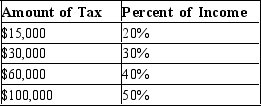 -Refer to Table 12-15. The tax system is
The "other" category of federal spending consists of many less expensive functions of government, including all of the following except
(Multiple Choice)
4.9/5 (83)
(83) Scenario 12-4
A taxpayer faces the following tax rates on her income: 20 percent of the first $40,000 of her income; 30 percent of all her income above $40,000.
-Refer to Scenario 12-4. The taxpayer faces
(Multiple Choice)
4.9/5 (81)
(81) When interest income from savings is taxed, people will save
(Multiple Choice)
4.9/5 (76)
(76) When the marginal tax rate equals the average tax rate, the tax is
(Multiple Choice)
4.8/5 (72)
(72) 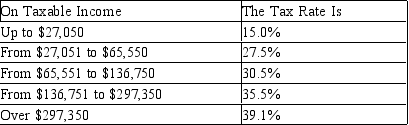
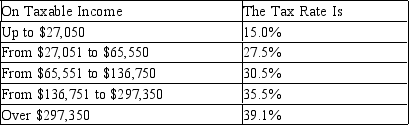 TABLE B

State and local governments generate revenue from all of the following sources except
(Multiple Choice)
4.9/5 (86)
(86) 
Filters
- Essay(0)
- Multiple Choice(0)
- Short Answer(0)
- True False(0)
- Matching(0)