



 Chat with AI
Exam 9: Application: International Trade

Exam 1: Ten Principles of Economics439 Questions
Exam 2: Thinking Like an Economist617 Questions
Exam 3: Interdependence and the Gains From Trade527 Questions
Exam 4: The Market Forces of Supply and Demand698 Questions
Exam 5: Elasticity and Its Application595 Questions
Exam 6: Supply, Demand, and Government Policies644 Questions
Exam 7: Consumers, Producers, and the Efficiency of Markets549 Questions
Exam 8: Application: The Costs of Taxation511 Questions
Exam 9: Application: International Trade493 Questions
Exam 10: Externalities524 Questions
Exam 11: Public Goods and Common Resources433 Questions
Exam 12: The Design of the Tax System551 Questions
Exam 13: The Costs of Production420 Questions
Exam 14: Firms in Competitive Markets543 Questions
Exam 15: Monopoly637 Questions
Exam 16: Monopolistic Competition587 Questions
Exam 17: Oligopoly496 Questions
Exam 18: The Markets for the Factors of Production564 Questions
Exam 19: Earnings and Discrimination490 Questions
Exam 20: Income Inequality and Poverty457 Questions
Exam 21: The Theory of Consumer Choice440 Questions
Exam 22: Frontiers of Microeconomics441 Questions
Select questions type


When a country allows trade and becomes an importer of a good,
(Multiple Choice)
5.0/5  (78)
(78) The nation of Wheatland forbids international trade. In Wheatland, you can buy 1 pound of corn for 3 pounds of fish. In other countries, you can buy 1 pound of corn for 2 pounds of fish. These facts indicate that
(Multiple Choice)
4.7/5 (62)
(62) Trade raises the economic well-being of a nation in the sense that
(Multiple Choice)
4.8/5 (64)
(64) If the world price of coffee is lower than Colombia's domestic price of coffee without trade, then Colombia
(Multiple Choice)
4.9/5 (77)
(77) Figure 9-24
The following diagram shows the domestic demand and supply in a market. Assume that the world price in this market is $20 per unit.  -Refer to Figure 9-24. With free trade, the country
 (Multiple Choice)
4.8/5 (84)
(84) Assume the nation of Teeveeland does not trade with the rest of the world. By comparing the world price of televisions to the price of televisions in Teeveeland, we can determine whether
(Multiple Choice)
4.9/5 (78)
(78) A major difference between tariffs and import quotas is that
(Multiple Choice)
4.7/5 (77)
(77) When a country that imported a particular good abandons a free-trade policy and adopts a no-trade policy,
(Multiple Choice)
4.8/5 (77)
(77) Import quotas and tariffs both cause the quantity of imports to fall.
(True/False)
5.0/5 (82)
(82) Scenario 9-3
Suppose domestic demand and domestic supply in a market are given by the following equations:  -Refer to Scenario 9-3. Suppose the world price in this market is $8 per unit. If the country allows free trade, by how much do consumer surplus, producer surplus, and producer surplus change?
 (Essay)
4.8/5 (81)
(81) Figure 9-1
The figure illustrates the market for coffee in Guatemala. 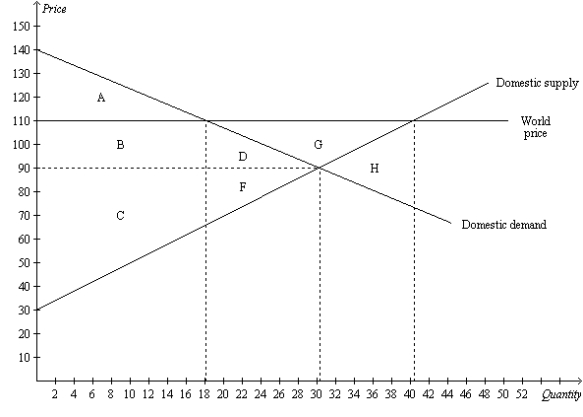 -Refer to Figure 9-1. In the absence of trade, total surplus in the Guatemalan coffee market amounts to
 (Multiple Choice)
4.7/5 (74)
(74) Figure 9-25
The following diagram shows the domestic demand and supply in a market. Assume that the world price in this market is $10 per unit.  -Refer to Figure 9-25. With free trade and a $5 per unit tariff, the country
 (Multiple Choice)
4.8/5 (60)
(60) The problem with the protection-as-a-bargaining-chip argument for trade restrictions is
(Multiple Choice)
4.9/5 (83)
(83) Figure 9-14. On the diagram below, Q represents the quantity of crude oil and P represents the price of crude oil.  -Refer to Figure 9-14. When the country for which the figure is drawn allows international trade in crude oil,
 (Multiple Choice)
4.7/5 (71)
(71) The imposition of a tariff on imported wine will increase the domestic price of wine, decrease the quantity of wine imported, and increase the quantity of wine produced domestically.
(True/False)
4.9/5 (98)
(98) If the world price of apples is higher than Argentina's domestic price of apples without trade, then Argentina
(Multiple Choice)
4.9/5 (71)
(71) Suppose Japan exports televisions to the United States and imports sugar from Argentina. This situation suggests
(Multiple Choice)
4.9/5 (76)
(76) Scenario 9-3
Suppose domestic demand and domestic supply in a market are given by the following equations:
-Refer to Scenario 9-3. With no trade allowed, how much are consumer surplus, producer surplus, and total surplus in this market?
-Refer to Scenario 9-3. With no trade allowed, how much are consumer surplus, producer surplus, and total surplus in this market? (Essay)
4.9/5 (85)
(85) When a country that imports shoes imposes a tariff on shoes, buyers of shoes in that country become worse off.
(True/False)
4.8/5 (81)
(81) 
Filters
- Essay(0)
- Multiple Choice(0)
- Short Answer(0)
- True False(0)
- Matching(0)