



 Chat with AI
Exam 9: Application: International Trade

Exam 1: Ten Principles of Economics439 Questions
Exam 2: Thinking Like an Economist617 Questions
Exam 3: Interdependence and the Gains From Trade527 Questions
Exam 4: The Market Forces of Supply and Demand698 Questions
Exam 5: Elasticity and Its Application595 Questions
Exam 6: Supply, Demand, and Government Policies644 Questions
Exam 7: Consumers, Producers, and the Efficiency of Markets549 Questions
Exam 8: Application: The Costs of Taxation511 Questions
Exam 9: Application: International Trade493 Questions
Exam 10: Externalities524 Questions
Exam 11: Public Goods and Common Resources433 Questions
Exam 12: The Design of the Tax System551 Questions
Exam 13: The Costs of Production420 Questions
Exam 14: Firms in Competitive Markets543 Questions
Exam 15: Monopoly637 Questions
Exam 16: Monopolistic Competition587 Questions
Exam 17: Oligopoly496 Questions
Exam 18: The Markets for the Factors of Production564 Questions
Exam 19: Earnings and Discrimination490 Questions
Exam 20: Income Inequality and Poverty457 Questions
Exam 21: The Theory of Consumer Choice440 Questions
Exam 22: Frontiers of Microeconomics441 Questions
Select questions type


Figure 9-1
The figure illustrates the market for coffee in Guatemala. 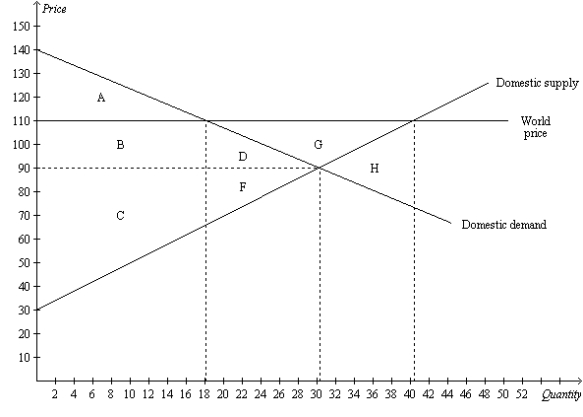 -Refer to Figure 9-1. Relative to the no-trade situation, trade with the rest of the world results in
 (Multiple Choice)
4.8/5  (75)
(75) Figure 9-15  -Refer to Figure 9-15. For the saddle market, area E represents
 (Multiple Choice)
4.8/5 (72)
(72) When the nation of Mooseland first permitted trade with other nations, domestic producers of sugar experienceda decrease in producer surplus of $5 million and total surplus in Mooseland's sugar market increased by $2 million We can conclude that
(Multiple Choice)
4.9/5 (72)
(72) Suppose a country abandons a no-trade policy in favor of a free-trade policy. If, as a result, the domestic price of beans increases to equal the world price of beans, then
(Multiple Choice)
4.7/5 (77)
(77) Scenario 9-1
The before-trade domestic price of peaches in the United States is $40 per bushel. The world price of peaches is
$52 per bushel. The U.S. is a price-taker in the market for peaches.
-Refer to Scenario 9-1. If trade in peaches is allowed, the
(Multiple Choice)
4.9/5 (71)
(71) Figure 9-5
The figure illustrates the market for tricycles in a country.  -Refer to Figure 9-5. With trade, this country
 (Multiple Choice)
4.9/5 (85)
(85) Japan imposes a $300 per ton tariff on imported steel, raising the price charged in Japan to $1,000. Using only this information, which of the following statements is correct?
(Multiple Choice)
4.8/5 (83)
(83) In analyzing international trade, we often focus on a country whose economy is small relative to the rest of the world. We do so
(Multiple Choice)
4.7/5 (81)
(81) President Bush imposed temporary tariffs on imported steel in 2002. The reasons for this trade restriction is most consistent with the
(Multiple Choice)
4.9/5 (79)
(79) If a country allows free trade and its domestic price for a given good is lower than the world price, then it will import that good.
(True/False)
4.8/5 (94)
(94) If the Korean steel industry subsidizes the steel that it sells to the United States, the
(Multiple Choice)
4.9/5 (75)
(75) Figure 9-17  -Refer to Figure 9-17. Relative to the free-trade outcome, the imposition of the tariff
 (Multiple Choice)
5.0/5 (66)
(66) Figure 9-17
-Refer to Figure 9-17. With trade and a tariff, total surplus is
-Refer to Figure 9-17. With trade and a tariff, total surplus is (Multiple Choice)
4.8/5 (93)
(93) Figure 9-22
The following diagram shows the domestic demand and domestic supply in a market. In addition, assume that the world price in this market is $40 per unit.  -Refer to Figure 9-22. Suppose the government imposes a tariff of $20 per unit. With trade and a tariff, total surplus is
 (Multiple Choice)
5.0/5 (84)
(84) Figure 9-5
The figure illustrates the market for tricycles in a country.
-Refer to Figure 9-5. If this country allows free trade in tricycles,
-Refer to Figure 9-5. If this country allows free trade in tricycles, (Multiple Choice)
4.8/5 (75)
(75) Figure 9-9  -Refer to Figure 9-9. Consumer surplus in this market before trade is
 (Multiple Choice)
4.9/5 (78)
(78) When a government imposes a tariff on a product, the domestic price will equal the world price.
(True/False)
4.8/5 (83)
(83) Figure 9-1
The figure illustrates the market for coffee in Guatemala.
-Refer to Figure 9-1. From the figure it is apparent that
-Refer to Figure 9-1. From the figure it is apparent that (Multiple Choice)
4.9/5 (83)
(83) When a country that imports a particular good imposes a tariff on that good,
(Multiple Choice)
5.0/5 (80)
(80) 
Filters
- Essay(0)
- Multiple Choice(0)
- Short Answer(0)
- True False(0)
- Matching(0)