



 Chat with AI
Exam 9: Application: International Trade

Exam 1: Ten Principles of Economics439 Questions
Exam 2: Thinking Like an Economist617 Questions
Exam 3: Interdependence and the Gains From Trade527 Questions
Exam 4: The Market Forces of Supply and Demand698 Questions
Exam 5: Elasticity and Its Application595 Questions
Exam 6: Supply, Demand, and Government Policies644 Questions
Exam 7: Consumers, Producers, and the Efficiency of Markets549 Questions
Exam 8: Application: The Costs of Taxation511 Questions
Exam 9: Application: International Trade493 Questions
Exam 10: Externalities524 Questions
Exam 11: Public Goods and Common Resources433 Questions
Exam 12: The Design of the Tax System551 Questions
Exam 13: The Costs of Production420 Questions
Exam 14: Firms in Competitive Markets543 Questions
Exam 15: Monopoly637 Questions
Exam 16: Monopolistic Competition587 Questions
Exam 17: Oligopoly496 Questions
Exam 18: The Markets for the Factors of Production564 Questions
Exam 19: Earnings and Discrimination490 Questions
Exam 20: Income Inequality and Poverty457 Questions
Exam 21: The Theory of Consumer Choice440 Questions
Exam 22: Frontiers of Microeconomics441 Questions
Select questions type


Figure 9-19. On the diagram below, Q represents the quantity of textiles and P represents the price of textiles. 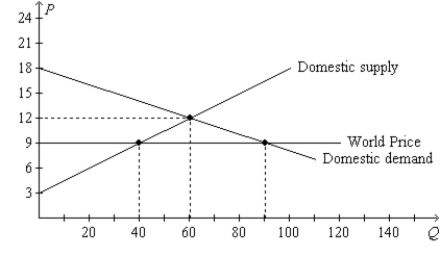 -Refer to Figure 9-19. With free trade, consumer surplus in the textile market amounts to
 (Multiple Choice)
4.9/5  (79)
(79) Suppose that Australia imposes a tariff on imported beef. If the increase in producer surplus is $100 million, the increase in tariff revenue is $200 million, and the reduction in consumer surplus is $500 million, the deadweight loss of the tariff is $300 million.
(True/False)
4.8/5 (76)
(76) Assume, for Colombia, that the domestic price of coffee without international trade is higher than the world price of coffee. This suggests that
(Multiple Choice)
4.7/5 (67)
(67) If the United States threatens to impose a tariff on Honduran blueberries if Honduras does not remove agricultural subsidies, the United States will be
(Multiple Choice)
4.9/5 (87)
(87) Suppose Brazil has an absolute advantage over other countries in producing almonds, but other countries have a comparative advantage over Brazil in producing almonds. If trade in almonds is allowed, Brazil
(Multiple Choice)
4.8/5 (87)
(87) Figure 9-1
The figure illustrates the market for coffee in Guatemala.  -Refer to Figure 9-1. In the absence of trade, the equilibrium price of coffee in Guatemala is
 (Multiple Choice)
5.0/5 (71)
(71) When a country takes a unilateral approach to free trade, it
(Multiple Choice)
4.9/5 (83)
(83) By comparing the world price of pecans to India's domestic price of pecans, we can determine whether India
(Multiple Choice)
4.8/5 (79)
(79) Figure 9-17  -Refer to Figure 9-17. When the country moves from free trade to trade and a tariff, consumer surplus
 (Multiple Choice)
4.7/5 (89)
(89) Figure 9-15  -Refer to Figure 9-15. With the tariff, the domestic price and domestic quantity demanded are
 (Multiple Choice)
4.8/5 (71)
(71) Suppose in the country of Jumanji that the price of wheat with no trade allowed is above the world price of wheat. If Jumanji allows free trade, will Jumanji be an importer or an exporter of wheat?
(Short Answer)
4.9/5 (76)
(76) If the world price of coffee is higher than Colombia's domestic price of coffee without trade, then Colombia
(Multiple Choice)
4.7/5 (67)
(67) Figure 9-4. The domestic country is Nicaragua.  -Refer to Figure 9-4. With trade, Nicaragua
 (Multiple Choice)
4.8/5 (81)
(81) Free trade allows firms to realize economies of scale, resulting in higher costs of production.
(True/False)
4.7/5 (83)
(83) Figure 9-5
The figure illustrates the market for tricycles in a country.  -Refer to Figure 9-5. The horizontal line at the world price of tricycles represents the
 (Multiple Choice)
4.7/5 (80)
(80) If a country is an exporter of a good, then it must be the case that
(Multiple Choice)
5.0/5 (81)
(81) Figure 9-14. On the diagram below, Q represents the quantity of crude oil and P represents the price of crude oil.  -Refer to Figure 9-14. When the country for which the figure is drawn allows international trade in crude oil,
 (Multiple Choice)
4.9/5 (80)
(80) Figure 9-5
The figure illustrates the market for tricycles in a country.
-Refer to Figure 9-5. If this country allows free trade in tricycles,
-Refer to Figure 9-5. If this country allows free trade in tricycles, (Multiple Choice)
4.7/5 (78)
(78) Suppose Ecuador imposes a tariff on imported bananas. If the increase in producer surplus is $50 million, the reduction in consumer surplus is $150 million, and the deadweight loss of the tariff is $30 million, then the tariff generates $130 million in revenue for the government.
(True/False)
4.9/5 (81)
(81) Suppose a country abandons a no-trade policy in favor of a free-trade policy. If, as a result, the domestic price of pistachios decreases to equal the world price of pistachios, then
(Multiple Choice)
4.7/5 (70)
(70) 
Filters
- Essay(0)
- Multiple Choice(0)
- Short Answer(0)
- True False(0)
- Matching(0)