



 Chat with AI
Exam 17: Project Management

Exam 1: Introduction to Operations Management70 Questions
Exam 2: Competitiveness, Strategy, and Productivity73 Questions
Exam 3: Forecasting164 Questions
Exam 4: Product and Service Design77 Questions
Exam 5: Strategic Capacity Planning for Products and Services103 Questions
Exam 6: Process Selection and Facility Layout151 Questions
Exam 7: Work Design and Measurement151 Questions
Exam 8: Location Planning and Analysis80 Questions
Exam 9: Management of Quality102 Questions
Exam 10: Quality Control141 Questions
Exam 11: Aggregate Planning and Master Scheduling81 Questions
Exam 12: MRP and ERP89 Questions
Exam 13: Inventory Management162 Questions
Exam 14: Jit and Lean Operations88 Questions
Exam 15: Supply Chain Management89 Questions
Exam 16: Scheduling134 Questions
Exam 17: Project Management137 Questions
Exam 18: Management of Waiting Lines81 Questions
Exam 19: Linear Programming105 Questions
Exam 20: Extension 4: Reliability10 Questions
Exam 21: Extension 5: Decision Theory126 Questions
Exam 22: Extension 7: Learning Curves68 Questions
Exam 23: Extension 8: The Transportation Model20 Questions
Exam 24: Extension 10: Acceptance Sampling65 Questions
Exam 25: Extension 14: Maintenance38 Questions
Select questions type


The path in a network with the average length of time to completion is called the critical path.
(True/False)
4.9/5  (87)
(87) What are the estimated slack times (in weeks) for activities A-H?
(Short Answer)
4.7/5 (82)
(82) What is the estimated standard deviation in the time for activity Z?
(Multiple Choice)
4.8/5 (75)
(75) The earliest finish time for an activity is equal to the latest finish time minus the activity time.
(True/False)
4.9/5 (77)
(77) When developing probabilistic estimates of project duration, it is necessary to know which of the following?
(Multiple Choice)
4.8/5 (91)
(91) What are the estimated standard deviations (in weeks) in the times for activities A-H?
(Short Answer)
4.9/5 (85)
(85) In "crashing" a project, a manager will generally focus on activities which:
(Multiple Choice)
4.9/5 (76)
(76) What is the estimated standard deviation in the time for activity E?
(Multiple Choice)
4.7/5 (80)
(80) Which of the following is not a form of risk reduction in project management?
(Multiple Choice)
4.9/5 (73)
(73) Consider the portion of a project depicted by this graph: 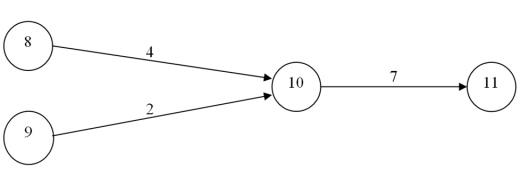 What is the earliest finish time for activity 10-11 (far right hand side), if the earliest start time of 8-10 (upper left hand side) is 12, and the earliest start time of 9-10 (lower left hand side) is 13?
 (Multiple Choice)
4.7/5 (77)
(77) A node has one entering activity, a, and two leaving activities, b and c.Given the following information, determine the latest starting time for activity a: EFb = 15, EFc = 17, LFb = 24, LFc = 27; activity times are a = 4, b = 6, c = 8.
(Multiple Choice)
4.8/5 (81)
(81) The advantage(s) a precedence diagram has over a Gantt chart is(are):
(Multiple Choice)
4.8/5 (73)
(73) A project consists of nine major activities, as shown below.There are three separate paths in the network: a-c-f, b-d-g, and e-h-i.
(A) What is expected project duration time?
(B) Determine the probability that the project will take more than 35 weeks to complete.(All times are in weeks.)
(Essay)
4.9/5 (66)
(66) The latest starting time for an activity is equal to the latest finish time minus the activity time.
(True/False)
4.9/5 (67)
(67) Which of the following would probably not involve the use of PERT?
(Multiple Choice)
5.0/5 (75)
(75) Activities not on the critical path have a slack time equal to zero.
(True/False)
4.9/5 (86)
(86) 
Filters
- Essay(0)
- Multiple Choice(0)
- Short Answer(0)
- True False(0)
- Matching(0)