



 Chat with AI
Exam 18: Electrochemistry

Exam 1: Matter, Measurement, and Problem Solving120 Questions
Exam 2: Atoms and Elements116 Questions
Exam 3: Molecules, Compounds and Chemical Equations144 Questions
Exam 4: Chemical Quantities and Aqueous Reactions199 Questions
Exam 5: Gases157 Questions
Exam 6: Thermochemistry110 Questions
Exam 7: The Quantum-Mechanical Model of the Atom100 Questions
Exam 8: Periodic Properties of the Elements120 Questions
Exam 9: Chemical Bonding I: Lewis Theory125 Questions
Exam 10: Chemical Bonding II: Molecular Shapes, Valence Bond Theory, and109 Questions
Exam 11: Liquids, Solids, and Intermolecular Forces123 Questions
Exam 12: Solutions127 Questions
Exam 13: Chemical Kinetics125 Questions
Exam 14: Chemical Equilibrium112 Questions
Exam 15: Acids and Bases126 Questions
Exam 16: Aqueous Ionic Equilibrium148 Questions
Exam 17: Free Energy and Thermodynamics103 Questions
Exam 18: Electrochemistry115 Questions
Exam 19: Radioactivity and Nuclear Chemistry105 Questions
Select questions type


The town of Natrium,West Virginia,derives its name from the sodium produced in the electrolysis of molten sodium chloride (NaCl)mined from ancient salt deposits.The number of kilowatt-hours of electricity required to produce 4.60 kg of metallic sodium from the electrolysis of molten NaCl(s)is ________ when the applied emf is 4.50 V.
(Multiple Choice)
4.9/5  (88)
(88) Balance the following redox reaction if it occurs in acidic solution.What are the coefficients in front of Zn and H+ in the balanced reaction?
Zn2+(aq)+ NH4+(aq)→ Zn(s)+ NO3⁻(aq)
(Multiple Choice)
4.9/5 (87)
(87) Use the standard half-cell potentials listed below to calculate the standard cell potential for the following reaction occurring in an electrochemical cell at 25 °C.(The equation is balanced. )
2 K(s)+ I2(s)→ 2 K⁺(aq)+ 2 I⁻(aq)

(Multiple Choice)
4.8/5 (73)
(73) Consider the following standard reduction potentials,
Ni2+(aq)+ 2 e- → Ni(s)E° = -0.26 V
I2(s)+ 2 e- → 2 I-(aq)E° = +0.54 V
Under standard conditions,
(Multiple Choice)
5.0/5 (78)
(78) The gas OF2 can be produced from the electrolysis of an aqueous solution of KF,as shown in the equation below.
OF2(g)+ 2 H+(aq)+ 4 e- → H2O(l)+ 2 F-(aq)E° = +2.15 V
Using the given standard reduction potential,calculate the amount of OF2 that is produced,and the electrode at which the OF2 is produced,upon the passage of 0.480 faradays through an aqueous KF solution.
(Multiple Choice)
4.8/5 (88)
(88) Identify the location of oxidation in an electrochemical cell.
(Multiple Choice)
4.9/5 (82)
(82) Which of the following reactions would be the most spontaneous at 298 K?
(Multiple Choice)
5.0/5 (81)
(81) How many electrons are transferred in the following reaction? (The reaction is unbalanced. )
I2(s)+ Fe(aq)→ Fe3+(s)+ I⁻(aq)
(Multiple Choice)
4.8/5 (67)
(67) 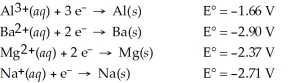
Balance the following redox reaction if it occurs in basic solution.What are the coefficients in front of Br2 and OH⁻ in the balanced reaction?
Br2(l)→ BrO3⁻(aq)+ Br⁻(aq)
(Multiple Choice)
4.8/5 (81)
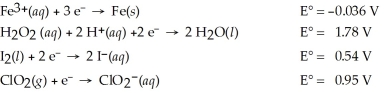
(81) Use the tabulated half-cell potentials below to calculate ΔG° for the following balanced redox reaction.
3 I2(s)+ 2 Fe(s)→ 2 Fe3+(aq)+ 6 I⁻(aq)

(Multiple Choice)
4.7/5 (76)
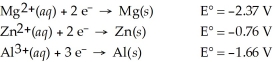
(76) 

Filters
- Essay(0)
- Multiple Choice(0)
- Short Answer(0)
- True False(0)
- Matching(0)