



 Chat with AI
Exam 18: Electrochemistry

Exam 1: Matter, Measurement, and Problem Solving120 Questions
Exam 2: Atoms and Elements116 Questions
Exam 3: Molecules, Compounds and Chemical Equations144 Questions
Exam 4: Chemical Quantities and Aqueous Reactions199 Questions
Exam 5: Gases157 Questions
Exam 6: Thermochemistry110 Questions
Exam 7: The Quantum-Mechanical Model of the Atom100 Questions
Exam 8: Periodic Properties of the Elements120 Questions
Exam 9: Chemical Bonding I: Lewis Theory125 Questions
Exam 10: Chemical Bonding II: Molecular Shapes, Valence Bond Theory, and109 Questions
Exam 11: Liquids, Solids, and Intermolecular Forces123 Questions
Exam 12: Solutions127 Questions
Exam 13: Chemical Kinetics125 Questions
Exam 14: Chemical Equilibrium112 Questions
Exam 15: Acids and Bases126 Questions
Exam 16: Aqueous Ionic Equilibrium148 Questions
Exam 17: Free Energy and Thermodynamics103 Questions
Exam 18: Electrochemistry115 Questions
Exam 19: Radioactivity and Nuclear Chemistry105 Questions
Select questions type


Balance the following redox reaction if it occurs in acidic solution.What are the coefficients in front of Cd and Ag+ in the balanced reaction?
Cd(s)+ Ag+(aq)→ Ag(s)+ Cd2+(aq)
(Multiple Choice)
4.8/5  (80)
(80) Nickel can be plated from aqueous solution according to the following half reaction.How long would it take (in minutes)to plate 29.6 g of nickel at 4.7 A?
Ni2+(aq)+ 2 e⁻ → Ni(s)
(Multiple Choice)
4.7/5 (92)
(92) A voltaic cell is constructed with two silver-silver chloride electrodes,where the half-reaction is
AgCl(s)+ e- → Ag(s)+ Cl-(aq)E° = +0.222 V
The concentrations of chloride ion in the two compartments are 0.0222 M and 2.22 M,respectively.The cell emf is ________ V.
(Multiple Choice)
4.9/5 (80)
(80) 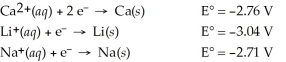
What is undergoing reduction in the redox reaction represented by the following cell notation?
Fe(s)∣ Fe3+(aq)∣∣ Cl2(g)∣ Cl⁻(aq)∣ Pt
(Multiple Choice)
4.9/5 (86)
(86) Use the tabulated half-cell potentials below to calculate the equilibrium constant (K)for the following balanced redox reaction at 25°C.
Pb2+(aq)+ Cu(s)→ Pb(s)+ Cu2+(aq)

(Multiple Choice)
4.8/5 (67)
(67) What is the shorthand notation that represents the following galvanic cell reaction?
Pb(s)+ Cu(NO3)2(aq)→ Pb(NO3)2(aq)+ Cu(s)
(Multiple Choice)
4.7/5 (87)
(87) The most useful ore of aluminum is bauxite,in which Al is present as hydrated oxides,Al2O3 · xH2O The number of kilowatt-hours of electricity required to produce 4.00 kg of aluminum from electrolysis of compounds from bauxite is ________ when the applied emf is 5.00 V.
(Multiple Choice)
5.0/5 (81)
(81) Which of the following reactions would have the smallest value of K at 298 K?
(Multiple Choice)
4.9/5 (71)
(71) How many grams of nickel metal are plated out when a constant current of 15.0 A is passed through aqueous NiCl2 for 60.0 minutes?
(Multiple Choice)
4.8/5 (77)
(77) The electrolysis of molten AlCl3 for 3.25 hr with an electrical current of 15.0 A produces ________ g of aluminum metal.
(Multiple Choice)
4.9/5 (98)
(98) How many electrons are transferred in the following reaction? (The reaction is unbalanced. )
Fe2+(aq)+ K(s)→ Fe(s)+ K+(aq)
(Multiple Choice)
4.9/5 (75)
(75) For the galvanic cell reaction,expressed below using shorthand notation,what half-reaction occurs at the cathode?
Zn(s)∣ Zn2+(aq)∣∣ Ni2+(aq)∣ Ni(s)
(Multiple Choice)
4.8/5 (88)
(88) Using the following standard reduction potentials,
Fe3+(aq)+ e- → Fe2+(aq)E° = +0.77 V
Ni2+(aq)+ 2 e- → Ni(s)E° = -0.26 V
Calculate the standard cell potential for the galvanic cell reaction given below,and determine whether or not this reaction is spontaneous under standard conditions.
Ni2+(aq)+ 2 Fe2+(aq)→ 2 Fe3+(aq)+ Ni(s)
(Multiple Choice)
4.9/5 (86)
(86) Calculate the cell potential for the following reaction that takes place in an electrochemical cell at 25°C.
Al(s)∣ Al3+(aq,0.115 M)∣∣ Al3+(aq,3.89 M)∣ Al(s)

(Multiple Choice)
4.8/5 (79)
(79) For a galvanic cell that uses the following two half-reactions,
Cr2O72-(aq)+ 14 H+(aq)+ 6 e- → 2 Cr3+(aq)+ 7 H2O(l)
Pb(s)→ Pb2+(aq)+ 2 e-
How many moles of Pb(s)are oxidized by three moles of Cr2O72-?
(Multiple Choice)
4.8/5 (80)
(80) Determine the cell notation for the redox reaction given below.
Sn(s)+ 2 Ag⁺(aq)→ Sn2+(aq)+ 2 Ag(s)
(Multiple Choice)
4.9/5 (75)
(75) Balance the following redox reaction if it occurs in basic solution.What are the coefficients in front of Al and F2 in the balanced reaction?
Al(s)+ F2(g)→ Al3+(aq)+ F-(aq)
(Multiple Choice)
4.7/5 (78)
(78) Determine which of the following pairs of reactants will result in a spontaneous reaction at 25°C.
(Multiple Choice)
4.9/5 (77)
(77) 
Filters
- Essay(0)
- Multiple Choice(0)
- Short Answer(0)
- True False(0)
- Matching(0)